

Af Roberto Assagioli m.fl. Uddrag fra bogen Skabende meditation.
Meditation har en meget betydningsfuld funktion, idet den skaber erkendelse om de mange indre ”modsætningspar”, om de involverede problemer og om teknikker til at afbalancere dem. ”Modsætningernes par” er de store dualiteter, som man har tendens til at svinge mellem, når man responderer først på den ene og derefter på den anden – f.eks. mellem ånd-stof, glæde-sorg, kærlighed-had. At erkende dem og afbalancere dem, således at der er ligevægt mellem dem, er en grundlæggende del både i den psykologiske og i den åndelige integration samt i ens fremskridt, og derfor er det et vitalt og praktisk orienteret emne, man bør give al mulig opmærksomhed.
Gennem arbejdet med at afbalancere modsætningernes par bliver man i stand til at finde frem til dette harmoniske ligevægtspunkt, og det er denne proces Buddha i sin lære kalder at betræde den ædle middelvej. Her må man forstå, at det drejer sig ikke om at vælge en middelvej på grundlag af kompromiser, men derimod om at finde frem til et højere og rigtigere spændingspunkt, hvor begge poler bliver anvendt på en konstruktiv måde.
Dualitet og polaritet
Polaritet er et universelt faktum. Dualitet har eksisteret fra det allerførste øjeblik, da den kosmiske manifestation begyndte at udfolde sig. Den første basale dualitet er både det, der er manifesteret, og det der ikke er manifesteret. I selve manifestationsprocessen er den grundlæggende polaritet ånd og stof. Alle polariteter er en relation mellem to elementer, og som sådan er relationen aldrig absolut men relativ i ethvert modsætningspar. Derved kan det samme element være positiv i sin relation til en bestemt ”pol” og negativ i sin relation til en anden.
Den mest almindeligt kendte polaritet i den fysiske verden findes mellem den positive og den negative pol i elektricitet. Denne polaritet har dannet grundlaget for kendskabet til stoffets sammensætning, idet man opdagede, at hvert atom er dannet af ladet elektricitet, og at det består af en positiv kerne og af et varierende antal negative elektroner (senere opdagede man, at det også består af forskellige mindre partikler).
Seksuel polaritet
I de tre riger med organisk liv (plante-, dyre- og menneskeriget) er en af de mest betydningsfulde og generelle polariteter den seksuelle. Den positive pol ses i det maskuline element og den negative pol i det feminine element. Dette betyder dog ikke, at den maskuline er aktiv, og at den feminine er passiv. Begge er aktive, men på hver sin måde: Det maskuline element er dynamisk og positivt, mens det feminine element er modtageligt og ”formeringsdygtigt”.
Yang og Yin
Udover mand-kvinde relationen findes der utallige polaritetstyper. Dette er specielt blevet understreget og fremhævet af kineserne, der betragter disse to principper som grundlaget for både den kosmiske evolution og for ethvert aspekt af menneskets liv. Det skabende aspekt, som Vesten symboliserer ved Faderen og Himmelen, kalder de Yang, og det modtagende aspekt, som Vesten symboliserer ved Moderen og Jorden, kalder de Yin. Denne filosofi giver udtryk for det synspunkt, at menneskehedens gode forhold afhænger af det harmoniske samspil mellem menneskenes og universets cykliske evolution, der væves sammen af utallige relationer og vekselvirkninger mellem Yang og Yin. Mange kinesiske skrifter behandler dette emne. Et af de mest interessante er I Ching og The Book of Transformations or Changes.
Nervesystemets polaritet
I levende organismer, som menneskets fysiske legeme, findes der mange polariteter. En af de mest betydningsfulde er den mellem det sympatiske og det parasympatiske nervesystem. Det førstnævnte stimulerer nedbrydningen af organiske stoffer og det sidstnævnte stimulerer fordøjelsen og opbygningsprocessen. Endvidere findes der polariteter mellem de forskellige endokrine kirtler.
I det følelsesmæssige område findes de velkendte dualiteter: Velbehag-smerte, begejstring-depression, tillid-frygt, tiltrækning-frastødning, kærlighed-had.
Tænkningens polaritet
På det mentale område findes der polariteter mellem den konkrete tænkeevnes analytiske aktivitet og den højere abstrakte tænkeevnes synteseskabende indvirkning samt mellem den induktive proces (fra det specielle til det generelle) og den deduktive proces (fra det generelle til det specielle). Menneskets personlighed har i sin helhed også forskellige grundlæggende polariteter, der er blevet underlagt omfattende undersøgelser af nutidens psykologer. Blandt de mest betydningsfulde psykologiske polariteter er: Impuls-hæmning, ydmyghed-selvhævdelse, følelse-fornuft, udadvendthed-indadvendthed.
Åndelig polaritet
Den grundlæggende dualitet i det åndelige område eksisterer mellem personligheden og sjælen, og det er en polaritet, der er årsag til mange indre konflikter frem til den tid, hvor der er opnået harmoniske relationer og en øget sammensmeltning eller forening (psykosyntese) i denne dualitet.
Samfundets polariteter
De relationer, der skabes til medmenneskene, skaber utallige polariteter. Ikke alene er der den mellem mand og kvinde, og mellem den enkelte og gruppen, der er også den mellem den unge og den ældre, mellem arbejdsgiver og arbejdstager, og på et endnu mere omfattende niveau mellem de nordiske og sydlandske typer, mellem vesterlændinge og østerlændinge etc.
Afbalancering
Der foregår hele tiden en vekselvirkning mellem de mange polariteter, og dermed konfronteres menneskene med det problem, at de skal afbalancere dem. Her er det kun muligt at give følgende korte overblik over de principper og generelle metoder, man kan benytte til afbalancering af de polare modsætninger med det mål at opløse de ”polare spændinger”, men det kan give en antydning om målet og naturen af den opgave, der skal gennemføres.
- Sammensmeltning af de to poler, hvilket indebærer, at den energi, de er ladet med, neutraliseres.
- Skabelse af en ny væren, af en ny realitet.
- Tilpasning af de polare modsætninger ved hjælp af et ”mellemliggende stadie” eller princip, der er højere end begge. En sådan regulerende indsats kan tilvejebringes på to måder:
- Ved at mindske antallet af udsving mellem de to yyddeerr– punkter, til tider endog til et nulpunkt, hvilket kan føre til en mere eller mindre komplet neutralisering (”den gyldne middelvej”). Et eksempel på dette, der har stor aktuel interesse, kan man se i udsvinget i en undervisningssituation mellem overdreven autoritet og ingen styring overhovedet i indsatsen for at afbalancere holdninger.
- Ved at styre forandringerne bevidst og klogt, således at resultatet bliver harmonisk og konstruktivt og i overensstemmelse med de cykliske forandringer, der forekommer både i de individuelle og generelle tilstande, og i de menneskelige og kosmiske tilstande.
- Syntese, tilvejebragt ved hjælp af et højere element eller princip, der transformerer, sublimerer og inddrager de to poler i en højere virkelighed.
Der skal være overensstemmelse mellem de forskellige typer af polaritet og metoderne til løsning af dem. Men det enkelte menneske har ofte den frihed – og som følge heraf det ansvar – at kunne vvæællggee mellem flfleeerrreee aaff– balanceringsmetoder. Det bør imidlertid understreges, at de antydede løsninger ikke altid udgør en så klar mulighed, som ovennævnte opstilling kan forlede til at tro. Til tider kan de overlappe hinanden eller kombineres på forskellige måder.
Disidentifikation
Afbalancering af modsatrettede kvaliteter inden for det følelsesmæssige område kræver, at der sættes ind med et højere og regulerende princip, der af natur er mentalt og åndeligt. Den første opgave er at forhindre, at man overvældes af følelser, eller at fornuften og viljen sløres. Den bedste metode, når det skal lykkes, er at undgå at identificere sig med følelserne, og at opretholde kontakten med sjælen, bevidsthedscentret, på et højere niveau for at blive i stand til at observere, evaluere og derefter beherske dem på klog måde.
Man må være klar over, at ordet ”beherske” ikke betyder ”undertrykke”, og at målet ikke er at skabe en ufølsom og utilnærmelig tendens. Herefter drejer det sig om en fundamental polaritet – velbehag-smerte. Så længe man forbliver slave af denne dualitet, dvs. at man altid grådigt søger velbehag og med frygt flygter fra smerte, ligeså længe vil man ikke finde fred eller sand tilfredshed. På den anden side fører et tvunget forbud eller en kunstig ufølsomhed så sandelig heller ikke til en tilfredsstillende løsning. Man kan kun nå en tilfredsstillende løsning ved hjælp af metoder, som kræver klar indsigt, og som sætter mennesket i stand til at forstå årsagerne til og naturen af både velbehag og smerte, og hvordan disse to begreber fungerer.
Denne indsigt giver den erkendelse, at ved at acceptere velbehag uden at kræve den eller være tiltrukket af den, og ved at acceptere uundgåelig smerte uden frygt og uden at gøre oprør mod den, kan man tilegne sig værdifulde lektier om både velbehag og smerte og ”uddrage den essens”, som de indeholder. Hertil kommer, at man gradvis kan løfte disse ”modsætningers” kvalitet og niveau. Man udvikler sig lidt efter lidt fra at føle glæde ved fysisk velbehag til glæde ved medfølelse og omtanke for til sidst at opleve åndelig glæde. Der skabes således en retning, der fører fra fysisk lidelse til følelsesmæssige vanskeligheder og derfra til intellektuel uro, og det fører til medfølelse med andre, med menneskeheden og med hele skabelsen. Dette giver mange erfaringer, hvor man samler visdommens frugter og lærer at holde bevidsthedscentret stabilt i stadig højere grad på et niveau, der ligger højere end niveauet for vekselvirkningen mellem de personlige velbehag og smerter.
Som det sidste kan man tilegne sig evnen til at identificere sig med det universelle væsen, med den over-individuelle sjæl og med det højeste væsen, og da vil man i usigelig lyksalighed kunne transcendere alle ”modsætninger”.
Specifikke polariteter
Foretager man en nærmere undersøgelse af de specifikke polariteter inden for det følelsesmæssige område, kan man tydeligt skelne mellem to former for løsning. Den ene foregår på det samme niveau og kan kaldes kompromisets ”mellemvej”, dvs. en sammensmeltning af de to poler. Den anden løsning opnås på et højere niveau og består af to processer:
- En klog styring og anvendelse af de to modsatte kræfter.
- Sammensmeltning af disse to kræfter til en højere syntese.
Den første metode med på klog måde at anvende de modsatte kræfter er forklaret nærmere i en speciel bog om magi, som – udover det egentlige emne – indeholder et interessant psykologisk materiale:
”For at kunne afbalancere kræfterne er det nødvendigt at fastholde dem lige stærkt og at anvende dem vekselvis. Jo mildere og roligere du er, des mere vil din vrede blive effektiv. Jo stærkere du er, des mere vil din venlighed blive skattet … jo mere indifferent du er, des nemmere er det at fa andre til at synes om dig …”
Ritual of High Magic, af Eliphas Levy, kapitel VIII.
En rigtig og konstruktiv anvendelse af denne metode forudsætter naturligvis gode motiver og rene intentioner.
Skabelse af syntese
Den anden metode, der gælder synteseskabelse, svarer til en vis grad til en kemisk kombination, hvor to kemiske elementer smelter sammen til en højere enhed, som derved får en kvalitet, der er helt anderledes, end den kvalitet hvert af de to elementer besad. Forskellen mellem de løsninger, der opnås ved kompromiser, og som opnås ved syntese, kan illustreres ret tydeligt med et triangulært diagram. Her er et par eksempler:
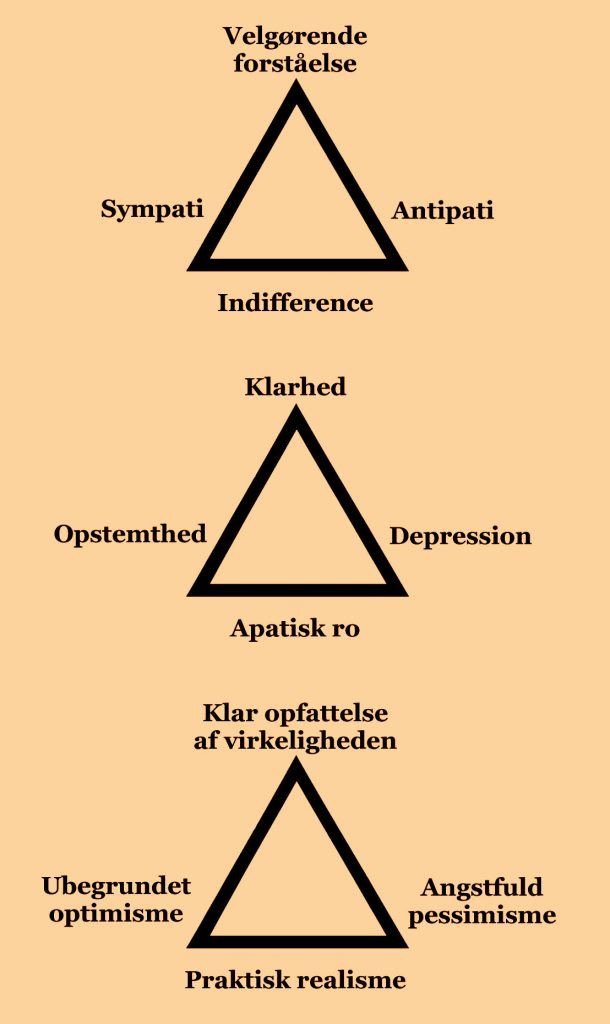
Modsætninger og deres syntese
Intense kriser og konflikter vil i mange tilfælde være årsag til, at man tager initiativ til at afbalancere, tilpasse og skabe syntese. Det vil dog i enkelte tilfælde være muligt at nå frem til det samme resultat på en mere trinvis og harmonisk måde. F.eks. vil klar forståelse af disse psykosynteseprocesser bevirke, at hele forløbet bliver lettere og hurtigere. Det væsentligste krav er som nævnt, at man undgår at identificere sig med en af de to poler, og at man i stedet kontrollerer, transmuterer og styrer deres energier ud fra en højere erkendelse og kraft.
Pyramidens symbolik
En anden måde, man kan betragte syntesen af kvaliteter på, er at huske pyramiden som symbol. Ved toppen findes forening, og derfra løber linjer nedad og fjerner sig mere og mere fra hinanden og ud på det fysiske
plan og på det menneskelige niveau, hvor der findes et maksimum af forskelligheder, der på menneskenes udviklingstrin indebærer konflikter, misforståelser og forskellige opfattelser.
Her er et eksempel, der kan tydeliggøre mange problemer: De tre vigtigste åndelige energier eller kvaliteter er sandhed, skønhed og godhed – dette har været erkendt siden Platons På toppen af pyramiden danner de en smuk syntese, men menneskeheden holder dem ofte vidt adskilt, og det er en kendsgerning, som man må erkende – og det sker almindeligvis ikke. Man kan skabe ægte skønhed uden at involvere godhed og sandhed. Man kan skabe videnskabelig sandhed uden at involvere godhed og skønhed, og ulykkeligvis kan der komme tilkendegivelser af virkelig godhed, der til tider er meget fjollede. I visse tilfælde besvarer dette det store spørgsmål om uafhængighed af kunst og moral, der på så glimrende måde er blevet debatteret. På pyramidens top findes harmoni og syntese, men på de lavere niveauer findes der store forskelligheder og ofte konflikter.
Tænkeevnen og hjertet
En anden polaritet, der har stor betydning, findes mellem ”tænkeevnen” og ”hjertet”, mellem fornuft og følelse. Dette reguleres først og fremmest ved at erkende disse to områders respektive funktioner og retmæssige aktiviteter, således at det ene område ikke dominerer det andet. Dette kan opfølges ved at styre de to områder ind i et dybere gensidigt samarbejde, hvorved de til sidst når frem til den syntese, som Dante så udmærket gav udtryk for med ordene ”intellektuelt lys fuldt af kærlighed”.
Den grundlæggende polaritet mellem menneskets personlighed og dets sjæl opfattes først som en enhed efter en længere proces med konflikter, transmutationer, tilnærmelser og kontakt, som først fører til delvise og senere endnu større fusioner, der kulminerer i en komplet sammensmeltning eller sjælsgennemtrængning. I denne proces spiller meditation en vigtig rolle. Denne vedvarende proces med psyko-åndelig vækst har fået mange navne, inklusiv individualisering, psykosyntese, selvudfoldelse og selvrealisering.
Sådan kan du komme videre
Her kan du modtage syv gratis meditationer, hvor du udvikler forskellige sider af dig selv
Læs også artiklen Psykosyntese en integral psykologi og biografien om Roberto Assagioli
Læs introartiklen om energipsykologi
Læs introartiklen om integral meditation
