

I dette dokument kan du finde en række psykosyntese diagrammer, som visuelt beskriver nogle af psykosyntesens begreber. De er til personlig brug.
Roberto Assagiolis “Ovaldiagram”

Roberto Assagioli’s Egg diagram.
This poster in 70×100 cm can be bought through me.
Price 10 $ + postage.
Here you can find a larger version of the egg diagram

Ovenstående er Roberto Assagiolis “Ovaldiagram” som illustrerer forholdet mellem menneskets bevidste og ubevidste elementer. Der er tre ubevidste områder, det lavere, mellemste og højere ubevidste. Kilden til bevidstheden er det højere Selv (6) der projicerer sig ned personlighedens verden som Jegets bevidsthed (5). Dette Jeg, der er den indre iagttager oplever virkeligheden gennem bevidsthedsfeltet (4). Læs meget mere om ovaldiagrammet i artiklen psykosyntesen -vejen til dit højere selv.
Download ovaldiagrammet i en pdf fil i god kvalitet.
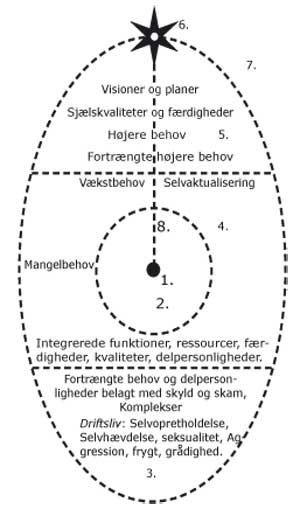
Ovenstående ovaldiagram beskriver mere specifikt nogle af de grundlæggende psykologiske elementer og hvor de har deres placering i diagrammet.
1. Jeget, 2. Bevidsthedsfeltet, 3. Lavere ubevidste , 4. mellemste ubevidste , 5. Højere ubevidste, 6. Højere Selv, 7. Kollektivt ubevidste , 8. Bevidsthedsbroen mellem Selvet og Jeget.
Download ovaldiagrammet i en pdf fil i god kvalitet.


Roberto Assagiolis “Stjernediagram”

Ovenstående diagram viser Roberto Assagiolis “stjernediagram”. Selvet (og Jeget) står centralt i diagrammet, som den rene bevidsthed der med sin vilje har mulighed for at realisere sig selv gennem udnyttelsen af alle de andre psykologisk funktioner. Assagioli har syv grundlæggende funktioner i modsætning til fx C.G. Jung der kun arbejder med fire. Viljen ser Assagioli dog mere som Selvets dynamiske side frem for en egentlig funktion.
Download stjernediagrammet i en pdf fil i god kvalitet.

Ovenstående farveillustration af stjernediagrammet forhandles gennem Nomina srl – Roma – tel. 06/5924850 Riproduzione Vietata. Den findes i flere størrelser bla. som postkort og plakat.
Psykosyntese og Delpersonligheder

Ovenstående diagram viser et eksempel på hvorledes der i vores indre lever forskellige typer af ubevidste/bevidste delpersonligheder som styrer vores adfærd. Disse delpersonligheder kan bedst beskrives som de roller vi spiller i forhold til livets mangfoldige situationer. Nogle af rollerne er autentiske dvs. er et sandt udtryk for den vi er på et givent tidspunkt, andre er uægte som følge tilpasning til at uempatisk miljø.
Download delpersonlighedsdiagrammet i en pdf fil i god kvalitet.
Psykosyntesens fem bevidsthedsniveauer

I Roberto Assagiolis litteratur er det tydeligt at han skelner mellem fem niveauer af bevidsthed , der adskiller sig fra hinanden ved at de øverste niveauer er nærmere den ultimative virkelighed. Disse bevidsthedsniveauer svarer til det Ken Wilber kalder for holarkier, dvs. de højere niveauer transcenderer men inkluderer de lavere.
De højere niveauer er udtryk for mere komplekse sammenhænge og bevidshedsniveauer og er set fra et moralsk perspektiv bedre end de lavere, da de inkluderer et mere omfattende perspektiv. Et menneske der udtrykker et worldcentrisk bevidsthedsniveau har en højere og mere udviklet bevidsthed end mennesker der udtrykker egocentriske og etnocentriske opfattelser. Førstnævnte transcenderer og inkluderer de sidstnævnte.
Intuition er set i det perspektiv en mere omfattende og højere evne end sansning, følelse og tænkning. Intuition er mere i overensstemmelse med guddommens opfattelse af virkeligheden, end sidstnævnte evner, der mere anvendes af selvet til at udtrykke den indre mening som erkendes gennem intuition.
Selvets udvikling (evolution) er set i det perspektiv en rejse fra barndommens identifikation med kroppen og sanserne henimod udvikling af følelser, tænkning og intuition. Alle de højere bevidsthedsniveauer kommer dog altid til udtryk gennem den fysiske hjerne og skal udtrykkes i et skabende samfundsengagement. (jvf. Wilbers fire kvadranter).
Download bevidsthedens niveauer i en pdf fil i god kvalitet.
Viljens niveauer

I ovenstående diagram er viljens forskellige manifestationer placeret på de forskellige niveauer. Det bør bemærkes at Roberto Assagioli kun anerkender viljens manifestationer når den er bevidst, dvs. er udtryk for bevidste valg .
Kentaur træning arbejder dog ud fra den hypotese at mange af de delpersonligheder som styrer individet er udtryk for såkaldt “imiterende vilje”, dvs. de er udtryk for individets internalisering af forældrenes og kulturens normer. Disse internaliserede normer styrer i høj grad individet og er et udtryk for at individet tilpasser sig omgivelsernes vilje . Derfor kaldes disse følelsesmæssige normer for “imiterende vilje”.
Selvet udvikler først sin personlige vilje til selvaktualisering – dvs. dets evne til at opnå fuld personlig behovstilfredsstillelse. Senere udvikler det evnen til at overskride sine personlige behov og deltage i de humanitære og spirituelle aktiviteter, som kendetegner den transpersonlige viljes højere behov.
Download viljens niveauer i en pdf fil i god kvalitet.
Dynamisk Meditation og dens stadier

I ovenstående diagram er den dynamiske meditations stadier indikeret. Meditationen tager udgangspunkt i en sædtanke (fx ærlighed), som sindet samles omkring gennem koncentration . Det fører til meditation først med sædtanke, senere går meditationen over i en ren fokuseret væren, hvor det liv som sædtanken symbolsk skjuler og den mediterende bliver ét.
I sjældne tilfælde går den mediterende ind i en ren kontemplationstilstand, hvor den nonduale bevidsthed erkendes. Resultatet af denne kontakt er Selvets oplysning og personlighedens inspiration, der fører til samfundsengagement.
Download meditationens stadier i en pdf fil i god kvalitet.
Abraham Maslows behovspyramide
 I dette diagram beskriver Abraham Maslow de menneskelige behovs hierarkiske opbygning. I artiklen: Maslows behovspyramide anvendt i psykosyntese terapi er der en kort beskrivelse af hans model.
Bemærk at modellen også rummer de selvrealiseringsbehov, som Maslow beskriver i bogen The Farther Reaches of Human Nature. Disse dækker de mystiske enhedsoplevelser og altruistiske behov som får mennesket til at overskride sit ego.
Her er en stor udgave af Maslows behovspyramide.
Download behovspyramiden i en pdf fil i god kvalitet.
 I dette diagram beskrives illustrativt hvorledes terapeuten virker som et eksternt forenende center for klienten. Terapeutens opgave er at holde billedet af hele mennesket (krop, sjæl, ånd) især når skyggemateriale fra det lavere ubevidste skyller hen over klienten. Roberto Assagioli beskriver den terapeutiske relation og diagrammet nærmere i ordbogsdefinitionen: overføring.
Her er en stor udgave af Terapeuten som eksternt forenende center.
Download diagrammet i en pdf fil i god kvalitet.
Viljens seks stadier
 I dette diagram beskrives essensen af Viljens seks stadier i en række nøgleord der mest er beregnet til de kursister der løbende deltager i mine Will-management kurser og derfor har fået stadierne uddybet.
Her er en stor udgave af Viljens seks stadier.
Download diagrammet i en pdf fil i god kvalitet.
Sådan kan du komme videre
Her kan du modtage syv gratis meditationer, hvor du udvikler forskellige sider af dig selv
Læs også artiklen Psykosyntese en integral psykologi og biografien om Roberto Assagioli
Læs introartiklen om integral meditation

