

Denne artikel er et uddrag fra min bog: Psykosyntesens Sjæl, af Kenneth Sørensen
”Maslow har præsenteret et oplysende forslag til en fremadskridende evolutionær udvikling i fem stadier.” (Assagioli)
I sidste kapitel citerede jeg Assagioli for, at ovaldiagrammet: ”udelader det dynamiske aspekt, der er det allervigtigste og mest essentielle i hele sagen.”
Det dynamiske aspekt er naturligvis udviklingsteorien, og i hans første bog Psykosyntese, giver han kun et skitseagtigt overblik over de brede linjer i hans udviklingsteori, men i hans senere bog Viljens Psykologi giver han langt flere detaljer. Når vi taler om udviklingspsykologien, så handler det om at beskrive selvets rejse fra ubevidst, selvbevidst til sjælsbevidst og transcendent væren. Jeg vil kun beskrive det store overblik, da teorien er for omfattende til at beskrives i detaljer i et enkelt kapitel.
Assagioli var tydeligvis inspireret af den Italienske digter og forfatter Dante Alighieri (1265–1321) som han betragtede, som en stor oplyst. Han relaterer derfor psykosyntesen til Dantes Guddommelige Komedie, som han kalder for ”et vidunderligt billede på en komplet psykosyntese.” (1975, s. 211) Dantes fortælling er et episk digt om en rejse gennem helvede, skærsilden og paradiset. Assagioli fortæller:
”Den første del – pilgrimsrejsen gennem helvede – indikerer den analytiske undersøgelse af det lavere ubevidste. Den anden del – opstigningen ad skærsildens bjerg – indikerer processen med moralsk renselse og den gradvise højnelse af bevidsthedsniveauet ved anvendelsen af aktive teknikker. Den tredje del – besøget i Paradis eller Himlen – betegner på en uovertruffen måde de forskellige tilstande med overbevidst realisering frem til den endelige vision af den universelle Ånd, af Gud selv, hvor kærlighed og vilje er smeltet sammen.” (1975, s.211)
I dette citat fortæller han klart, at han tager udgangspunkt i en stadiemodel, hvor vi udvikler os fra bunden af ovaldiagrammet og op i gennem niveauerne mod selv-realisering. I min masterafhandling Integral Psychosynthesis (Sørensen, 2008), giver jeg mange andre relevante kilder til denne opfattelse. Stadiemodellen er naturligvis en grov skitse, for som vi skal se i dette kapitel, tilføjer han mange nuancer.
Assagioli udviklede løbende nye ideer omkring sin personlighedsmodel og inddrog teorier fra kollegaer, når de så dagens lys. En af disse var den amerikanske psykolog Abraham Maslow, som skrev en række indflydelsesrige bøger i 50erne og 60erne. Han var en vigtig person i forbindelse med udviklingen af den humanistiske og transpersonlige psykologi. Han var specielt kendt for udviklingen af sin behovspyramide, som blev en vigtig udviklingspsykologisk teori.
Assagioli omtaler flere steder Maslow som en vigtig pioner og opfordrede sine studerende til at studere hans bøger grundigt. (Udateret 2) I Viljens Psykologi, som udkom i 1973 kort før hans død i 1974, tager Assagioli skridtet fuldt ud og integrerer Maslows behovspyramide i sit ovaldiagram. (2005, kap. 8-10) Maslow bliver citeret ikke mindre end 25 gange i denne bog, så der er ingen tvivl om det tætte forhold, der eksisterede mellem Assagiolis og Maslows udviklingsteorier.
Dette er et særdeles vigtigt skridt, fordi han her komplementerer sin personlighedsmodel med en forholdsvis detaljeret udviklingspsykologisk forståelse, baseret på Maslows opdagelser og sine egne fund. Han placerer dermed også psykosyntesen inden for en stadiemodel, hvor selvet udvikler sig gennem en række naturlige udviklingsstadier, fra bunden af ovalen og op mod sjælen. Disse er universelt gældende for alle mennesker.
Der hersker tydeligvis stor forvirring om dette forhold i psykosyntesemiljøet, da især de to indflydelsesrige psykosyntetikere John Firman og Ann Gila i deres bøger, har foreslået store og afgørende ændringer i Assagiolis originale fremstilling af psykosyntesen. Der er to forskellige udviklingsteorier inden for den transpersonlige psykologi, som er ret forskellige, og Assagioli hører til samme retning som Maslow og den nutidige amerikanske tænker Ken Wilber. Det er udførligt behandlet i min masterafhandling, og jeg vil derfor ikke komme nærmere ind på det her. Den hollandske tænker Frank Visser har skrevet en glimrende artikel om de to konkurrerende udviklingspsykologier. (Visser, 1998)
Udviklingen gennem de tre ubevidste områder
Lad os nu beskrive selvets udvikling fra bunden af diagrammet og op igennem alle niveauerne ud fra Assagiolis beskrivelse og Maslows opdagelser. Den centrale kerne i Maslows udviklingspsykologi er opdagelsen af de behov, der driver selvets motivation igennem livet fra basal behovstilfredsstillelse af sult til de mest transcendente behov for mening og oplysning. Maslow opdagede den mekanisme, at tilfredsstillelsen af en type behov på et givent niveau, på et tidspunkt vil føre til opvækkelsen af et højere behov, som så vil drive selvet til det næste niveau. Denne opdagelse skitserede han i sin behovspyramide, som her er indsat i ovaldiagrammet, ud fra Assagiolis egne udtalelser. (2005, s. 89, 93, 99)
Vi vil kun berøre stadierne kortfattet, men således forklarer

Ovaldiagrammet og Maslows behovspyramide
Assagioli det:
”Maslow har klart beskrevet ”behovenes hierarki” i Motivation and Personality. Han omtaler først de basale psykologiske behov, derefter de personlige behov som tilhørsforhold, kærlighed, selvværd og selvaktualisering, og endelig en tredje gruppe: De transpersonlige behov eller metabehovene. Når de første to grupper af behov er opfyldt, afføder det paradoksalt nok en følelse af kedsomhed, livslede, tomhed og meningsløshed. Det fører til en mere eller mindre blind søgen efter ”noget andet” og noget mere.” (2005, s. 93)
Her forklarer Assagioli, hvordan Maslows behov passer ind i ovaldiagrammet:
”Vi kan se på diagrammet over menneskets psykologiske konstitution (ovaldiagrammet). De basale og normale personlige behov handler om det lavere og midterste psykologiske liv, såvel bevidst som ubevidst. Imidlertid er der også et tredje og højere niveau, området for det overbevidste, der kulminerer i det Transpersonlige Selv.” (2005, s. 99)
Vi kan ud fra disse citater konkludere, at de basale behov i Maslows pyramide: de fysiologiske behov og sikkerhedsbehov hører til det lavere ubevidste, mens tilhørsforhold, selvværd og selvaktualisering hører til det mellemste ubevidste. Behovet for mening og transcendens hører til det overbevidste.
I nedenstående citat fortæller Assagioli, hvordan behovene i det mellemste ubevidste vækker selvets vilje til at tilfredse disse behov og dermed sættes behovene i direkte sammenhæng med udviklingen af viljen:
”Alle behov opvækker tilsvarende drivkræfter mod deres tilfredsstillelse. De drifter, der vedrører de basale og elementære behov, er mere eller mindre blinde, instinktive og ubevidste. Men når vi taler om de mere personlige behov, fører drifterne gradvist til bevidste, viljesbetonede handlinger, rettet mod deres tilfredsstillelse. Derfor vil ethvert behov før eller senere opvække en tilsvarende vilje.” (2005, s. 99)
Udviklingen i det mellemste ubevidste kulminerer i det, som Assagioli kalder for den personlige psykosyntese. Det er den harmoniske integration af alle ressourcerne i det lavere og mellemste ubevidste omkring selvet, som et center af ren selvbevidsthed og vilje. Dette udviklingsstadie sammenligner han med Maslows selvaktualisering. (2005, s.108) Det stadie kendetegner det målrettede og selvbevidste menneske, som er frigjort i sit personlige liv og formår at udleve sine personlige behov og drømme.
Selvaktualisering er ikke primært båret af behov for anerkendelse (selvværd), men mere et behov for at udforske sin kreative rækkevidde. Hvor meget kan jeg udrette i livet, når jeg samler alle mine ressourcer omkring nogle få udvalgte områder? Det er spørgsmålet, man stiller sig. Det er i denne fase af livet, den modne voksenalder, at viljen for alvor begynder at slå igennem. Det sker naturligvis kun, hvis man udviklingsmæssigt formår at aktivere disse potentialer og ikke hænger fast i de tidligere stadier, som uigennemtrængelige komfortzoner af tryghed. Det er i denne fase, at vi begynder at trække på de første helhedsbevidste energier. Vi integrerer så at sige alle personlighedens kræfter for at nå nogle overordnede mål. Derfor kunne man også kalde dette stadie for det integrale, men uden at der nødvendigvis er nogen spirituel eller humanitær motivation til stede.
Det selvaktualiserede menneske kan nemlig fortsat være selvisk, så stadiet åbner ikke nødvendigvis op til nogen højere humanitær motivation, men kan handle om driften mod succes og det at fremvise sine personlige kræfter og magt.
Selvrealiseringsprocessen begynder, når selvet åbner op til energierne i det overbevidste, ofte på baggrund af en forudgående eksistentiel krise. Assagioli beskrev tidligere: ”Når de første to grupper af behov er opfyldt, afføder det paradoksalt nok en følelse af kedsomhed, livslede, tomhed og meningsløshed.” Når Selvet bevæger sig gennem denne værdikrise, kommer det til at være bestemmende for, om det er personlighedens eller sjælens behov, der skal bestemme den fortsatte kurs i livet. Dybest set handler det om at finde en ny motivation for at leve og udfolde sig; en motivation der udspringer af værdierne i det overbevidste.
De syv udviklingsstadier
Assagioli definerede allerede sin overordnede udviklingsmodel i 1934, hvor han skelnede mellem den personlige og transpersonlige psykosyntese. (1975, s.30) Her fortæller han, at det er den transpersonlige udvikling, der fører til Selvrealisering, og den definerer Assagioli meget specifikt som foreningen mellem selvets selvbevidsthed og sjælens. (1975, s. 202)
Men det er først i Viljens psykologi, at han med hjælp fra Maslows opdagelser beskriver alle stadierne i ovaldiagrammet. Assagioli skriver: ”Maslow har præsenteret et oplysende forslag til en fremadskridende evolutionær udvikling i fem stadier.” (2005, s. 107) Disse fem stadier beskriver forskellige typer af mennesker, og hvad der motiverer dem. Han definerer dem på følgende vis:
De to første mennesketyper og stadier er styret af mangelbehovene i det lavere ubevidste og mellemste ubevidste. De næste to typer og stadier relaterer til selvaktualiseringsfasen, og dermed energierne i den øverste del af det mellemste ubevidste. Der er to typer af selvaktualisering, en mere selvisk selvaktualiseringsfase og et højere udviklingsstadie, hvor selvaktualiseringen orienterer sig mod de transcendente værdier. Dernæst er der den femte type og stadiet, som er selvrealiseringsfasen, hvor livet er målrettet den kreative udfoldelse af energierne i det overbevidste og den direkte identifikation med sjælen.
Assagioli inddeler det femte selvrealiseringsstadie i tre veldefinerede processer, så vi opnår i alt syv stadier på vejen mod fuld selvrealisering. De tre transpersonlige stadier er:
- Aktiveringen og udfoldelsen af potentialerne i det overbevidste, og han eksemplificerer dette stadie gennem nogle af historiens fremtrædende genier. Leonardo da Vinci og Goethe hører til dette stadie.
- Den direkte identifikation med sjælens selvbevidsthed, hvor selv og sjæl smelter sammen. Gandhi, Florence Nightingale, Martin Luther King og Albert Schweitzer hører til dette niveau.
- Den direkte kontakt og forening mellem sjælen og det Universelle Selv (Gud, Brahman, Enheden). De højeste mystikere gennem alle tider hører til her. Buddha og Kristus med flere.
Selvrealisering er med andre ord primært en proces, der går gennem det overbevidste, mod sjælen og det Universelle Selv. Der er dog en langstrakt renselsesfase, som er den del af selvrealiseringsprocessen, hvor vi forædler personlighedens energier, så de kan udtrykke den universelle kærlighed-visdom, der strømmer ned fra det overbevidste. Assagioli beskrev denne fase i forbindelse med stadierne i Dantes Guddommelige fortælling.
Det er det personlige selvs aspiration og vilje i kombination med kaldet fra det Transpersonlige Selv, der fører til, at selvet transcenderer begrænsningerne i den ”normale” bevidsthed. Men den spirituelle udvikling manifesterer sig ikke kun som en psykospirituel opdagelsesrejse. Der er andre typer af transcendens, der ser helt anderledes ud og som relaterer til forskellige mennesketyper. Assagioli nævner følgende:
- Transcendens gennem transpersonlig kærlighed. Her udvikler mennesket sig gennem at udtrykke nogle af de højere former for kærlighed: altruistisk, selvopofrende og hengivenhed til natur, mennesker og Guddommen. Man kunne kalde det for kærlighedens vej til sjælen.2. Transcendens gennem transpersonlig handling. Her udvikler mennesket sig ved at skabe godgørende konkrete aktiviteter, der gør en forskel i verden. Det er typer af humanitær social aktivisme, som ofte er forbundet med personlige ofre og risici, fordi det kræver, at man giver alt til sagen. Det kunne kaldes for handlingens vej til sjælen.
- Transcendens gennem skønhed. Dette er æstetikkens vej, og det er velkendt, at kunstnere er villige til at gennemgå utrolige lidelser for at realisere den skønhed, som de er i intuitiv kontakt med.4. Transcendens gennem selvrealisering. Dette er oplysningens vej og relaterer til de mennesker, som bevidst søger at realisere de potentialer, der eksisterer i det overbevidste, og som har deres oprindelse i sjælen.
Disse typer af transcendens kan også udtrykkes i viljesbegreber, den fundamentale vilje til at transcendere personlighedens begrænsninger gennem forening med nogen eller noget større og højere. Mere præcist, vi finder en forening af vilje og kærlighed i dem alle. (2005, s. 103)
Udviklingen er ikke lineær
Assagioli var udmærket klar over, at mennesker ikke udvikler sig på en énsporet og lineær måde, hvilket behovspyramiden kunne indikere. Nogle mennesker har udviklet transpersonlige kvaliteter i deres personlighed, samtidig med at de slet ikke er integreret i det personlige område. De er idealister, men har ikke særlig stor styrke til at leve det ud. (2005, s. 107)
Det betyder dog ikke, at den overordnede rejse ikke går gennem en række universelle stadier. Det er blot ikke en trappe, man bevæger sig op ad et skridt ad gangen. Det er mere en proces, der indebærer to skridt frem og et tilbage, hvis processen skal være sund. Det vil sige integrativ og transformativ. Hver gang selvet erobrer et nyt og højere stadie, må det tilbage og integrere de foregående stadier ud fra de nye værdier og behov, som det nye stadie indebærer.

Ovaldiagrammets spiraludvikling
Ethvert skridt frem vil altid indebære en konflikt med de foregående stadiers behov, indtil de er integreret og samarbejder med det nye stadie. Når vi begynder at vågne op til de dybe spirituelle niveauer i det overbevidste, stilles vi over for kravet om at kunne reflektere denne bevidsthed i vores fysiske adfærd. Vi må med andre ord indlede en proces, hvor kroppen og alle de underbevidste dele må udvikles, så de kan leve op til den nye virkelighed.
Det er en dyb transformativ proces at få vores følelsesliv til at reagere med favnende kærlighed og visdom i alle situationer. Det ved enhver, der praktiserer en spirituelt orienteret livsstil. Det er en helt naturlig orden i den evolutionære proces, at vi må vekselvirke mellem opstigning og nedstigning. I denne optik opstår der gradvist et bevidst samarbejde mellem selvet, sjælen og alle de underbevidste kræfter, vi indeholder.
Jeg har forsøgt at illustrere denne udviklingsproces i det følgende diagram. Jeg har indsat personlighedens tre grundlæggende aspekter i diagrammet og stadiet for den integrerede personlighed. Når udviklingen er sund, foregår der en kontinuerlig udveksling og udvikling mellem energierne i top og bund af ovalen, som udvikler vores seksualitet, forhold til penge og magt, efterhånden som vores værdier og perspektiver på livet ændrer sig.
Når de basale energier ikke løbende inddrages i den spirituelle udviklingsproces, opstår der mange skyggesider, som udspiller sig destruktivt i livet. Det ser man ofte i mange transcendensorienterede, spirituelle miljøer.
Det er vigtigt at huske på, at det overbevidste skal manifesteres gennem det lavere ubevidste, førend vi kan bringe det gennem kroppen og ud i livet som tjeneste for menneskeheden. Derfor er det ikke nok at transcendere de personlige behov; vi må inkludere seksualitet, aggression og selvhævdelsesenergierne i processen, men bringe disse energier ind under den dybere kærligheds domæne, som sjælen repræsenterer.
Assagioli understregede igen og igen, at hele formålet med at søge oplysning er tjeneste for menneskeheden, og at de mystiske, ekstatiske højdepunkter, samt kontakt med sjælen skal anvendes til det formål. (1975, s. 207, 210, 2006, s. 251, 270) Det er menneskehedens syntese og i yderste forstand en kosmisk syntese, som er hele evolutionens endemål. (Udateret 7.)
Dette er ligeledes formålet i forhold til evolutionær panenteisme. Den transcenderende bevægelse op mod højere bevidsthed afbalanceres af bevægelsen ud mod menneskeheden. Så i en vis forstand går vi op på bjerget (mod det overbevidste og transcendente) for at gå ned af bjerget og dele ud af vores inspiration, kærlighed og vilje, fordi vi har erkendt, at menneskeheden, planeten og kosmos er en sammenhængende guddommelig enhed.
Assagioli anerkendte, at mennesker er på forskellige evolutionære udviklingstrin og talte for, at man i undervisningen forsøger at fastslå et barns evolutionære niveau. (1960) Han er også klar over, at det er en holdning som vækker modstand, bl.a. siger han:
”En anden grund eller pseudo-grund til modvilligheden … er en fejlagtig opfattelse af, at alle mennesker er lige, samt det demokratiske ideal. … Det forekommer at være næsten en fornærmelse at indrømme, at der er mennesker af højere psykologisk såvel som åndelig statur.” (Besmer, 1973)

Ovaldiagrammet og holarkier
Alle mennesker har naturligvis lige stor værdi essentielt set, men deres perspektiver og synspunkter er ikke lige gyldige eller værdifulde set fra et evolutionært perspektiv. Kønnenes ligeberettigelse er fx et bedre perspektiv en et mandschauvinistisk perspektiv, fordi det inkluderer flere menneskers velfærd. Der er mere kærlighed i ligeberettigelsesperspektivet, derfor er det bedre. Mennesker der har dette perspektiv har dermed en højere bevidsthed på dette område.
Inden vi går til næste emne, vil jeg lige at vise en anden spændende måde at illustrere de forskellige niveauer på. Det er gennem holarkier (helheder inden i helheder, se diagram), hvor kroppen (1) omsluttes af følelser (2), der omsluttes af tanker (3), der omsluttes af personlighed (4), der omsluttes af sjælen (5) i den yderste oval. Det overbevidste hører i denne forbindelse med til sjælens udstråling, og det universelle Selv (Gud) er hele baggrunden, den universelle væren. Ånd kan opleves som henholdsvis universel væren (et felt) og et universelt Selv (kerne).
Udviklingslinjer i psykosyntesen
Det, vi hovedsagelig har beskrevet ovenfor, er selvets udviklingsstadier, belyst gennem de styrende behov, som selvet til enhver tid identificerer sig med. Psykosyntesen har dog også et langt mere nuanceret udviklingsperspektiv, som omhandler, hvordan de syv psykologiske funktioner udvikler sig – de funktioner selvet oplever og udtrykker sig gennem.
Den schweiziske psykiater C.G. Jung arbejdede med fire funktioner: følelse, tænkning, sansning og intuition. Roberto Assagioli anvendte syv, og dem vil vi tage udgangspunkt i. Assagioli viser sit stjernediagram og de psykologiske funktioner i sin bog Viljens Psykologi. (2005, s. 17) De psykologiske funktioner er de evner, selvet tager i anvendelse på sin rejse gennem livet. I diagrammet ser vi funktionerne sat ind i Assagiolis stjernediagram. I midten har vi selvet med viljen, og ud fra det center udspringer de øvrige psykologiske funktioner, der modtager og formidler energierne fra selvet.

Stjernediagrammet
Psykosyntesen arbejder med:
Vilje (7)
Intuition (6)
Tænkning (5)
Fantasi (4)
Passion (3)
Følelse (2)
Sansning (1)
Tallene relaterer til deres position i stjernediagrammet.
Disse funktioner er alle mennesker i besiddelse af. De er vigtige at kende, fordi det er gennem udviklingen af de evner, som de indeholder, at vi lærer at mestre de forskellige energier, og dermed vores liv. De psykologiske funktioner er selvets handleredskaber, når den skal manifestere sig i verden, såvel som når den skal søge indsigt i de indre verdener. I centret af stjernen finder vi selvet, som en ubevægelig vågenhed og væren. Assagioli kalder, med Aristoteles ord, selvet for den ubevægelige bevæger. Det gør han, fordi der ud fra dette stille center strømmer aktive kræfter gennem de psykologiske funktioner. De udfolder den bevidsthed og intention, som selvet er et udtryk for på ethvert givent udviklingsniveau.
Viljen er den instans i os, som giver energien retning gennem formål, valg og beslutning. Viljen er den bagvedliggende motivation, som sætter alt andet i bevægelse, men ofte er den så subtil, at vi ofte ikke bemærker den. Vilje forudsætter selvbevidsthed førend det er sand vilje og ikke blot ubevidst begær. Gennem viljen træffer vi beslutninger og viser, hvad vi vælger at identificere os med på ethvert givent tidspunkt gennem valget af vores handlinger.
Følelsen er vores sensitivitet, som registrerer og fornemmer kvaliteten af den psykologiske atmosfære, vi til enhver tid befinder os i. Den fortæller os, om noget føles behageligt eller ubehageligt. Den sætter os i sensitiv kontakt med omverdenen, så vi mærker, hvad der sker inden i og uden for os selv.
Tanken fortæller os, hvad noget er, den indsamler viden, systematiserer den og sætter navn på og giver en mental helhedsvurdering af alle de andre indtryk, som kommer ind fra de øvrige funktioner. Den fortolker vores virkelighed ud fra den til enhver tid eksisterende viden. Den giver os endvidere mulighed for at kommunikere vores virkelighed ud til omgivelserne gennem sproget.
Fantasien. Det er den legende og fabulerende evne til at skabe billeder, der er stærkt stemningsmættede. Vi anvender fantasien, når vi visualiserer og forestiller os virkeligheden, som den kunne være. Disse forestillinger har, uanset hvor ”uvirkelige” de er, en stærk påvirkning på vores følelses- og tankeliv, og i den forstand virker de – er virkelige.
Passion, Assagioli kaldte funktionen begær, og den inkluderer alle de instinkter, drifter, ønsker, begær og behov, der opleves som tiltrækning og frastødning. Passion er det, der bevæger os. Det er den magtfaktor, som får ting til at ske. Der findes mange niveauer af passion, fra overlevelsesinstinktet til den brændende kærlighed til Gud.
Sansning er kroppen med dens fem sanser og selvets evne til at handle i den fysiske verden. Kroppen forankrer alle de andre funktioners energier i et ydre handleindtryk, men giver også informationer omkring hvad der sker i den ydre verden, og hvordan det påvirker kroppen. Sansning og kroppen giver energi og livskraft, som holder os sunde.
Intuition findes på flere niveauer, men Assagioli omtaler den fortrinsvis som en transpersonlig funktion. Den giver os en direkte indsigt i helheden og hvordan vi, en situation, eller en ting passer ind i et større mønster. Intuition er den direkte adgang til sandhed og vores evne til at opleve, hvordan alt i universet hænger sammen i et indbyrdes forbundet netværk.
Det er disse psykologiske funktioner som psykosyntesen anvender metoder til at udvikle. Et af de fundamentale træk ved psykosyntesen er ”udviklingen af de aspekter af personligheden, som er enten utilstrækkelig eller mangelfuld”. (1975, s.29) Assagioli er meget opmærksom på den ”ubalancerede udvikling”, som mange mennesker gennemløber, og har udviklet mange aktive teknikker til at udvikle de svage psykologiske funktioner. (1975, s. 57)
I Viljens Psykologi argumenterer han for den hierarkiske natur[1] af alle de psykologiske funktioner, det vil sige, at de kan være svagt eller højt udviklet. Maslow organiserede behovene i et hierarki, hvor de øverste behov i pyramiden er mere komplekse end de basale, og derfor udtryk for en højere udvikling. Assagioli gør det samme med de psykologiske funktioner: ”Forekomsten af forskellige eksistensplaner, der har forskellige værdier, er en indlysende og ubestridelig manifestation af evolutionens storslåede lov, som udvikler sig fra simple og grove til stadig mere raffinerede og højt organiserede stadier.” (2005, s. 88) Set i forhold til kærligheden kan den være egoistisk eller empatisk eller med Assagiolis ord: ”en kærlighed, der er dominerende, besiddende, jaloux og blind, er på et lavere niveau end den, der er blid og opmærksom på den elskede som person, som søger denne persons velfærd… ”. (2005, s. 88) Han trækker også denne parallel til alle de andre psykologiske funktioner, således at de bliver udviklingslinjer, der kan udfoldes fra bunden af ovalen til sjælens niveau. Jo højere et niveau den psykologiske funktion udvikles til, des mere inklusiv bliver den, det vil sige universel i sin funktion. Assagioli er klar over modstanden mod hierarkier og citerer C.G. Jung for følgende: ”Jung beklager med rette denne pseudo-humanitære opfattelse og forkerte forståelse af demokrati: ”Ønsket om bringe alle mennesker på samme niveau og reducere dem til samme status som får ved at undertrykke den naturlige aristokratiske og hierarkiske struktur (bemærk venligst: i den psyko-spirituelle betydning) fører uundgåeligt før eller senere til en katastrofe.” (1967b)

Ovaldiagram med udviklingslinjer
Når vi medinddrager selvets egen udvikling, når vi op på otte grundlæggende udviklingslinjer. I diagrammet udviklingslinjer er de 8 linjer ikke lige udviklede, og det illustrerer den kompleksitet, som kendetegner menneskets udvikling.
Ken Wilber har gjort et stort arbejde med at udbrede kendskabet til de forskellige udviklingslinjer, og jeg kan varmt anbefale hans bog Integral Psychology, hvis læseren ønsker et detaljeret studie af disse stadier og linjer.
Konklusionen er, at vi kan være meget højt kognitivt udviklede, men samtidig meget ubevidste omkring vores følelsesliv eller have svært ved at føre vores tanker ud i livet. De otte udviklingslinjer er de primære linjer, der har relation til selvets udvikling. Vi kan dog sagtens finde mange andre udviklingslinjer, som opstår ud fra en kombination af en eller flere funktioner. Vores værdier, seksualitet, æstetik og mange andre områder har hver deres eget udviklingstrin, men det bliver for vidtgående at komme ind på her.
I diagrammet udviklingslinjerne ses en person, hvis selvlinje (5) er udviklet til det rationelle selvbevidste niveau. Vedkommende har dog en meget høj grad af empati og medfølelse (2), og idealisme (7). Hvis hans selvlinje krydsede grænsen til det overbevidste, ville hans oplevelse af adskilthed med andre mennesker opløses. Vi kan med andre ord sagtens have en høj udviklet idealisme, ved fx at arbejde for dyrs velfærd, men uden at vores selvidentitet er blevet udvidet til det universelle.
Lad mig kort beskrive selvets og tre af de primære funktioners udviklingslinjer, ud fra min egen forståelse af dem.
Selvets udviklingslinje (5) er et udtryk for vores bevidstheds vidde og højde; kort sagt: på hvilket niveau af bevidsthed i ovaldiagrammet har vi vores tyngdepunkt. Fra kropsbevidsthed til Åndens enhedsbevidsthed handler selvets udvikling om, hvor meget vi kan iagttage eller være nærværende med og inkludere fra egocentrisk til kosmocentrisk bevidsthed. Selvet vågner op til de enorme indre landskaber af energier, når vi fx mediterer, derfor er nærværsmeditation, som indebærer disidentifikation, en af de primære metoder til den udvikling.
Viljens udvikling starter, når vi begynder at tage bevidste reflekterede valg. Før da er vi mere styret af drifter, tryghed og tilpasning til omgivelserne. På personlighedens niveau er viljen orienteret mod at få magt over sit liv og at få succes. Når viljen bliver motiveret af den gode vilje i overbevidstheden, så får vi evne til at skabe harmoni, fællesskab og syntese i verden. Det vil sige, samle mennesker, organisationer og nationer omkring godgørende formål og humanistiske værdier, som forener verden.
Følelsernes udvikling vedrører udviklingen af vores sensitivitet, og hvor meget vi følelsesmæssigt kan leve os ind i – hvor mange mennesker og levende væsener, vi kan rumme. Det er udvikling af empatisk forståelse, men ikke kun i horisontal forstand, som større og større sociale cirkler. Der tænkes også på at løfte følelserne ind i den overbevidste verden, så de kan udtrykke den upersonlige, universelle og ubetingede kærlighed. Rummeligheden handler også om at kunne ”bære” de destruktive og tunge følelser og den smerte, de forvolder.
Tankens udvikling handler om, hvor meget vi forstår, hvor store og forskelligartede perspektiver vi har på vores virkelighed. Det er såvel forståelse af de ydre sociale sammenhænge, vi indgår i fra familie til verdenssamfund, men også forståelse af de indre kulturelle værdier, som vi bevidsthedsmæssigt er indlejrede i. ”Vertikalt” handler det om at udvide vores perspektiver til også at kunne forstå vores plads i den kosmologiske sammenhæng og hele det energiunivers, vi er en del af. Tankens udvikling handler om kvaliteten af vores fortolkninger af virkeligheden, hvor integrale vi er, hvor mange perspektiver vi kan trække på, når vi skal forstå et aspekt af virkeligheden.

Selvets evolutionære rejse mod sjælen
Jean Hardy tilbyder i sin bog A Psychology with a Soul, en alternativ udviklingsmodel, der også er hierarkisk. I den (se illustrationen) ser vi, hvordan selvet udvikler sig gennem stadierne krop, følelser og tanker frem mod sjælen.
Set i forhold til ovenstående bliver det formentlig tydeligt, hvor mangefacetteret psykosyntesens udviklingsteori er. Der er et sidste element, vi endnu ikke har berørt, og det er udviklingen i forhold til det kollektive ubevidste. Det område uden for ovaldiagrammet, vi deler med resten af menneskeheden og skabelsen.
Det kollektivt ubevidste
De forskellige ubevidste niveauer er ikke opstået som følge af fortrængning, men er ontologiske virkelighedsniveauer, forskellige frekvenser af energi, som mennesket deler med resten af skabelsen.
Den enkelte kan meget vel have fortrængt den bevidste adgang til nogle af disse områder. Men det er ikke på den måde, at disse områder er blevet skabt, set ud fra dette perspektiv. Assagioli baserer sin psykologi på det, som Huston Smith (1976) har kaldt for ”the Great Chain of Being”, (Den store værenskæde) som er de bevidsthedsplaner, der med Assagiolis ord ”er en essentiel del af psykosyntesen”. (Udateret 2)
Eksistensens hierarkiske opbygning er en universel opfattelse, man finder inden for de fleste spirituelle traditioner (Smith, 1976). Ken Wilber har i sine bøger ligeledes inkluderet en lang række moderne forskere, som kommer frem til samme konklusion.
I nedenstående diagram vises det hvorledes langt de fleste verdensreligioner er enige om at den fysiske verden ikke er den eneste, men at de eksisterer en række parallele indre verdener:
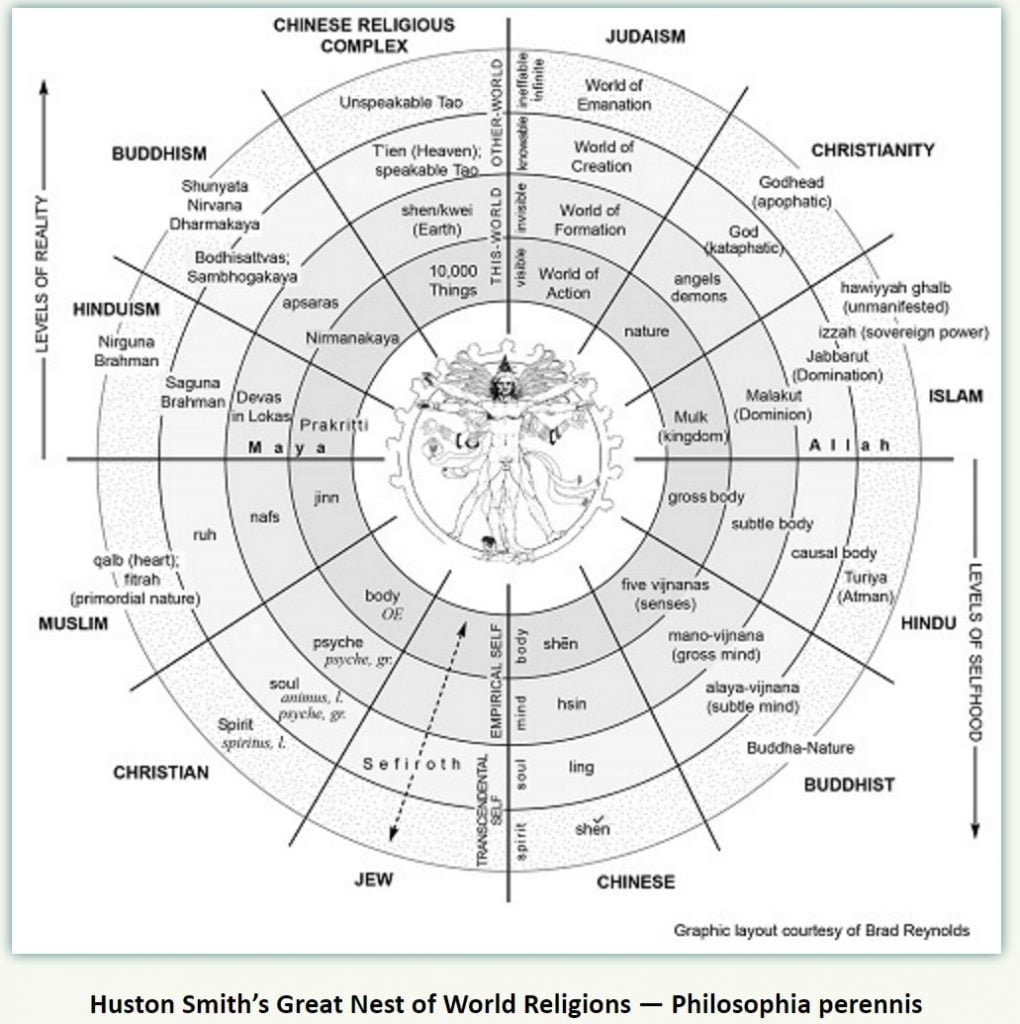
Den store værenskæde opstod i forbindelse med verdens skabelse (The Big Bang), hvor der ikke blot blev skabt en materiel verden, men også en række indre verdener gennem åndens involution. Denne involution blev omtalt i starten af kapitel I, og Assagioli beskriver disse verdener således: (2006, s.87-88)
”Den tredje symbolgruppe, der ofte ses, omfatter elevation, opstigning eller erobring af det “indre rum” som en opstigende proces. Der findes en række indre verdener med hver sine specielle egenskaber, og de består både af højere niveauer og af lavere niveauer. Den første er lidenskabens og følelsernes verden, hvor der er stor afstand og en markant forskel i niveau mellem blind lidenskab og de højere følelser. Så kommer intelligensens eller sindets verden. Her findes også forskellige niveauer, fx niveauet for det konkrete, analytiske sind, og niveauet for den højere filosofiske fornuft (nous). Endvidere er der forestillingsevnens verden med et lavere og et højere område, intuitionens verden, viljens verden og derefter de endnu højere og ubeskrivelige verdener, der kun kan omtales som “transcendente verdener”.
I nedenstående diagram har jeg udarbejdet en grundlæggende skitse over de forskellige indre verdener. I artiklen Psykosyntese og panenteisme (Sørensen, 2015), har jeg samlet alle de relevante citater, som Assagioli nævner. Modellen viser en gruppe af hierarkier eller holarkier, hvor de højere verdener transcenderer, og samtidig inkluderer de foregående. Det er med andre ord en model over det kollektive ubevidste, for at bruge det jungianske begreb. Assagioli fortæller følgende: ”Det kollektive ubevidste er en enorm verden, som strækker sig fra det biologiske til det spirituelle niveau, hvorfor der må skelnes mellem oprindelse, beskaffenhed, kvalitet og værdi.” (1967b)
Diagrammet viser at selvet, sammen med resten af menneskeheden, må foretage rejsen gennem de forskellige verdener for at forene sig med sin spirituelle kilde. I første omgang med det transpersonlige selv eller sjælen og senere med det universelle selv, som jeg her har valgt at kalde Spirit-in-action for at bruge et udtryk fra Ken Wilber. Forestillingsverdenen er en syntesisk funktion og kan befinde sig på flere niveauer samtidig, fra forestilling af lydindtryk, til intuitive forestillinger. (1975: 143)

“The Great Chain of Being – Den store værenskæde”
Dette var de afsluttende kommentarer omkring psykosyntesens udviklingsteori. Det har desværre ikke været muligt at give en detaljeret beskrivelse af alle de mange stadier, men jeg håber, at læseren selv vil studere de kildehenvisninger, som er givet undervejs.
Vi er nu klar til at tage fat på hver af de syv centrale kernebegreber i psykosyntesen, og vi starter med disidentifikation. Lad os afslutte med et citat af Assagioli, der betoner hvad der er det grundlæggende motiv i psykosyntesen:
”Jeg retter en inderlig appel til alle terapeuter, psykologer og pædagoger om aktivt at engagere sig i det nødvendige arbejde i forbindelse med forskning, eksperimenter og deres anvendelse. Lad os føle og følge det store behov for at helbrede de alvorlige sygdomme, der for øjeblikket plager menneskeheden. Lad os forstå det bidrag, som vi kan yde til dannelsen af en ny civilisation, der er karakteriseret af harmonisk integration og samarbejde – og gennemsyret af syntesens ånd.” (Assagioli, 1975, s.9).
[1] Assagioli er på linje med Maslow og Wilber i forhold til at opfatte virkeligheden som hierarkisk opbygget. Hans anvendelse af Maslows behovspyramide er det tydeligste eksempel. Han tilslutter sig hierarkier flere steder i sit forfatterskab: 2006, s.180, 199, 201, 222, Keen 1975.
Sådan kan du komme videre
Læs også artiklen Psykosyntesens personlighedsteori
Her kan du modtage syv gratis meditationer, hvor du udvikler forskellige sider af dig selv
Læs også artiklen Psykosyntese en integral psykologi og biografien om Roberto Assagioli
Læs introartiklen om integral meditation
