

Assagioli at twenty-four on Jung’s association experiment: reaction times, the signs of an affective complex and the limits of a “practical, fruitful and elegant” method
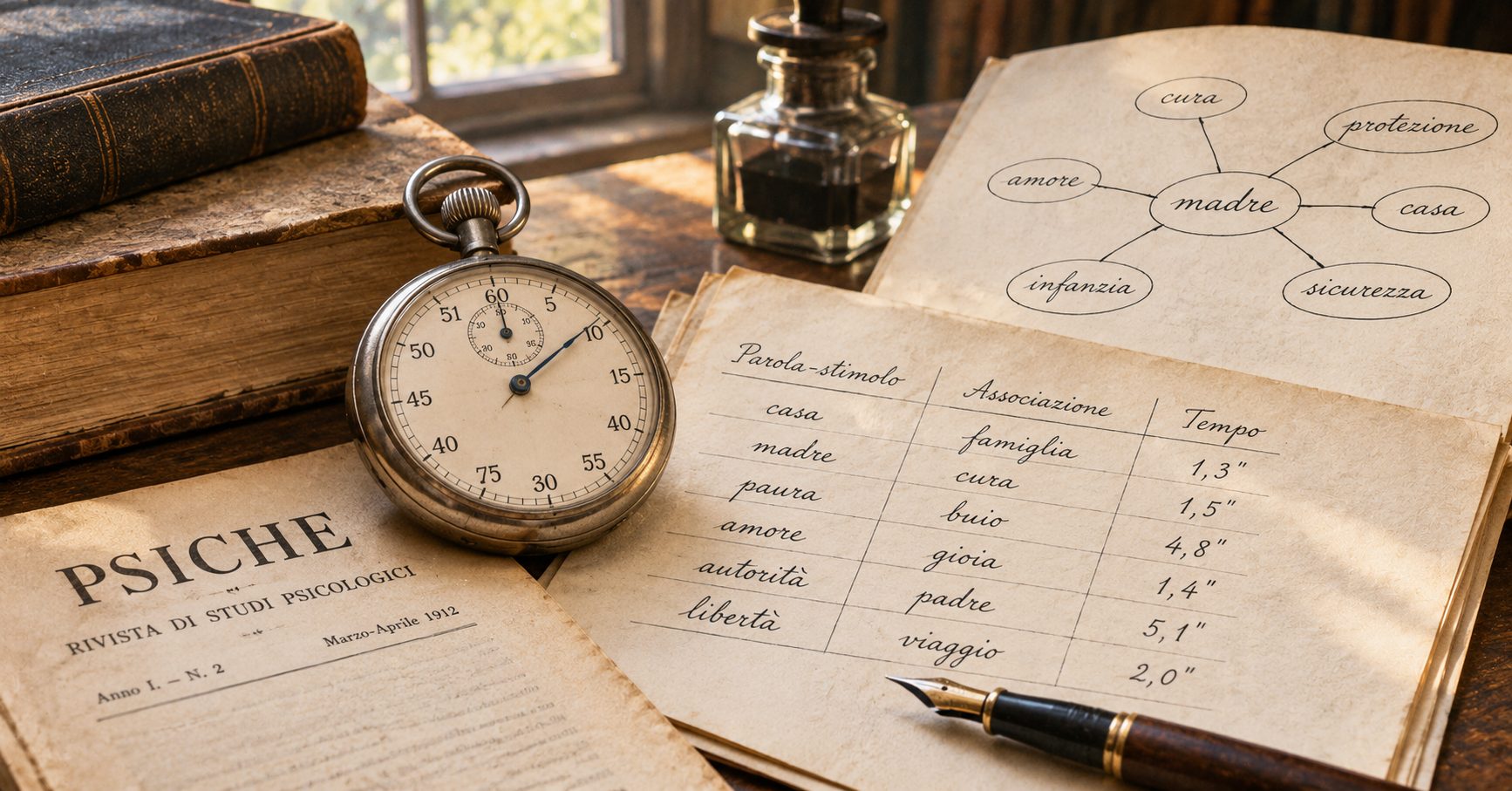
By Roberto Assagioli
Source: “Note e commenti: La psicologia e il pubblico – Il metodo delle associazioni” [Notes and Comments: Psychology and the Public – The Method of Associations], Psiche I, no. 2 (March–April 1912): 136–39, a reply to Prof. Morselli’s essay in the same issue; Archivio Assagioli, Florence, Doc. #23641
Translated and edited with notes by Jan Kuniholm
Editorial Note
The abstract and contextual subtitle in this online edition have been added by the editor, Kenneth Sørensen, to support readability, navigation, and archival consistency. The original wording has not been altered.
Abstract
In this short reply, published in the second issue of the journal Psiche in 1912, the twenty-four-year-old Roberto Assagioli answers Enrico Morselli’s critical essay on the word-association experiment developed by C. G. Jung. Assagioli presents the method as psychoanalysts use it: as a quick initial orientation to a patient’s affective life, useful in differential diagnosis, in identifying “mental types” and in forensic work, but never a substitute for psychoanalysis proper through free association. He grants that reaction time is no exact measure, yet argues that the delays caused by an “affective complex” are large enough to stand out, and he lists eight further signs of a complex, from superficial or nonsensical responses and repetition of the stimulus word to blushing and perseveration. He defends his own lists of stimulus words, explains why the method exposes rather than suffers from feigning, and concludes that, properly supplemented, it is one of the most practical, fruitful and “elegant” methods of the psychology of his day.
In the extensive study published in this issue, Prof. Morselli has presented a series of very subtle and detailed critical observations on the “Jungian” method of associations. I consider it appropriate to respond briefly to some of those remarks, both because in part they concern me personally, and because they provide me with the opportunity to supplement Morselli’s exposition and to clarify the scope and intentions of the method as applied by psychoanalysts.
Psychoanalysts use it primarily for an initial orientation regarding the patients’ psychic life and for a rapid exploration of their affectivity, and for this essentially practical purpose, the method — as attested by numerous observers — works very well. It also provides highly useful data for the differential diagnosis of certain pathological forms[1] and for the identification of different “mental types,” and lends itself to important forensic applications. However, one must not ask the method for more than it can give; with a hundred associations, one certainly cannot expect to probe all the recesses of a soul! The experiment must be supplemented with proper psychoanalysis (through “free associations”); only in this way can the meaning of the “reactions” obtained be established with certainty.
Morselli raises many doubts about the value of reaction time as an indicator of “affective complexes.” I agree with him that this indicator has no absolute or mathematical value, but I believe his reservations are excessive. It is true that reaction time is influenced by many other extrinsic factors, but these generally can only cause insignificant fluctuations in reaction time.
Thus, the fact that the presentation is a trisyllable or a tetrasyllable has a negligible influence for the purposes of the experiment, especially since I do not see how the subject could complete the term before it is fully pronounced (e.g., after hearing the first two syllables of the Italian word compassione, they might equally think of compagno, compagine, comparare, etc.). Likewise, the difference in reaction time between abstract and concrete presentations is so small that it cannot constitute a source of error, especially since it is easy to account for.[2]
On the other hand, the prolongation of reaction time caused by an “affective complex” is generally quite significant, so much so that a lack of reaction is not uncommon.[3]
I must also note that the measurement of reaction time is not the only “indicator of an affective complex” (Komplexmerkmal); there is the one mentioned by Morselli, which is obtained through the complementary “reproduction” experiment; there are also several other important ones, namely:
- A superficial, strange, or nonsensical reaction (this is almost always the effect of “repression”).
- A reaction that clearly betrays the existence of the affective complex (“egocentric reaction”).
- The repeated use of the same reaction.
- The repetition of the stimulus word (another sign of “repression”).
- The substitution of the stimulus word with one similar in sound that has some connection to the complex (“assimilation”).
- The sense in which stimulus words are taken — those having both a literal and a metaphorical meaning.
- Various emotional manifestations (blushing, laughter, facial expressions of various kinds, signs of embarrassment, etc.).
- The persistence of a “complex sign” (especially the prolongation of reaction time) during subsequent associations (“perseveration”).
This last phenomenon is quite understandable, since an affective state, once evoked, does not dissipate immediately but tends to persist. For this very reason, when compiling the list of stimulus words, an effort was made to alternate those most likely to arouse feelings with concrete and neutral presentations. Overloading the list with abstract terms would cause a great deal of interference, making the experiment confusing and less conclusive. If one wishes to test other presentations, one can easily prepare a third or perhaps a fourth series of stimulus words.
As for the investigation of the sexual sphere, practice has shown me that the presentations contained in the series I compiled are sufficient (dear, marry, kiss, woman, sin). Likewise, it seems to me that the words with double meanings in my lists are quite numerous and appropriately chosen for the ease with which they can be taken in a metaphorical, moral, or religious sense (e.g., cold, fall, prick, pure, aspire, dear, pray, count, etc.).[4]
Morselli then mentions the danger of being misled by feigning. To me, however, it seems that the method of associations perhaps avoids this danger better than any other. In fact, an attempt at feigning necessarily manifests itself through a prolonged reaction time or a lack of response — facts that are precisely “signs of a complex” and draw the experimenter’s attention. This has been amply demonstrated by the interesting applications of the method to judicial investigations. Thus, for example, Katzen-Ellenbogen was able, through the association experiment, to expose the feigning of insanity in a criminal.[5]
On the other hand, for reasons that are easy to guess, such judicial applications present special difficulties and sources of error and must be carried out with the utmost caution.
In conclusion, I believe that the association method — provided the lists of stimulus words are supplemented with other appropriately selected items on a case-by-case basis, and provided the meaning and significance of the reactions are brought to light through subsequent psychoanalysis — constitutes, as it stands, one of the most practical, fruitful, and elegant methods in experimental psychology.[6]
[1] Especially to distinguish the “mixed states” of manic-depressive psychosis and neurasthenic states from the initial stages of early dementia (see in this regard the excellent work by A. Ley and P. Menserath, L’étude expérimentale de l’association des idées dans les maladies mentales. Gand, Vander Haeghen, 1911).
[2] Jung sought to measure this difference accurately and found that the average reaction time to concrete nouns was 1.67 seconds, while that to abstract nouns was 1.95 seconds in the 26 subjects he studied.
[3] Therefore, it is not very appropriate to calculate the “arithmetic mean” of reaction times. Instead, the so-called “probable mean” is more useful, which is found by ranking the reaction times in order of magnitude and taking the middle value (i.e., the 25th value in a series of 50).
[4] The reader is aware that the listed words were Italian in the original version of this essay. Therefore the effects of the particular words are likely not to be the same as might be anticipated in English. —Ed.
[5] Katzen-Ellenbogen, E. W., “The Detection of a Case of Simulation of Insanity by Means of Association Tests.” Journ.Abn. Psychol. VI, 1911-1912, p.19.
[6] Note that the term “experimental psychology” at the time of this writing referred to psychotherapy or other practices in which a practicing psychologist “experiments” with techniques in their clinical setting. —Ed.
