

Psychosynthesis in marriage – beyond right and wrong: Assagioli’s 1965 lesson on the relativity of points of view, three diagrams of the couple, the kinds of love, and the couple within society

By Roberto Assagioli
Source: Lessons in Psychosynthesis, Seventh Lesson, Istituto di Psicosintesi, Florence, 14 March 1965
Translated by Jan Kuniholm and Catherine Ann Lombard
Editorial Note
The abstract and contextual subtitle in this online edition have been added by the editor, Kenneth Sørensen, to support readability, navigation, and archival consistency. The original wording has not been altered. The notes are the translators’. This text belongs to a series of Assagioli’s talks and lectures on the psychosynthesis of the couple (1957–1972), edited by Jan Kuniholm and Catherine Ann Lombard.
Abstract
In this lesson of March 1965 Roberto Assagioli turns from the problems of the couple to psychosynthesis in marriage, which can succeed only within a conception of life shared by both partners and freed from two illusions: the pursuit of pleasure as an end and the expectation of a perfect partner. Drawing on the relativity of points of view, he shows that disputes over who is right are futile. Three diagrams illustrate a relationship based mainly on sexual attraction, one based mainly on spiritual communion, and a complete, balanced psychosynthesis at all levels, exemplified by Robert and Elizabeth Browning. He then distinguishes kinds of love, from possessive love to love that respects the other’s right to be him or herself, discusses how partners can adjust through alternating assertive and accommodating attitudes, and stresses the integration of the higher qualities of the opposite sex in each person. The lesson ends with the couple and the family within society, recommending Keyserling’s Book of Marriage and the education of young people for marriage.
The psychosynthesis of the couple, which is the goal of marriage, can be implemented in a satisfactory way only if it is framed or placed within a general conception of life that is understood and accepted by both spouses. This concept requires the elimination of two fundamental errors and illusions.
The first is the search for pleasure and happiness as ends in themselves; that is, a hedonistic and selfish conception of life. But such ends can never be achieved, since suffering cannot be eliminated from life; any attempt to escape it, to push it back or rebel, only increases it. On the other hand, a willing acceptance and understanding of the useful and necessary function of suffering attenuates it, and can not only counterbalance it but also make it a source of joy. Here, perhaps a clarification is needed: to understand anything in psychology, one must always keep in mind the multiplicity of human nature, its various levels, the different subpersonalities that exist simultaneously inside us. So there can be suffering on one level and joy on another. They do not neutralize each other, they coexist; and in these cases it could be called a “peaceful coexistence” (in a different sense from the political one!).
The second mistake or illusion is the search for stability, “security,” for static harmony or peace. These cannot exist in human life, which by its very nature is fluid, dynamic, constantly evolving, as is cosmic life in all its manifestations. Stability, security, and peace exist and can be found, but only in a higher sphere of reality, in the transcendent where our true being, the spiritual Self dwells. But it is an illusion to seek that stability and peace in one’s personal life, which includes various relationships with others. The spiritual Self lives in a sphere of reality that has laws and an essence completely different from those of the sphere of becoming, of changing, of evolution.
Personal human life is essentially development, growth, and implementation of latent, superior possibilities. It is struggle and triumph, and therefore necessarily implies conflicts, tensions, overcoming, and alternations of joy and suffering—in addition to the possible coexistence which I have mentioned. When this is well-understood and accepted, the fundamental error of attributing fault—for the difficulties, the disharmonies and the travails that are inherent in life in the world—to external conditions or to other people, is avoided.
One of the major obstacles to the implementation of the psychosynthesis of the couple, and one of the most common and most difficult to eliminate, is mutual blame. It manifests itself in the innumerable discussions about who is “right” and who is “wrong;” but this approach is totally misguided! It is not a question of “right” or “wrong,” but of different points of view, appraisals, and accents. These are determined primarily by the different psychological constitution of man and woman in general; then, by the different psychological types; and also, by the individual peculiarities of each, and by their different experiences throughout life. This is part of the general principle, the fundamental truth, that in both the physical and psychic world there is nothing absolute; everything is relative.
In the physical world, each phenomenon is relative in at least three ways: first, by its position in space; second, in the flow of time; third, according to the scale of dimensions and the orders of magnitude that the observer examines. The laws that apply at the molecular and atomic level are not applicable to the sub-atomic one. All modern physics has shown this.
This relativity exists even more in the psychological field, and in more varied and complex ways. This was well highlighted by “general semantics,”[1] which has demonstrated the non-applicability of Aristotelian logic with its “principle of the excluded middle.” On this occasion I cannot go into technical explanations, but I will clarify this point with a very simple analogy. According to the “excluded middle principle,” an object is either white or black; a statement is either true or false; but—unfortunately for the logicians*,* and fortunately for those who feel the value of the wonderful variety of life—there is an indefinite series of grays, and numerous combinations of white or black areas can be made.
Applying this to our theme, disputing the mutual “right” or “wrong” makes little sense and is of no use. The differences of opinions or appraisals and the consequent choices and decisions to be implemented must be examined objectively, serenely—I would say “scientifically.” In this way, and only in this way, is it possible to reach a mutual understanding —an agreement with opportune reciprocal concessions, without any “winner” or “loser,” and therefore a harmonious and fruitful cooperation. This applies to all sorts of problems, from spiritual and psychological to practical.
Based on these premises, we examine the multiple relationships that can exist between the two members of the couple, and how the corresponding integrations can be produced. Given the complexity of these relationships and interactions, it is necessary to start from the fundamental ones. These exist first of all at the three main levels in which the human being functions, indicated in the following diagrams, based on the fundamental layout of the structure of the human being that you all know.
DIAGRAM A
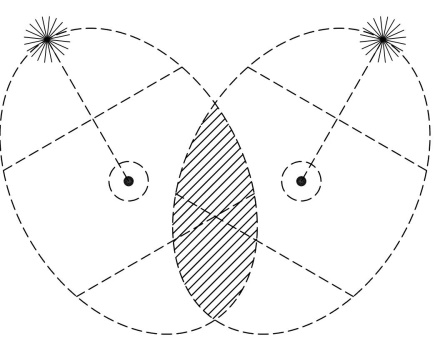
This indicates a relationship based above all on sexual attraction, that is, on the bio-psychic level, with a share of emotional-affective participation.
DIAGRAM B
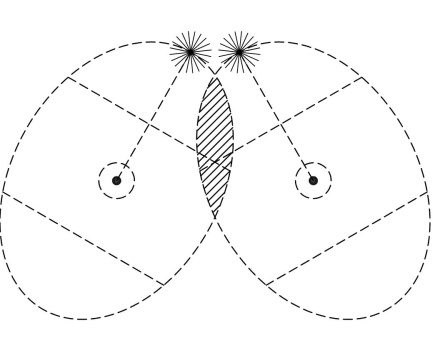
This is the inverse of the first, indicating a relationship based above all on a spiritual communion at the level of the superconscious, with a component that reaches the affective and mental part (middle zone of the human being). A wonderful example is that of Saint Francis of Assisi and Saint Clare; another is that of Saint Francis de Sales and Saint Chantal, who were creative in the sense that their concerted activity made possible the foundation of the “Order of the Visitation” by Saint Chantal.
DIAGRAM C
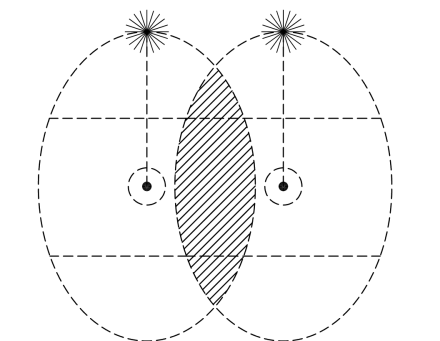
The third diagram represents a complete and more or less balanced psychosynthesis between the elements existing at all levels; the relationships go from physical to spiritual. Note that “complete” does not mean “integral” or absolute. As appears from the diagram, each of the two persons remain in two individual and independent zones or parts.
We have an example and an interesting demonstration in the union between the two poets Robert and Elisabeth Browning. They felt very attracted to each other and married despite serious difficulties (obstinate opposition from her father and her precarious health) and were together in excellent harmony and understanding. Robert Browning had several feminine characteristics, while Elizabeth was endowed with virile energies too, so there was a vast area of psychological and spiritual interaction and fusion. Both were poets, but it can be said that it is difficult to find poets so different from each other; therefore, in their integration, in their communion, there was also a wide margin of independence and freedom. For example, Elizabeth was very interested in parapsychological phenomena and also made experiments [in this area]; this was a field Robert didn’t believe in and that didn’t attract him, but he left her completely free to pursue it, and she didn’t try to convert him to any faith in that sense. Here is an “edifying” example, I would say (to use a somewhat antiquated but expressive word), of how a satisfactory psychosynthesis can be implemented, of the couple with two very different people.
Respect for the personality of the other and recognition of his or her right to be him or herself are essential, not only for a true and proper psychosynthesis of the couple, but also for avoiding the quarrels and conflicts that embitter married life and endanger its continuity. That respect and recognition require, above all, the understanding that perfect fusion and consonance (which are the ideal and pretense of “romantic love”) are unachievable—and are not even to be hoped for, because they would produce a “egotistical twosome.” They also require the relinquishment of two strong tendencies that are inherent in human nature: that of wanting to shape the spouse in one’s own image and likeness, and that of wanting to shape the other according to one’s own idea or “ideal image” of a person of the opposite sex.
With regard to all the diagrams, it must be remembered that the situations represented by them are not static or permanent. Changes of various kinds can happen—indeed, they always do happen: changes of moving closer or distancing oneself; that is, attraction and contact or detachment and even repulsion. Furthermore, variations and developments can occur in relationships which could be indicated by changes in the inclination of the egg diagrams that represent the two people. A frequent case is that of a relationship beginning with a prevailing sexual attraction [such as in Diagram II-A], which then develops in affectivity and also in mental understanding. Sometimes the beginning is purely emotional, sentimental and passionate with subsequent mutual understanding, in the best cases, on both the physical and spiritual levels. At other times the beginning is “at the highest level” [as in Diagram II-C]. It is a spiritual understanding, with subsequent integration of the other levels.
A more differentiated and precise way of describing and examining these various relationships is one based on different bio-psychological functions and activities.
- At the biological level there is physical, sexual attraction. It is a vast and currently much-discussed topic, but I cannot deal with it on this occasion. I will only say that sexual harmony and disharmony (in strictly the biological sense), certainly has considerable importance in the couple’s psychosynthesis, but not the preponderant or almost exclusive one that many attribute to it, especially as a result of the spread of psychoanalytical doctrines. There are examples of couples who have implemented psycho-spiritual communion without, or despite the lack of, harmony in sexual relations, or after their ceasing sexual relations. Conversely, there are numerous couples with satisfactory physical relationships which are not enough to avoid serious conflicts. This has been stated by various scholars, including the highly experienced and cultured psychiatrist Erich Fromm. He spoke about it in his book The Art of Loving (Milan, Mondadori, 1963), which is a good treatment of the theme, although it also contains some questionable ideas. The weakest part in Fromm’s book concerns the spiritual aspect, the relationships with God, since he did not have any spiritual experience of his own. However, he does admit the existence of the spirit and the possibility of communion with it.
- Relationships on the emotional level would require an even longer discussion. In fact, they constitute the boundless theme of what is called “love.” This is a word that is used in different and opposite ways. Here, too, I will have to limit myself to a few hints; that is, to indicate some of the types of emotional relationships that can most help or hinder the couple’s psychosynthesis. There are in fact:
a. The love that could be called “integrative,” in which each of the two seeks, more or less consciously, what he or she lacks or aspires to. Maslow calls it “love and belonging needs.” It includes passionate love and romantic love. In its best aspects it produces a mutual integration, and therefore favors the psychosynthesis of the couple. But not infrequently it is a demanding, absorbent, and jealous love.
b. Possessive love. It has similarities with the previous type but it differs from it in that who “loves” in this way does not seek integration with the loved person, but tries to possess them for themselves, to dominate them. In extreme cases this is actually not “love” but a manifestation of the “will to power.” In America the type of woman who seeks this is called a “vamp,” that is a “vampire”!
c. “Oblational” love, whose characteristics are devotion, dedication, willing sacrifice for the loved one, or for a superior Being. In the past, oblational love was a [common] characteristic of the Indian wife, who considered her husband to be her lord, her “guru” or spiritual instructor, and even a representative of God. Oblational and possessive love are often found in motherly love, combined in various proportions.
d. “Radiant” love. This type is unlike the “oblational” one, with which it could be confused. It does not consist in giving oneself (or something of oneself) to another being, but a pouring out of love to many or to all beings. It can have various features or specific qualities: fraternity, compassion, and co-communion.
These different types of love are not mutually exclusive, but, given the multiplicity of the human being, they can mix in various proportions and alternate in various times and ways.
- In the mental field, mutual understanding is not easy, given the diverse ways men and women use the mind. This does not mean that the woman is less intelligent than the man—as some people have erroneously asserted—but that she [often] uses her intelligence in a different way. In [what might be called] “undeveloped” women, the mind is dominated by feelings and emotions, and is placed at their service—but this also happens to many men! In [what could be called more]“highly developed” women, the mind is subordinated to intuition, whose insights it tries to grasp and interpret. On the other hand, a man [often] wants to use his mind as his sole instrument of knowledge. He seeks and finds—or deludes himself into thinking he has found—in his logical mind the motives that impel him into action. Generally [such a man] has no intuition, and therefore does not understand nor appreciate it in women. Knowing these differences can greatly help to reach an understanding.
- In the field of the will, interpersonal relationships have a great importance, both in general and particularly in married life, since they are often the cause of the most bitter conflicts that can lead to the dissolution of a marriage. These conflicts are produced by the tendency to self-affirmation, to domination, to the imposition of one’s own will. Note that this is a tendency that exists in all people, and not only in the types who are constitutionally strong-willed and imperative. It also exists in weak people as a reaction or hyper-compensation for feelings of inferiority, or for a real deficiency. These conflicts can be mitigated and also resolved by frank recognition and a serene and in-depth examination of the problem by both partners, with the good will to solve it using suitable means. The mutual understanding in this sense can be implemented in two ways:
a. First, by a clear separation of the “fields” of dominance and authority in family life. These distinctions are natural, and, therefore with good will, agreement on them can be reached without too much difficulty.
b. Second, by an appropriate alternation of assertive and accommodating attitudes [on the part of each partner]. It is good to keep in mind, in these situations, the psychological mechanism that could be called “shifting the target,” or “target displacement.” For example, when a mother is unhappy or exasperated by the behavior of her children or the maid, she often discharges her irritation on her husband when he returns home! Conversely, [for example], a husband who has suffered abuse or humiliation in the office or in another work situation often discharges his repressed irritation onto his wife. If you are able to remember and be convinced in such situations that in reality your spouse does not at all “have it in for you,” and if, therefore, you manage not to react or argue, everything will be over after such a “discharge,” and indeed a surge of affection can take over. This emotional “game of forces” has been acutely described by Laura Archera Huxley, wife of the writer Aldous Huxley who recently passed away, in her book entitled You Are Not the Target. It is a book full of humor and gives witty and original practical advice on the art of living. (New York, Farrar Strauss, republished in 1998 by Da Capo Lifelong Books).
The alternation of attitudes in this type of relationship can be consciously regulated by coming to an agreement in moments of calm and mutual understanding. Thus, the spouses can agree to be assertive and “discharging,” or accommodating and “receptive,” at different moments of the day; or, as an American couple has proposed and implemented, on alternate days (except Sunday, considered to be a day of truce and equal communion!).
Then there is another difference in the relationships, of which the spouses should have a clear awareness: the difference between the three attitudes and functions that each man and woman have, and which can be considered as sub-personalities. In a man there are the filial (son) attitude and the conjugal (husband) and fatherly functions; correspondingly in a woman there are the filial (daughter) attitude and the conjugal (wife) and maternal functions. In the normal evolution of life, the filial “personality” appears first, then the conjugal one, to which are added the paternal or maternal ones. I said “added,” since the earlier attitudes and functions remain to varying degrees throughout one’s life. Here too there are typological differences. For example, there are women in whom the conjugal function clearly predominates and the maternal function is deficient, while in other women the opposite occurs.
But in addition to these differences that are more or less permanent or gradually evolving, there is often a rapid alternation between the three attitudes, depending on the circumstances and life events. There are times when a man or a woman feels inclined to abandon themselves to their partner in a childlike way and ask their help. At other times, they feel impelled to behave with their spouse in a paternal or maternal way. A clear knowledge of these alternations and rhythms, and their conscious and agreed upon implementation, is one of the most important tasks of the art of “living together.”
All this helps to eliminate many unnecessary disagreements and creates the conditions for the implementation of the couple’s psychosynthesis. On the positive side, the two essential qualities for this psychosynthesis are: loving understanding and the spirit of cooperation. They are necessary in all interpersonal relationships, but particularly in those between a man and a woman. There can be no order, harmony, or social peace if these qualities do not exist in individuals, and especially in the family.
But the psychosynthesis of the couple has even more profound aspects. Cohabitation produces intense mutual influences and great changes in both “terms of the twosome.” To understand them well, we need to start from the fact (of which I spoke earlier) that nobody is one-hundred percent “man” or “woman;” but there is a share or percentage of psychological elements of the opposite sex in every human being. This is a completely normal fact. Indeed it can be said to be necessary, otherwise there could be no mutual understanding or common ground. However, as Jung has clearly pointed out, the characters and the psychic functions proper to the other sex often remain in a primitive state—in the rough, as it were. They can remain repressed in the unconscious or be denied or devalued by the individual. For example, the repression of emotional or sentimental life by Nordic men[2] is common, which is the cause of many conjugal disharmonies and failures among them. In other cases, however, the eruption and excessive affirmation of the characteristics of the opposite sex can occur, such as has happened in cases of extreme feminism as a reaction to the unjust position of social and legal inferiority to which women were, and still are to some extent, subjected.
The psychosynthesis of the individual requires that the elements of the opposite sex existing in him or in her be recognized and developed in their higher aspects, and integrated, albeit in a subordinate way, into a complete personality. But it is essential that the higher aspects are developed, since it is easier for the lower ones to be manifested, that is, masculinized women and effeminate men—and this often happens. This integration of each individual is facilitated, indeed implemented spontaneously to some extent, by their living together.
The psychosynthetic function of marriage has been well described by the Swiss psychiatrist Alphonso Maeder in his essay on “Marriage and Self-development,” published in the largest and most valuable book on marriage. The book consists of three parts:[3] [the first is an introductory essay by Hermann Keyserling elucidating the philosophical basis of the “problem of marriage.”] The second part considers “Marriage in Space and in Time;” that is, all the various types of marriage that have existed in various civilizations in various eras. The third, “Marriage as an Eternal Problem,” deals with the fundamental problems of marriage in itself. The book contains 24 essays by eminent writers, including Tagore, Jung, Adler, Havelock Ellis, Wilhelm, Mann, Boeck, along with the broad introduction by Hermann Keyserling. The title of the book in German is Das Ehe Buch (The Book of Marriage, London, J. Cape, 1927 and New York Harcourt Brace & Co. 1926). It is out of print,[4] in both languages, and we hope that there will be an intelligent publisher in Italy who publishes a translation. It is a book that certainly “would sell” and that would always be topical! Keyserling’s ideas on this theme—original ideas, partly questionable but often very right and based on a profound knowledge of human nature—are also expounded in his other books: Vie Intime, The Problems of Personal Life, America Set Free, etc.
So far we have considered the couple for themselves. But the couple is not isolated; it has connections, relationships with other human beings and groups, and with the supra-individual Reality, and carries out a creative action at the various levels of life. At the biological—or rather psycho-biological—level, the procreation of children occurs through sexual union. Thus, the couple becomes a larger group: the family. On the psychological and spiritual level, the spouses become parents; that is, they perform, or should perform, their respective paternal and maternal functions. These functions, which have a high human and social value, are now in an acute crisis. Modern life, with its needs, difficulties, and struggles, with its intense rhythm, with its prevailing extroversion, is in conflict with the intimacy and closeness of family life.
But the family crisis above all is the result of the absence of a sense of responsibility and adequate psychological preparation on the part of parents. In mothers the illusion that “love” is enough; in the fathers there is often a “psychological absence:” an inability or neglect in carrying out one’s paternal task. This has been noted by many, and their remedies have been indicated: recognition of this deficiency; awareness of the damage it produces; a sense of responsibility, and therefore a disposition to adequately prepare to carry out one’s paternal or maternal function well; and a sincere and generous dedication to this great task.
Parents should be helped in this; but they should also be willing to get help! I think it is interesting to report what a teacher from Arezzo who teaches in an orthophrenic school[5] of handicapped children. Ersilia Bonelli, recently wrote:
“. . . Too many people, who are ignorant in the field of education, have only the conviction to act for the good of the child and to be an example of perfection for him.
The child spends tense hours at school and, when he returns home, he finds, almost always, an atmosphere even more charged with incomprehension, nervousness and oppression. The school and the family both blame the child, like Jesus between Herod and Pilate.
Special and differential schools are being set up for under-gifted children and teachers are being encouraged to train together, but a teacher cannot tell a parent that their child shows poor intelligence or application to study. Instead of worrying about finding the causes, the parent considers the teacher incompetent, and, more often, he blames the child who is forced, with additional lessons and blows, to make an excessive and unnatural effort.
If we do not want more and more abnormal adults, let us ensure that their childhood unfolds according to the directives of nature . . . at least make the family capable of carrying out its educational mission. One cannot educate without being educated!
It is therefore the duty of the state to set up preparatory courses (as they do in any other professional field) and make them compulsory for parents, giving them the main and basic notions of psychology, pedagogy and mental hygiene. (It takes a few hours a week).
Parents regard children too much from the standpoint of their own egos. The child is forced to accept our demands, often without understanding him or her, which makes the child feel guilty and incapable.
Even the child has a dignity to defend, and his exhausted soul is wounded and humiliated by the rudeness and corporal punishment that parents impose. We are scandalized, because in some countries the whip and the stick are used on children, as if in Italy there was not yet a similar shame. In addition to causing disturbances to the nervous system, such treatment makes a child a failure or a rebel, or at best a hypocrite and a liar.
We fear the abuses of the body, but how many parents are guilty of abuse of the spirit of their children, not bearing in mind that love cannot be true love if it is not guided by conscience. “
—(This article was published in the newspaper La Nazione on January 21, 1965.)
At the social level there is the problem of the integration of the couple and the family into society. Here too there is a crisis. As I mentioned, modern life tends to break up the family; in America it has been said that the house has often become like a garage (!) in which parents and children come and go; everyone looks after their own occupations and interests, but there is no life in common. On the other hand, elsewhere there is still often an egoistic isolation of the couple and the family group. Instead, what is needed is a willing participation in social life by the spouses, along with humanitarian activities and the education of children in socialization. I will speak more of this in the next Lesson which will deal (among other things) with the subject of social psychology.
[1] General Semantics was first presented under that name by Alfred Korzybski in 1933 with the publication of Science and Sanity: An Introduction to Non-Aristotelian Systems and General Semantics, and advanced by others. According to this approach, things cannot be defined in the way that Greek philosopher Aristotle maintained, and therefore the polarities of Aristotelian logic are not valid descriptions of empirical reality.—Ed.
[2] Following Keyserling, Assagioli used the term “nordic” to include all “northern Europeans,” which for him included English, Swiss, Germans and other peoples living north of the Alps. This blanket judgment may have seemed to be borne out by Dr. Assagioli’s experience during his lifetime. It is not at all certain that such prejudices were truly justified, then or now. —Ed.
[3] I have corrected Assagioli’s description of this book, in that he described only two parts: the second and the third. In fact the book is published in three parts: the first part is an extended essay by Keyserling that provides the context for the successive two parts, which are as RA has described.—Ed.
[4] An English edition is now available from archive.org.—Ed.
[5] Orthophrenic schools were developed by Maria Montessori for training teachers in educating mentally disabled children.
