

Psychosynthesis of the couple: why two beings come together, the couple as a new entity, balance of authority and freedom from parental images – an undated French manuscript by Assagioli
By Roberto Assagioli, M.D.
Source: undated typed manuscript in French, Document #16008, Archivio Assagioli, Florence
Transcribed and translated from the French with notes by Jan Kuniholm
Editorial Note
The abstract and contextual subtitle in this online edition have been added by the editor, Kenneth Sørensen, to support readability, navigation, and archival consistency. The original wording has not been altered. The notes are the translator’s; several of them place the author’s views on gender roles in their time. This text belongs to a series of Assagioli’s talks and lectures on the psychosynthesis of the couple (1957–1972), edited by Jan Kuniholm and Catherine Ann Lombard.
Abstract
In this undated manuscript on the psychosynthesis of the couple, written in French, Roberto Assagioli first asks why two beings of the opposite sex come together, answering on four levels: the sexual instinct, the emotional need to place affection outside oneself, the mental level, and the spiritual level, on which a man and a woman seek to create a small community bound on the plane of the soul. Four drawings show the stages of union, from two separate personalities to a new entity, the couple, represented by an ellipse with two foci. Assagioli then discusses the balance of the couple: authority and responsibility shared equally, the specific and complementary functions of man and woman, and the damage done by the projection of parental images and by a lack of detachment from the parents. Where the parents’ roles have been deficient, the psychologist may supply what was missing. For the psychosynthesis of the couple, the essential condition of a successful union is the fullest possible harmonisation of the two personalities, beginning with the resolution of infantile complexes.
The first question to ask when studying the psychological phenomena that accompany the formation of a couple, is the reason for this rapprochement between two beings of the opposite sex. We can schematically divide the answer into four parts:
1. What is called the sexual instinct is a great force which drives males to mate with females, a fact which is observed on almost every level of the entire animal world. Instinctively, when mating, animals obey a great law: the law of reproduction; it is undoubtedly the most profound and in any case the most primitive reason for the attraction of two beings of the opposite sex.
2. On the emotional level, it is obvious that the man must place his affection on an object which is external to him. During the first years of his life the child focuses all his affection on his parents, and especially on his mother to whom he owes his life and the first nourishment. Advancing on the path of life, the child’s emotional object changes continuously, passing through multiple stages, from the mother to the hero, until adolescence where there is often a revolt of the child, who takes actions to escape from the control of parents. It is then that the image of the ideal woman is formed, which can often be tinged with that of the mother, from whom the adolescent is not yet detached. It is important to note the close dependence which exists between the mother image and the wife image, because from this arise many conflicts in marriage. Indeed, if we assume a certain attachment between the mother and the son, and that the latter does not know how to emotionally eliminate the influence of his mother, this son will tend to seek a wife on whom he can project his maternal image, and will assume the attitude of a son towards his wife, which will cause conflicts, jealousies, and disappointments in the marriage. It is the same for the woman who often seeks in her husband mainly a father, because she has not known how to detach herself enough from the paternal image, and intuitively feels the need to find in her husband the emotional and material support that her relationship with her father offered her. In addition to this it has been recognized by Jung that there exists in the unconscious of each being an element of the opposite sex; however, this feminine side of the man for example, naturally tends to be expressed by supporting the attraction of the man for the woman. A man in whom the feminine element is not fully developed cannot understand the woman; he presents such a one-sidedness that it is impossible for him to be bonded with a woman. This attraction of poles of opposite sign is found in electricity: indeed, there are positive charges and others negative, and one notes that those which are of opposite charge attract, while those which have the same charge repel. One of the principles of all philosophy is that of duality, duality between the spirit—masculine fertilizing element—and matter—feminine fertilized element; the dynamic and the static, the transcendent and the immanent. In all religions also we find this notion, which is represented in a large number of myths. Sexuality is a direct expression of this duality. If we consider it psychologically, as Jung did, we can admit that sexual polarity is a “horizontal” phenomenon. The spiritual definition of polarity as given by Keyserling would be represented by a “vertical” relationship between the spirit, (fertilizing element) and matter (fertilized element). The attraction between the two poles would then be explained by a constant search for the absolute in which the morphological differences represented by sexuality disappear.
3. Humanity[1] needs social life; people hate loneliness because we feel at risk there. Humanity is essentially dependent on the world around us. In this great anxiety of loneliness, humans seek to escape by three means:
a. In a “horizontal” way, where they identify with the outside by means of passion, debauchery, ambition, sport, etc. They forget themselves in the crowd and thus lose consciousness of their individuality.
b. In a “top-down” or “regressive” manner, in which they reject the current state of things—the state of consciousness—and long for the fetal state, the state of an infant where they were not yet beings of consciousness; it is also possible to replicate this state of “non-being” by means of alcohol or drugs.
c. In a “progressive” way, where they seek to come into contact with the soul, which in essence has the consciousness of the “whole.” They then seek love on the higher plane; love of an ideal, of another being, of all other beings, of God who is All.
The existentialism which advocates [or posits a fundamental] separateness cannot satisfy humans because it offers them a state of insecurity and transience which is not viable.
In marriage, it may happen that an individual seeks to lose oneself in the couple, to lose one’s personality by merging entirely in the other: this is a romantic ideal that we can call regressive, and which has been illustrated notably by the story of Tristan and Isolde. It naturally leads to suicide, because it is impossible to lose oneself entirely in one’s beloved: this is a false interpretation of a true intuition: to be delivered from the limits of the personality. The mistake is to achieve this fusion only on the emotional and physical plane, true and total union being possible only on the plane of the soul.
4. On the spiritual plane, the man seeks in the woman a companion on whom he can count in the daily struggle to exist; he wants to create beautiful children with her, capable of living in harmony. Above all, he wants to create a small community in which the bonds are established on the soul plane, and in marriage, he realizes a small part of what the great human family is.
CONDITIONS FOR SUCCESS OF THE UNION
In most marriages, the union is based only on physical, emotional or social factors, and we note that after some time of intoxication, a “substantial” union—something that should last—hardly exists. They do not know enough what a great adventure marriage is; what an effort of adaptation it requires; and what physical, emotional, mental and even spiritual conflicts it causes. In many cases, the spouses know each other too little and unite instantly with a sudden and unreasonable impulse. They do not count on the time that is required to reveal certain sometimes very unexpected aspects. The common life of two beings who coexist intimately for many hours, each bringing their own habits, tastes, and comforts, sometimes causes friction due to the lack of understanding and detachment. We easily understand then, that if there is no more fundamental bond than physical attraction or emotional attraction between them, conflicts are not long in coming—especially if in addition, practical issues such as money and health present difficulties. It is therefore obvious that unions which are based on more solid foundations than the above-mentioned are all the more likely to succeed and prosper, as they are based on a more genuine and deep attraction. is easier for two beings who are united on the soul plane to apply themselves, little by little, to harmonize their two personalities, than for them to start from an emotional or physical attraction on the personal plane in attempting to arrive at creating a soul connection.
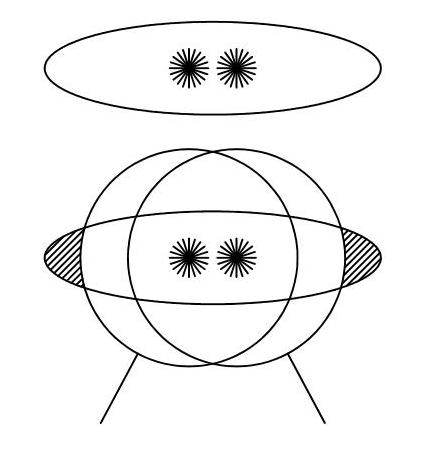
We can very schematically represent the different stages of the union of two beings by the following drawings:
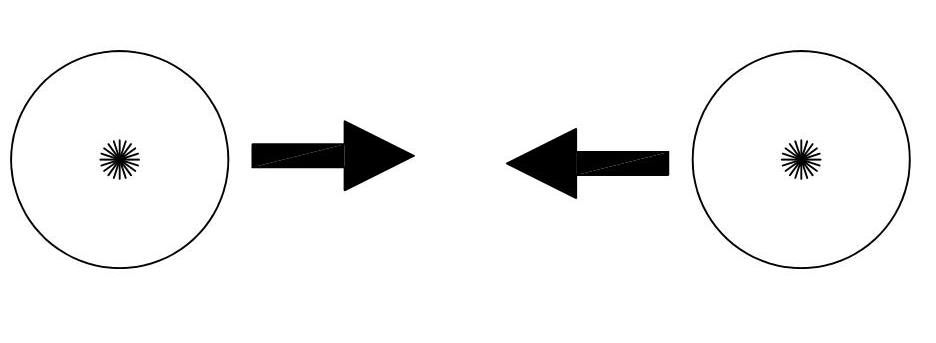
Drawing #1
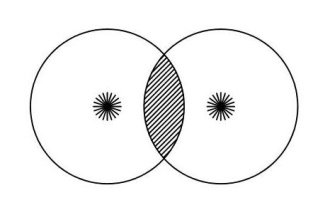
Drawing #2
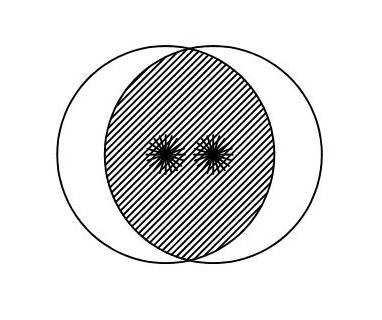
Drawing #3
Drawing #4
In drawing #1, the circles represent the personalities of the two individuals, and the center points their centers of consciousness. There is an attraction in the majority of cases due to emotional and physical affinities. In #2, the two individuals have pooled part of their personalities, that is to say that in certain parts of their emotional and mental body, there are points which have been pooled by the two individuals through deeper mutual knowledge. But this union does not yet include the centers of consciousness which remain independent. It is only after very deep contact and a large number of common experiences (drawing #3) that the centers of consciousness are on a common ground for the two individuals. Even in marriage, this state is rarely reached. There is then a fundamental understanding of the two beings on the three personality planes: physical, emotional, mental. It is at this moment that the strength of the couple is greatest, because two individual energies are then pooled for the benefit of a new entity. The couple is not only responsible for the unification of the conscious energies of each individual, but also of their unconscious forces, which then seem not only to function on the level of the individual personality, but also on that of the new personality, which becomes “the couple.” Two spouses who have achieved such a union have a great coherence in executing plans of action, which does not exclude their personal independence.
This new entity is represented in drawing #4 by an ellipse: the ellipse indeed has the remarkable property of depending on two focal points while the circle—which is only a special case of the ellipse—has only one. Likewise the couple depends on the two centers of consciousness; it exceeds the limits of a single personality. The darkened part of the ellipse which exceeds the two circles represents the creations of the couple: on the physical level this is expressed by children; on the emotional level, by the love and the devotion of the spouses one for the other and for the children. On the mental level, there can be cooperation in various activities, in particular the education of children. We therefore see that the most important work of the spouses is to achieve the most nearly total union on all levels in order to be able to use the maximum energy to achieve common goals. This union is only possible if each strives to forget individual desires in favor of the requirements of the couple.
Several things must be considered with regard to the notion of balance in the couple. First, the authority must be divided equally, each of the spouses having fifty percent of both responsibility and initiative; for if one of the spouses has a lesser share, the relations one will have with the other will no longer be those which characterize spouses but rather children, or even slaves. The will to control is inherent in a man. It is normal for him to look after her;[2] but he must know how to maintain balance. In marriage, each must place a certain amount of their will to control—half of the authority—in the couple. As for the rest, which should not be repressed, a man will use it either in his work, in sport, or in self-control. Women can use theirs in the education of children and in all “women’s work.”[3] It is absolutely necessary to avoid the states of “matriarchy” or “patriarchy” which are too often the occasion of a very unhappy despotism. As a result, indeed, how could a child have a true image of the father in a “matriarchy” where the mother makes all the decisions and takes on the specific functions of a man? Likewise, in many couples, the woman is reduced to the state of tacit servant and subjected by the authority of an angry tyrannical husband.
The man and the woman have specific functions which they must fulfill to maintain the balance of the couple, and especially to serve as an example for the children. Because it should not be forgotten that when the children will have become parents in their turn, they will instinctively take the same attitudes as those as those of their parents. If this image was distorted, either they will react by an opposite excess; or more simply, their conduct will be affected by their parents’ shortcomings.
In some couples, one can realize that the emotional roles of the parents are reversed, that is to say that the father has many feminine characteristics and that the woman presents typically masculine traits. This is due to the fact that man is still too attached to the mother concept and that he has not known how to develop the virile side in himself. This is often also caused by a deficiency on the part of his own father, who was unable to present a positive and complete image to him. The man then takes an infantile and filial attitude towards his wife: this is reflected in the fact that he requires an exaggerated tenderness from his wife, and that he withdraws when it comes to making practical decisions. This attitude is even more marked if, on the other hand, the woman was impressed by a very strong image from her father. The opposite can obviously also occur. The woman then seeks above all in her husband the father from whom she has not been able to detach herself, and she takes a childish attitude towards him.
This lack of detachment vis-à-vis the parents’ images can cause many imbalances, ranging from jealousy—for example, the woman being jealous of her mother-in-law for the affection that her own husband gives her—to incapacity in sexual activities.
The first step to take, before marriage, is therefore for each spouse to have a true picture of the importance of parents in their lives, in order to avoid the classic struggles with mothers-in-law;[4] then it is a question of everyone playing their roles well.
It might be good to list the qualities specific to each gender[5]:
1. Man is first of all a struggler, a warrior. He must also look reality in the face, with all it represents as to responsibilities and efforts. He is the one who faces the financial problems, who protects the home and solves the practical problems. The main aspect of this function is courage and a sense of organization. His second function is that of husband, whose fundamental role is “fertilization” on all levels. On the mental and spiritual level, he becomes the “guru” or instructor of his wife and children; it is he who transmits his knowledge and expertise to the members of his family, whose spirit he “fertilizes.” The function of “husband” can also assume, relative to women, the “father” and “son” aspects. Indeed, as it was said above, the woman—unconsciously—seeks some of the qualities of her father in her husband; in some states, especially when the woman is sick or weak, the husband must be able to take on the attitude of a benevolent and protective father. Likewise for the function of sons. The woman can often take the role of a mother relative to a weak or tired husband.
But it should be noted that these functions are secondary. A union in which the woman always plays the role of daughter or mother relative to her husband is unbalanced (we can note as a typical example of “mother-woman” and “husband-son” the union of George Sand and Chopin). A man must know how to be a good father, and this is perhaps his most delicate task, because in this capacity he must take on the role of instructor, demanding supervisor, amusing facilitator, of comrade—in a word, an “initiator of life.”
The importance of the parents’ unconscious attitudes towards children, who are eminently receptive to psychic stresses, cannot be appreciated enough. Above all, we must avoid any discord within the household and rely on the beneficial action of peace and love.
2. The functions of women are complementary to those of men. She is first of all the affectionate wife whose main characteristic is tenderness. Then she is the mother, to whom the children come to complain and be comforted. Her fundamental quality is therefore affectivity and sensitivity.
In the case where the roles of the parents have been deficient, the psychologist intervenes, to fill, in a way, the role that the father or mother has not been able to fill. By his or her attitude, advice and relationships with the patient, the psychologist must arouse in him or her the true sense of what it is to be “parents.” In the few weeks or months that the treatment lasts, he takes the patient through stages which go from childhood to independence, by adopting the attitudes that the parents should have had.
In addition to the theory of transference, in which the doctor is only the representation of a projection of the father or mother image that the patient’s unconscious contains, we must consider that the doctor becomes an objective reality independent of the phenomenon of projection. He really represents a father or mother energy, an image of reality of the father or the mother, and thus he causes an introjection of the image in the patient. The role of parent can also be assumed by a teacher, an older friend, an older brother or sister. There is then a living relationship between the elder and the younger, the instructor and the pupil, equivalent to that which unites the physical parent to the child.
It appears from what has been said that the essential condition for success in terms of human relations and more specifically union in marriage lies in the most complete possible harmonization of the personalities of the two individuals; the first step in this harmonization is the resolution of infantile complexes and the problems engendered by relationships with parents; the second step is made possible by an ever-expanding understanding of others and an elevation of the center of consciousness to the level of the soul.
[1] Translator-Editor’s Note: Following the conventions of the time of writing in his culture, Assagioli used the word “man” as the generic term for humanity. I am not certain whether or not in his case the use of the “generic masculine” in language crosses over into the assumption that “what applies for the male applies for the species.” In any case, I have changed the usage of the “masculine generic” nouns and pronouns to be more inclusive when it seems appropriate.
[2] This phrase is uncertain in the original: it was hand-written into the transcription by R.A. and the letters are blurred. The words chosen here represent the translator’s best approximation of what original meaning was intended.
[3] This work was clearly written before the modern era in which the choices of activity and work available to women, both within and outside the home, have expanded considerably from when Dr. Assagioli was writing.
[4] This reference to “classic struggles” with mothers-in-law was more of a reality in Mediterranean and middle eastern families in an earlier time, in which several generations lived under one roof—compared, say, to modern American families, where this situation occurs relatively rarely.
[5] This was clearly written in a time and place where the gender roles of men and women in society were at a very different level and mix than is found in many, if not most, cultures in the western world as of the early 21^st^ century. At the time and place Assagioli was writing, formal education of women and children was limited; the transmission of knowledge and skills was primarily a family affair rather than the province of schools. This is still a common state of affairs in many parts of the world. This section is balanced by the author’s insistence on the balance of authority and responsibility between spouses, and that any “inferiority” of one of the spouses is the cause of much difficulty. Nevertheless it appears that the author has thought out aspects of the male role more than that female role, which he describes as “complementary” to that of the male.
