

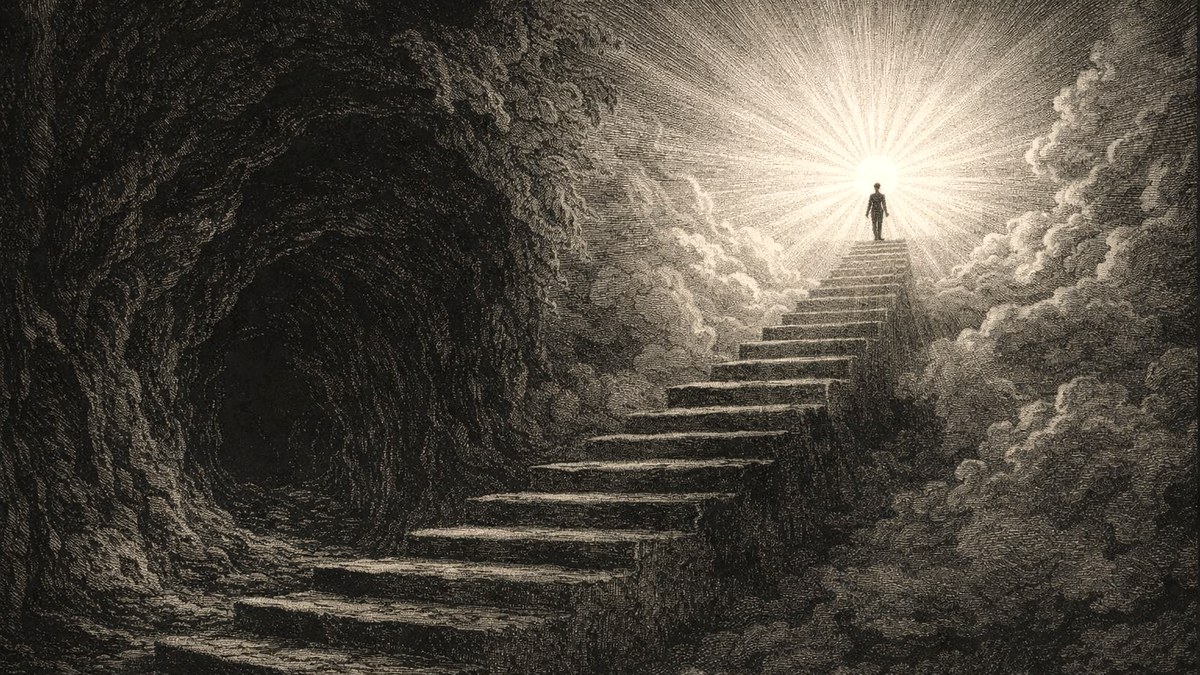
Meaning drains, guilt sharpens, and the ground gives way beneath a life once felt to be solid: inner dissolution is the price the soul pays for its own awakening.
By Roberto Assagioli
Doc. #23243–23244 | Archive: Assagioli Archives, Florence
Original title: Le crisi di crescenza spirituale
Translated and edited with notes by Jan Kuniholm [1]
Editorial Note
This article presents Roberto Assagioli’s early analysis of the stages and crises of spiritual development. Written prior to the formal systematization of psychosynthesis, as can be found in Spiritual Development and Nervous Diseases. The abstract, contextual subtitle and subheadings in this online edition have been added by the editor, Kenneth Sørensen, to support readability, navigation, and archival consistency. The original wording has not been altered. The translation, footnotes, and scholarly editorial commentary are by Jan Kuniholm, who has contributed contextual annotations throughout.
Abstract
Assagioli maps spiritual development through stages analogous to childhood, adolescence, and maturity, showing how each carries its own crisis. The first great turning point occurs when ordinary life loses its hold and the personality enters a period of inner dissolution: meaning drains away, guilt sharpens, and the foundations of identity crumble. If the soul surrenders rather than resists, an awakening follows, flooding consciousness with light and expansive purpose. For some, however, a second and deeper crisis arrives in the dark night of the soul, where even spiritual gifts are stripped away until nothing remains but naked being. Drawing on Christian mysticism and comparative tradition, Assagioli presents these crises not as illness but as necessary passages toward the unitive life and the sovereign freedom of the spirit.
1. Stages of Inner Development
If we consider even superficially the various human beings around us, we will soon realize that they are not equally developed from a psychological and spiritual point of view. It is easy to observe and note that some of them are still at a primitive and almost savage stage; others are a little more developed, others even more advanced, and finally some — a small number — have transcended normal humanity and are reaching the superhuman or spiritual stage.
We will not dwell on the possible causes of these differences; it is an interesting problem, but one that is beyond the scope of our subject. But whatever the causes, this diversity of inner development among human beings is useful, indeed necessary. It gives rise to various relationships between individuals, relationships of authority and obedience, of teaching and learning, of oppression and revolt, which constitute fruitful experiences. In a world where humanity were all at the same level, these vital actions and reactions would not exist; life would be simpler but also more monotonous, less interesting and stimulating; it would be boring, and much of its purpose would be lost.
For the study of the various stages of spiritual development, we can find a good guide in the principle of analogy, which the ancients held in high esteem and which moderns have too often neglected and overlooked. It is true that analogy easily gives rise to fanciful interpretations and arbitrary deductions, but when used with discrimination and appropriateness, it can provide the key to many secrets of nature and the soul. In our case, the use of this key is not difficult, and it is very enlightening.
2. Childhood and Primitive Consciousness
The analogy between the psychology of children and that of primitive individuals and peoples is evident and has often been noted. Children, like savages or primitive people, are simple, impulsive, curious, and easily distracted. They live only in the present, are sensitive and emotional, but their feelings, although intense at the moment, are not deep and are short-lived. They are not moral, because their sense of responsibility is not yet developed, and they are prone to unconscious cruelty; they tend to personify objects and natural forces. Their personality is rudimentary, and they do not perceive it as clearly separate from the surrounding world.
At a slightly more advanced stage, we find, on the one hand, older children and, on the other hand, souls of a corresponding inner age, who appear to us in their most typical aspects at the beginning of great civilizations. Think, for example, of the men of the early Vedic age in India, or those of the Homeric period in Greece, with their fresh sense of poetry and simplicity, their lively sense of childlike communion with nature, and their somewhat childish gods, who only very gradually rose from personifications of natural forces and human passions to become symbols of high spiritual principles.
Before proceeding with this analysis, it is worth remembering that in every age of the body and soul, as in every psychological type and every human manifestation, we must distinguish between the lower and higher aspects of the same principle or quality. Thus, in primitive souls we find lower qualities of harshness and violence, a certain barbarism, a primitive intelligence, a certain cunning and tendency to deceive, a candid selfishness, and little sensitivity to the suffering of others. Many of these characteristics can also be found, to a greater or lesser extent, in the Homeric heroes described in the Iliad. The higher aspects of this psychological age are described by poets when they celebrate the golden age: purity, innocence, naturalness, docility, devotion and obedience to the gods, or a childlike trust in God.
In our civilization, we do not find many souls of this type; we must look for them among faithful servants and devoted followers, and mostly among country people and mountain dwellers. These souls develop mainly through external activity, through which they gain experience, develop their minds, and acquire moral qualities such as patience, courage, perseverance, and self-sacrifice. The main ideal for them, their course of action, lies in devotion, loyalty, and obedience to the gods or to God, to their superiors, to moral and religious precepts, and to established laws.
3. The Titanic and Promethean Stage
But souls cannot, and must not, remain forever in this infantile stage. Their development is marked, as in adolescence, by a series of conflicts and contrasts. In the mental realm, critical reflection begins, giving rise to problems and doubts. The principles instilled in them and the dominant theories are no longer accepted without question; the mind demands their credentials, wants to know their origins, their foundations, their consistency with facts. On the emotional side, there is an intensification and complication of feelings, the emergence of new passions. On the active side, we find a vehement desire for independence, a fierce revolt against the “gods,” against all kinds of authority. This is the Titanic and Promethean stage. We also find an accentuation of self-consciousness and self-assertion, which often tends toward subjective introspection and is the main characteristic of the romantic attitude. This is a disharmonious and chaotic stage, painful and troubled for those who experience it, and uncomfortable and difficult to deal with for others.
The lower aspects of the soul at this age are excessive self-assertion, destructive impulses, anarchy, fanaticism, pride, intransigence, a tendency to go to extremes, intolerance, and a lack of respect and understanding for others. On the other hand, the higher aspects are idealism, a spirit of sacrifice for a cause, generosity, courage and boldness, an appreciation of beauty, a sense of honor, and in general all the qualities included in chivalrous attitude and conduct. The Dharma[2] of this age is the development of the mind and autonomous moral powers, the affirmation of self-awareness and spiritual independence, the study of life and the acquisition of broader experience, active dedication to a cause or ideal that is no longer accepted from outside but felt inwardly, and to which one adheres by a free act of will.
Many souls are currently at this stage, and some of the characteristics listed above are applicable to the mentality of the majority of our contemporaries. One need only recall the rapid dissolution of old traditions and forms, the restlessness, critical individualism, and rebellious attitude that now prevail.
4. The Adult Soul: Harmony and Crystallization
Let us now observe the characteristics of the adult soul. If we compare adult men and women with young people, we find that there has been a gradual decrease in vital exuberance and emotional effervescence, and a parallel increase in mental and rational faculties. The chaotic state, the rapid changes, the oscillations between extremes, have given way to a certain settling down: the personality has formed and consolidated.
This stage also has its lower and higher aspects. The former consist mainly of excessive limitation, hardening, and dryness. Contact with the harsh realities of life, struggles, disappointments, and failures destroy generous dreams, dampen enthusiasm, and severely test the individual’s faith. This can lead to a reaction of skepticism and discontent that can lead to cynicism. The development of the mind, which is a necessary tool, brings with it dangers such as excessive criticism and intellectual crystallization, which hinders and destroys the awareness of reality. Absorption in practical interests and personal duties easily leads to separateness and undue assertion of the personal self and selfishness. The higher aspects of this psychological age can be summarized in three words: Harmony, Balance, and Efficiency. During this period, the soul is capable of achieving balance between Spirit and form. The personality is formed and perfected, and becomes a well-formed, constructed, and resilient instrument of expression for the soul, but still sufficiently flexible. It is then ready to implement the will of the Spirit in the world.
This age, while appearing more static and free from tumultuous crises, is nevertheless spiritually the critical age, the point of separation of paths, the point that decides the future of the soul. If the process of hardening and crystallization proceeds unchallenged, and form increasingly prevails over the vital and spiritual side, old age inevitably sets in with its negative aspects of ossification, weakening, egocentrism, and gradual segregation from the surrounding life. And if this process is not interrupted by the intervention of some balancing influence, it can lead to extreme unresponsiveness and extreme selfish isolation, culminating in spiritual death, just as senility ends in physical death.
5. The Crisis of Spiritual Rejuvenation
Fortunately, other factors often intervene to halt the downward slide of the personality and gently and gradually turn it toward the upward path, freeing it from the illusions and attachments of “normal” life and putting it in touch with its spirit. When this happens, a strange phenomenon can be observed: that is, strange when viewed from the ordinary point of view. Namely, the emergence of a new inner youth, whose best qualities are added to those of mature age without replacing them. There is an interesting physical correspondence to this fact. In some cases of robust men over 80 years of age, the beginning of a third set of teeth has been observed, which is a very partial but significant attempt by nature toward physical rejuvenation. In such cases, this remains only a small beginning, because there is no corresponding psychological and spiritual rejuvenation to support it.
In other cases, there is an attempt at emotional rejuvenation. The best-known example is that of Wolfgang Goethe, who fell in love with a young German girl at the age of 84. This happened while he was in full possession of his mental faculties, and should not be considered, as is often thought at first glance, as a sign of senility; on the contrary, it was a true feeling of an idealistic and youthful character, which found expression in exquisite poetry. But even these flames, flared up by an old fire, quickly die out, because they are not fed by anything lasting. In the case of spiritual rejuvenation, however, it is something very profound and spiritual, something fundamental, which is produced by the connection, so to speak, of the personality with its inner spirit, from which a powerful influx of spiritual energy, light, and love pours forth, enlivening and transforming it.
After this brief overview of the stages of inner growth, we think it is appropriate to consider a little more closely the two most important and decisive crises, the one just mentioned, which precedes and determines inner rejuvenation, and another, dark and mysterious one, which occurs at a later stage and corresponds to what mystics call the “dark night of the soul.” In order to fully understand the meaning of the unique inner experiences that usually precede the awakening of the soul, it is necessary to recall some psychological characteristics of the ordinary man.
6. The Awakening of the Soul
Rather than living, one could say that the ordinary man lets himself live. He takes life as it comes and does not ask himself about its meaning, value, or purpose. If he is vulgar, he is concerned only with satisfying his personal desires: with obtaining various sensual pleasures, becoming rich, and satisfying his ambition. If he is of a higher disposition, he subordinates his personal satisfactions to the fulfillment of the various family and civil duties that have been inculcated in him, without worrying about the basis on which they are founded or their true hierarchy. He may even declare himself religious and believe in God, but his religion is external and conventional, and he feels at peace when he has obeyed the precepts of his church and participated in various rituals. In short, the common man believes in the implicitly absolute reality of ordinary life and is tenaciously attached to earthly goods, to which he attributes a positive value. He thus considers life to be an end in itself, and even if he believes in a future paradise, his belief is entirely theoretical and academic, as is evident from the fact — often confessed with comical naiveté — that he wishes to go there . . . as late as possible!
7. The Crisis of Meaning and Dissolution
But it can happen, and in fact does happen in some cases, that the ordinary man is surprised and disturbed by a sudden change in his inner life. Sometimes, following a series of disappointments, often after a strong moral shock, such as the loss of a loved one, sometimes for no apparent reason, in the midst of complete well-being and good fortune, a vague uneasiness arises, a sense of dissatisfaction and lack; but not the lack of something concrete, rather something vague and elusive that he cannot define. Little by little, a sense of unreality and vanity of ordinary life is added; all the personal interests that previously occupied and preoccupied him ‘fade’, so to speak, losing their importance and value. New problems arise; the person begins to wonder about the meaning of life, the reason for so many things that he previously accepted as natural; the reason for his own suffering and that of others, the justification for so much inequality of fortune, the origin of human existence, its end.
And here misunderstandings and errors begin. Many people, not understanding the meaning of these new states of mind, consider them whims, normal fantasies in a negative sense, and, suffering from them (since they are very painful), they fight them in every way; fearing they will lose their minds, they strive to cling to the ordinary reality that threatens to escape them. Indeed, sometimes, as a reaction, they throw themselves into [ordinary life] with greater fervor, seeking new occupations, new sensations, and new stimuli. By these and other means, they sometimes succeed in stifling their restlessness for the moment, but they can almost never destroy it completely: it continues to smolder deep within their being, undermining the foundations of their ordinary existence and, after years it can erupt more intensely. The state of agitation becomes increasingly painful, the inner emptiness more intolerable. The person feels annihilated, everything that seemed to constitute their life appears to them to be a dream, disappearing like a larva [into a cocoon], while the new light has not yet dawned; indeed, the person is generally unaware of its existence or does not believe it is possible to attain it. This general torment is often accompanied by a more definite crisis: the ethical conscience awakens and becomes more acute, the person is assailed by a great sense of guilt and remorse for the evil they have done, they judge themselves severely and are seized by deep discouragement. At this point, thoughts of suicide often arise; physical annihilation seems to the person to be the only logical consequence of their inner collapse and dissolution.
I must point out that what I have said is only a general outline of such experiences and their development. In reality, there are numerous individual differences. Some do not reach the most acute stage, others arrive there almost suddenly; in some, philosophical searching and doubts prevail, while in others the moral crisis is at the forefront. And not infrequently, this profound upheaval gives rise to various nervous and psychic disorders.
8. The Meaning of Spiritual Crisis
What is the meaning of this crisis? It is caused by the fact that spiritual consciousness, that is, the sense of the eternal and the transcendent, before revealing itself in its positive aspect of enlightenment and expansion, makes itself felt in a negative way. In other words, it makes us feel that every particular thing, even good things, when considered and loved for itself and apart from the rest — as it usually is — is ephemeral and vain. It makes us feel that nothing limited has any value in itself, that every separative and antagonistic assertion of our personal self is wrong and doomed to failure: not because it violates external and arbitrary norms and codes, but because it is contrary to the very nature of spiritual reality. But the blind and ignorant soul is afraid to abandon itself, it does not want to let go of the props that support it, the attachments to things and people it fears losing, and therefore it resists the invitations and commands of the spirit as much as it can, until, having reached the limit of its resistance, it is forced to surrender. Then, instead of the feared annihilation, it rediscovers with joyful wonder a new, vaster and higher life, and is flooded with light and joy. The world itself appears transfigured, and behind the changing appearances it feels the powerful rhythm of supreme unity pulsating in things and beings.
9. The Period of Illumination and Expansion
This strange and bitter struggle between the soul and the Spirit has been admirably described by two contemporary poets: Francesco Chiesa[3] in his poem La Voce, contained in the collection I viali d’oro,[4] and Francis Thompson[5] in his poem The Hound of Heaven.[6] The awakening of the soul is usually followed by a period of joyful inner and outer expansion, which takes different forms in different cases. Sometimes the mystical and illuminating aspect prevails; at other times, new energies are released into action, into impersonal and heroic action, into an apostolate of good, or into artistic creativity. This period can last a long time, even a lifetime.
10. The Dark Night of the Soul
In other cases, however, things do not unfold in such a simple and favorable way. Sometimes the personality is unprepared or unintegrated and cannot withstand the force of the spiritual influx, and reacts to it in a disharmonious and morbid way. This produces the exaltations, imbalances, and fanaticism that are observed in various spurious mystics and supposedly “enlightened” individuals, which have discredited them in the eyes of the public, which is unable or unwilling to distinguish the true mystics and enlightened individuals from the former, who are nothing but caricatures and counterfeits.
In other cases, after a period of light, joy, and fruitful activity, the struggle begins again. The ordinary personality had only been temporarily dominated by the new spiritual consciousness and had not been permanently transformed. The “old Adam”[7] resurfaces with his habits, tendencies, and passions, and the soul realizes that a long, complex, and arduous work of purification and transformation of the human elements is still necessary. In some cases, this work is imposed harshly and inexorably by the Spirit itself. Thus, the soul is forced to enter that “dark night” that was experienced — and described — by St. Teresa,[8] St. John of the Cross,[9] Madame Guyon,[10] and many other mystics. It is an inner state of suffering and deprivation similar to that which precedes the awakening of the soul, but, so to speak, raised to a higher octave: that is, deeper, more complete, and more radical.
11. The Mystical Process of Stripping and Annihilation
I will indicate its nature and meaning according to Christian tradition, summarizing the lucid exposition contained in the booklet L’Amour Divin: La Vie Intérieure Simplifiée et Réduite à con Principe Fondamental (English translation – The Interior Life: Simplified and Reduced to Its Fundamental Principle), published by Fr. Joseph Tissot,[11] a booklet that is perhaps the best modern exposition of the interior discipline of Catholicism without narrow-mindedness or sentimentality:
“God alone is God; his gifts are not Him, they are only the instruments of His operations . . . they must be only the means by which He enters, and if they remain in the soul, they take the place of God. According to the analogy of St. Francis de Sales, as long as the needle remains in the fabric, the thread cannot penetrate it; the needle only passes through the fabric to allow the thread to penetrate. So God’s gifts must simply pass through the soul to allow God to enter. Consequently, each gift must be annihilated in order to make room for a higher gift.
“The first gifts with which God begins his operations in the soul are usually consolations, which are intended to conquer the lower part of the soul, the sensitive part, to detach it from creatures and attach it to God. Once this effect has been achieved, consolations disappear so that the soul does not become attached to them, for they are not God, and if the soul becomes attached to them, all the work of divine life stops. Therefore, consolations must disappear under the blows of dryness, which comes to annihilate God’s gifts. When dryness has accomplished its work, that is, when it has sufficiently stripped the soul of all attachment to consolations, God sends a higher gift, which is the light destined to conquer the intellect, detach it from the sight of creation and give it the sight of God. The soul then has profound insights into the mysteries of faith.
“When the soul’s intelligence is firmly established in faith and detached from creation, the lights are destroyed and darkness follows, which is a new stripping away; the darkness that destroyed the lights is followed by great desires, burning ardor whose mission is to conquer the will for God. Under their influence, the soul is consumed by the need for God’s glory. Once their work is done, these ardors are destroyed in disgust and impotence. With the previous gifts, God has successively acted on the senses, the intellect, and the will; He has detached them from creation and attached them to Himself . . . now He will shake and break these powers (for they are well detached) in order to test his solidity, and He will again take up the foundation and His work in order to complete it. For these powers are indeed detached from creation, but they are not yet detached from themselves. They still retain deep traces of the sight, love, and search for God outside themselves, and it is necessary that the falsehood, vanity, and slavery of this selfishness disappear completely for piety to reach its full fulfillment. God will take care of this.
“He begins by stirring up the lower part with frightening temptations of impurity, anger, and all manner of things; everything is upset in the passions. After that, God goes further and devastates the intellect and the will with darkness, boredom, and internal oppression; the soul finds no peace anywhere. The work of annihilation goes even further. God now takes away from the soul the active power; that is, the faculty of acting that it had preserved through the previous storms. At this moment, it is totally powerless to act; it has only one power: that of suffering and receiving. But even this power, that is, a passive virtue, will be taken away from it. The poor annihilated soul can do nothing, absolutely nothing. Everything is taken away from it, everything is destroyed, everything is annihilated. Nothing comes from it, it produces nothing from its depths: neither a thought nor a feeling nor an action. It has no human movement left, no purely natural life; it is mystical death: everything is consumed. At this moment, every obstacle to God’s full entry has disappeared, and He enters and takes possession of this soul through mystical marriage, which brings about the state of unity.”[12]
A similar stage and experience, at least in certain respects, but considered from a voluntary and active point of view, is described in Hermetic, initiatory, and alchemical traditions as a trial by fire and as washing in water.
12. Acceptance, Love, and Cooperation with the Spirit
Understanding the nature and function of this trial can make it less harsh and less long; instead of undergoing it by force, one can cooperate willingly and intelligently in its action, accepting and not trying to reject the terrible and magnificent gift it wants to give us. Such cooperation can be summed up in two words: Acceptance and Love. Accept generously and comprehensively all those sufferings, that stripping away and that annihilation. Even more: to love it, to want to abandon everything and consist in pure being, in complete inner nakedness. It is a less obvious heroism, but far more arduous and higher than those manifested by external acts, which are understood and admired by the crowds; and the achievements to which it leads are far more precious. Thus we arrive at what has been called “the holy freedom of the children of God,” the unitive life.
13. The Unitive Life and Spiritual Freedom
St. John of the Cross boldly states that those who have attained it “seem to be God himself and have the same properties as Him.” It is the state of victory and liberation that Easterners call Moksha and Nirvana. In it, every desire, every personal craving is consumed, every attachment “burned,” every fear vanished. The Spirit thus freed acquires a subtle and formidable power: it is capable of Wu-Wei, action without action, which nothing can resist.
14. Spiritual Crisis in Modern Civilization
With these brief remarks, I have tried to give an overview (to use the expression now in vogue) or rather a perspective of the stages and crises of spiritual development. At first glance, it may seem that I have led you into a world very different from the one that thrives and pulsates around us, far from the noise of cars, the whistling of factory sirens, dances and theaters, and nagging economic problems; but this distance is less than one might think. What we ordinarily see of modern life is only the façade; but behind it lies the life of souls in turmoil. Behind the turmoil and external struggles, there are silent clashes and bitter conflicts of psychic and spiritual forces. Behind the painted masks writhing to the sound of jazz, behind the men in evening suits guzzling cocktails, behind those gambling in the gaming halls or snorting cocaine, who can say how many tormented souls there are trying to escape the pursuit of the heavenly hound?[13] And in clinics and asylums, behind the figures motionless with exhaustion, mute with despair, or screaming wildly in their unbearable pain, who can say how many souls there are who, misunderstood and ignored, are going through terrible trials of inner dissolution, of spiritual darkness? How many fatal mistakes, how many painful and unnecessary conflicts and complications could be avoided if these souls understood themselves and were understood?
Therefore, talking about spiritual crises in our day, far from being an untimely, academic discussion, or a topic for the curious, is a response to an urgent need and is a clear duty for those who have even a little experience and knowledge of them. We must forcefully tell this to humanity, which is entirely focused on seeking well-being and satisfaction outside itself, thirsty for pleasure and power — that all conquests over nature, all domination of matter, all mechanical intensity and speed, can have instrumental value and symbolic meaning at most, but that only through the awakening of the deep soul, only with the acknowledged and realized sovereignty of the spirit, can man acquire that primary power, that secure peace, and that divine freedom which are his supreme and unconscious aspiration.
Notes:
[1] The original is an undated typed manuscript. Editor’s interpolations are shown in [brackets].
[2] Assagioli appears to use the term dharma as meaning an individual’s inner duty or the course of unfoldment of one’s nature. —Ed.
[3] Francesco Chiesa (1871-1973) was an Italian-speaking Swiss poet and short story writer. —Ed.
[4] I Viali d’oro [The Golden Avenues] was published in Switzerland in 1911.—Ed.
[5] Francis Thompson (1859-1907) was an English writer and poet. —Ed.
[6] This is Thompson’s most well-known poem, first published in 1890. —Ed.
[7] “The old Adam” was a phrase most used in Christian teaching, first used by Martin Luther to refer to people who were spiritually unregenerate or untransformed. —Ed.
[8] St. Teresa of Avila (1515-1582) was a Carmelite nun and prominent Spanish mystic and reformer. Her autobiography and other spiritual writings a concerned with spiritual ascent and mystic experiences. —Ed.
[9] St. John of the Cross (1542-1591) was a Spanish priest and mystic, author of Dark Night of the Soul and other works. —Ed.
[10] Jeanne Guyon, commonly known as Madame Guyon (1648-1717) was a French Christian whose spiritual and mystical writings were condemned as heretical by the Roman Catholic Church, which had her imprisoned. Her writings were disseminated and became influential in many spiritual circles. —Ed.
[11] First published in 1913 in French. Fr. Tissot (1840-1894) was a French priest and member of the Society of St. Francis de Sales. —Ed.
[12] Selections from Chapter IV, Book II, translated from Assagioli’s version in Italian. —Ed.
[13] This is a reference to the poem by Francis Thompson, op.cit.
