

Seven criteria of psychosynthetic therapy, set down in a lecture manuscript: the body counted in, energy put to work, the superconscious invited, and often the patient trained out of therapy.
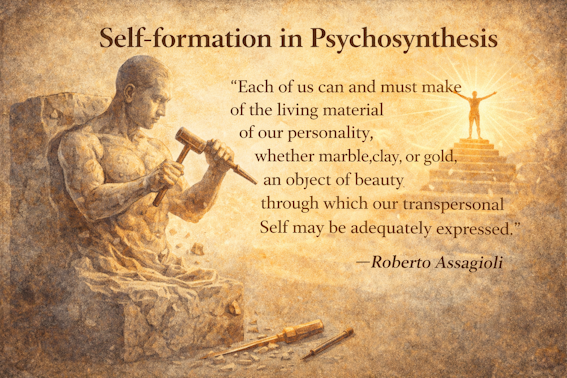
By Roberto Assagioli
Docs. #23763, #23764, #23765 | Archive: Assagioli Archive, Florence
Original title: Principi informatori e risultati della terapia psicosintetica
Lecture manuscript, (post-1966)
Translated and edited with notes by Jan Kuniholm
Editorial Note
The abstract and contextual subtitle, in this online edition have been added by the editor, Kenneth Sørensen, for clarity and navigation. Jan Kuniholm’s editorial notes on the dating of the manuscript and on the archival sources have been preserved as part of this edition. The manuscript was written after 1966 and reflects perspectives of its time. The text is presented here as historical material supporting the study of the tradition’s line of thought.
Abstract
In this lecture, Assagioli lists what makes psychosynthetic therapy its own thing. Seven criteria follow: the body brought into the integration through relaxation, autogenic training, movement and sport; all available energy put to constructive use, transformed and sublimated where needed; the superconscious deliberately invited; the Self realised as the centre that lives and wills; a therapeutic relationship wider than transference; the patient’s own active cooperation; and social life harmonised. A second part reports what came of it, from psychosomatic and phobic symptoms clearing to a changed attitude toward life.
PRINCIPLES
The criteria that characterize psychosynthetic therapy and distinguish it, in a certain way, from other psychological and psychotherapeutic concepts are implicit in the previous general exposition and can be easily recognized. They also stand out clearly from the comparison between psychosynthetic therapy and Jungian therapy presented in the lectures on Jung and Psychosynthesis. (see the first three lectures of the 1966 Course) [2]
Therefore, I will limit myself to highlighting the following points:
1° – Inclusion of the body in the integration of personality. (Bio-psychosynthesis).
Psychosomatic medicine has provided and continues to provide increasingly ample evidence of the constant interaction between biological and psychological conditions and factors. Therefore, a synthetic therapy must include the use of a number of psycho-physical techniques, such as:
- Relaxation
- Autogenic Training
- Neuromuscular training and coordination through gymnastic exercises
- Rhythmic movements (dance)
- Free (spontaneous) movements
- Sports and games, both in groups and individually, etc.
2° – Utilization of all the energies of the individual, both those already active and those that are gradually released during the course of treatment. Their constructive use can be achieved through direct expression, but more often it is necessary to transform and sublimate them. In psychosynthetic therapy, specific techniques are used for this purpose.
3° – Encouraging and promoting, through appropriate procedures, the awakening or assimilation of transpersonal superconscious energies (“peak experiences”).
4° – Self-realization, or, more precisely, realization of the Self, understood as the individual center that lives and wills, and of its relationship with the trans-individual and universal Self. This can be considered as development along a new dimension of awareness or being. Psychosynthesis has exercises that have proven to be very effective for this purpose. (Disidentification and Self-Identification Exercise, Rose Exercise, etc.).
5° – Interpersonal relationships between therapist and patient.
In psychosynthetic therapy, these are not limited to transference (in the strict sense) and its elimination, but include:
- The specific relationship created by the “therapeutic situation,” in which the therapist assumes the “paternal” role, and that of advisor and guide.
- More general and positive human relationships, which gradually derive from the previous ones, as the patient assumes a more mature and independent attitude and position in life.
6° – Maximum cooperation of the patient with the caregiver, through the use of various techniques and active exercises. In many cases, this allows the patient to complete the treatment on their own, with gradually decreasing control by the therapist, until the therapist is no longer needed.
7° – Helping the patient to harmonize and extend their social and interpersonal relationships, and to integrate into the various groups and communities that form the organism of humanity. This is a necessary but very difficult task, due to the current chaotic and unhealthy condition of humanity. Now, simply conforming to a defined social life is impossible and involves the repression of some of the individual’s most genuine needs and tendencies. Psychosynthetic therapy takes this conflict between the individual and society into account and sets itself the goal of establishing the best possible relationship, given the current circumstances.
These same criteria that characterize the psychosynthetic therapeutic process can be and are applied in psychosynthesis:
a) In education, promoting the development of every potential of the individual, not only in childhood and early youth, but also throughout their life, adding to the positive qualities of each successive stage those of the following stage (psychosynthesis of the ages).
Psychosynthesis also emphasizes the value, indeed the duty, of identifying and educating gifted and talented children and young people. Some of its techniques are particularly suited to this purpose.
b) In the social life of the community, promoting, by appropriate means, the formation and development of new and better ways of human living (Maslow’s The Good Society), new forms of civilization and culture.
Therapeutic Outcomes and Existential Transformation
RESULTS
It is not surprising that psychosynthetic therapy, with its “openness,” the great variety of its techniques, and its response to the actual existential needs of the individual — seen in the light of a being in continuous development and becoming — yields positive and often very satisfactory results.
To give an accurate picture of these results, it would be necessary to provide complete clinical histories of some cases, but here I will limit myself to briefly mentioning the most salient results.
In many cases, the main and fundamental result has been “existential,” in the sense that a completely different attitude toward life and toward oneself has developed.
The patient has moved:
- From rebellion to internal acceptance, as the basis for subsequent constructive action.
- From doubt, denial, and lack of understanding to the recognition of a positive meaning in life and adherence to it.
- From immobility or regression to gradual and continuous development.
- From slavery within a “vicious circle” to spiral ascent and expression.
- From fixity and emotional attachments to free and radiant love.
- From mental limitations and barriers to a broader vision or intuitive perception of reality.
- In some cases, there has been a shift from a “normal” or average level of consciousness to supernormal realizations and “peak experiences.”
Some of the specific therapeutic results have been:
- The elimination of psychosomatic dysfunctions of the digestive and circulatory systems, the healing of psychic impotence, etc.
- Freedom from phobias and obsessive ideas of various kinds (agoraphobia); fear of exams and public speaking; fear of illness (nosophobia) and death.
- Healing of homosexuality. [3] [4]
These results were achieved within the framework of, or as an effect of, general psychosynthetic treatment aimed at the integration, maturation, and development of the patient’s personality.
…
[1] While this typed manuscript was undated, it is clearly given as a lecture after 1966, as indicated in the first paragraph of this article. —Ed.
[2] The lectures on “Jung and Psychosynthesis” can be found online at https://kennethsorensen.dk/en/c-g-jung-and-psychosynthesis/ —Ed.
[3] There is at least one documentation of Assagioli’s use of psychosynthesis therapy to accomplish the “full sexual normalization” of a young man described as homosexual, whom he described as having suffered from “psychosexual trauma” by being “corrupted by a tutor.” See Assagioli Archives Doc. #20846 (hand-written notes in Italian). There is evidence that Assagioli continued to the end of his life to regard homosexuality, or what he called “sexual inversion,” as an issue that for some people would be a matter of psychotherapeutic activity. See also Assagioli, Psychosynthesis of the Couple, Cheshire Cat Books, 2022. —Ed.
[4] Assagioli’s inclusion of “healing of homosexuality” among the positive results of psychosynthetic therapy reflects the prevailing psychiatric consensus of his era rather than an aberration from it. When the American Psychiatric Association published the first edition of the Diagnostic and Statistical Manual of Mental Disorders (DSM-I) in 1952, homosexuality was classified as a “sociopathic personality disturbance”; the DSM-II of 1968 retained it as a “sexual deviation.” Wikipedia This classification meant that, within the mainstream framework of psychiatry through the 1960s and into the early 1970s, therapeutic interventions aimed at changing sexual orientation were considered legitimate clinical practice. The intellectual roots of this position ran from the 19th-century German psychiatrist Richard Krafft-Ebing, who viewed homosexuality as a “degenerative” disorder, through Sigmund Freud, who framed it as arrested psychosexual development, to mid-century psychoanalytic orthodoxy. Psychiatric News This manuscript postdates 1966 but was almost certainly composed before the decisive shift in professional consensus: in 1973, the APA removed the diagnosis of “homosexuality” from the DSM, following an internal deliberative process that weighed competing theories — those that pathologized homosexuality and those that viewed it as a normal variation of human development. PubMed Central. Even after that decision, homosexuality was not immediately depathologized in full: the DSM-III of 1980 introduced “Ego-Dystonic Homosexuality,” and it was only with the DSM-III-R of 1987 that any reference to homosexuality as a disorder was removed entirely. Namisb Assagioli’s view is therefore best understood as a product of the psychiatric culture in which he was trained and practised — one that has since been comprehensively revised. KS—Pub.
