

Inter-individual psychosynthesis: man and woman, the four types of couple, and education in the family – Assagioli at the Valmy conference of the Psychosynthesis Research Foundation

By Roberto Assagioli, M.D.
Source: transcript of the conference of the Psychosynthesis Research Foundation, Valmy Estate, Greenville, Delaware, 23–25 May 1958
Editorial Note
The abstract and contextual subtitle in this online edition have been added by the editor, Kenneth Sørensen, to support readability, navigation, and archival consistency. Obvious transcription errors have been corrected; the original wording has otherwise not been altered. This text belongs to a series of Assagioli’s talks and lectures on the psychosynthesis of the couple (1957–1972), edited by Jan Kuniholm and Catherine Ann Lombard.
Abstract
In this talk at the 1958 conference of the Psychosynthesis Research Foundation at Valmy, Roberto Assagioli outlines inter-individual psychosynthesis, beginning with the typological polarities of man and woman on the physical, emotional, mental and intuitive levels. With four diagrams he shows the four possible types of couple: a relationship on the lower level only, a purely “platonic” relationship, a satisfactory normal synthesis, and a developed psychosynthesis that reaches beyond the couple into common tasks and a shared spiritual life. He then turns to the family: the harm done by parental quarrels and rivalry for the child, the united front of the parents, respect for the child as a budding personality and not a possession, and the study of psychology by every parent and in every school. Children need both horizontal relations with their peers and vertical relations with adults, and should contribute to the life of the family as a small community. Assagioli ends with the wider questions of nation, society and humanity.
Let us start with the fundamental polarities of man and woman. There is a fundamental typological difference between man and woman. There are all possible differentiations and differences, type percentages and so on. I have illustrated this in a diagram.
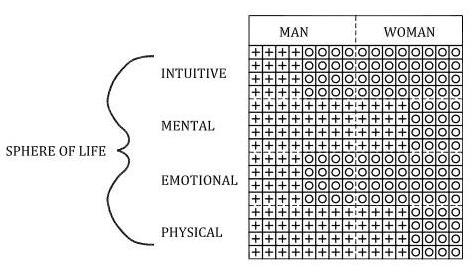
In the average, normal man of the active, sensation type, man is more actively functioning on the physical plane. He is the doer, he is extravert and active and predominantly functioning on the physical plane.
Woman is less so; she also functions on the physical plane, of course, but is more passive, receptive, elaborating. Man is more impulsive biologically and intends to conquer the outer world; woman, to preserve life. On the emotional and feeling level her functions are much more developed and often refined; man is less developed and often a crude individual on the emotional plane. On the mental level, the thinking function is more developed in man; and on the intuitional level woman, as a percentage, is more developed both actively and passively than man.
This well known fact we have to keep well in mind for the psychosynthesis of the couple. In reality, matters are not simple, because all the reactions and other compensations—for instance, the feminist movement has been a reaction and over-compensation to these excessive differentiations. Woman has felt rightly the need to enter more actively into the physical world and to develop her mental apparatus, and that for her is right and good. Only, as all revolutions and reactions, often they go to extremes. So, this balance between man and woman is the most intimate and personal problem and one of the widest social problems at the same time.
There are some prerequisites in the psychosynthesis of the couple and the first is, I think, the acceptance of their respective roles, and the mutual respect and appreciation of those respective roles, which go hand in hand—easily said, but very difficult to accomplish; but it is a pre-requisite for the psychosynthesis of the couple. Here, in this diagram, I have indicated the possible situations in the man-woman relationship.
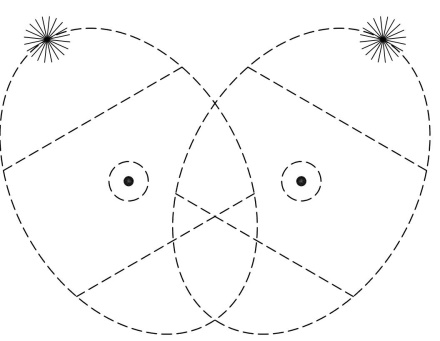
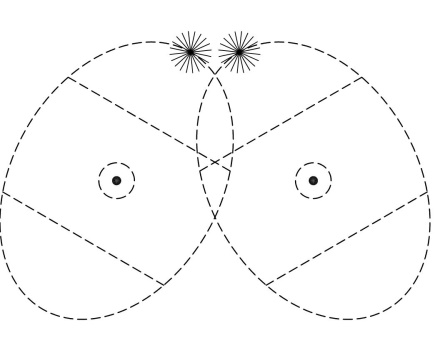
1. Relation at a lower level (e.g. sexual attraction). 2. “Beatrice” relationship: platonic, unreal, on higher level only.
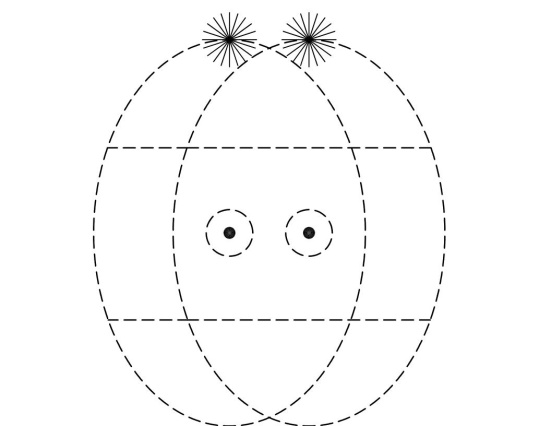
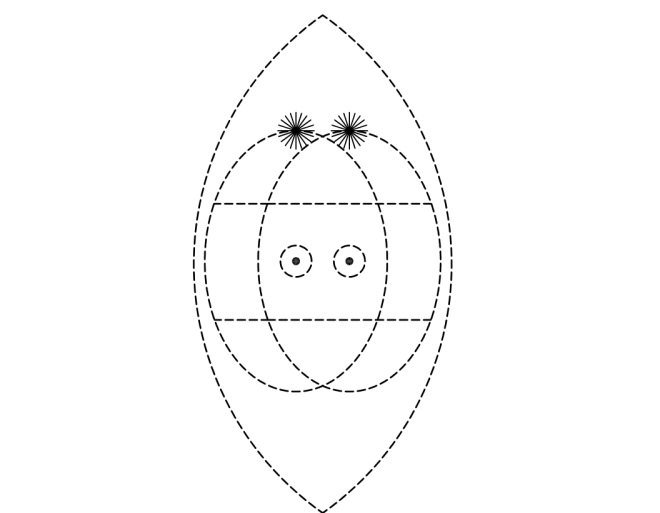
3. Satisfactory normal synthesis of the couple. 4. Developed psychosynthesis of the couple.
Here [in diagram #1], we have the unfortunately frequent situation in which there is very partial synthesis—it does not really deserve the name of synthesis, but is really relationship and passion blending on the lower level. That is a typical case of purely sexual attraction which attracts the lower part of both with no participation of the self, just the physical relationships, fleeting or more or less lasting.
The second diagram shows the opposite. It could be called “platonic” love, in which there is a relationship on the higher level, but it is a false relationship, with suppression of the other relationships on other levels and with no real human participation, only a mutual aspiring to the higher which cannot last because it is only natural in the good sense of the word.
Here, we have the [third] diagram of the satisfactory normal synthesis of the couple—not complete, but fairly advanced. Here there is the participation of each self partially in the life of the other. There is an amount of physical blending, a great amount of emotional and mental blending, a certain amount of higher—let us call it spiritual—blending. So here we have a good example of psychosynthesis of the couple with partial blending; each is not lost in the other, each retains his and her individuality but participates consciously in the life of the other.
And in [diagram] #4, we have a much more developed psychosynthesis of the couple, harmonious on all levels, more or less equal on all levels, but it goes beyond the couple. The relationships are the same as in the [third] diagram, but here the prolongation goes below—below in the good sense— and above with a common public task in the education of children. In the life of the couple there is a common life in the world, and beyond the personal relationship there is a common spiritual life actively which can be religious, humanitarian or that kind. So that is beyond the couple; the couple is not lost in itself, but is in contact with other human beings and all their activities. This marks a step from the first psychosynthesis of the couple to the synthesis of groups.
The next type of problem is what we call the psychosynthesis of the family group—in the simplest way, that of parents and children. This brings in the question of education in the family, education by the parents. We know that most neuroses, psycho-neuroses, nervous troubles, come from the clash between the parents in the presence of the children—often in the physical presence of the children. In this “stone age” there are so many husbands and wives who quarrel in the presence of their children without any realization of what they do. They pretend and believe that they love their children, yet they inflict on them actual psychological wounds just as if they made them with a knife. Even cultured, intelligent people of the so-called higher classes do just that.
If only we were not so grossly anti-sociological and anti-human! Also, latent strife can be just as bad as open conflict, especially the kind where the parents tries to attract the child onto his or her side. This is often more or less subconscious, but it is disastrous. This kind of rivalry of parents often leads to over-indulgence of the child so as to win it to one side; and that is another blasphemy of love—they say they love the child so much; really they want to possess it, not love it. Well, there are very gross things but they are very, very common; so that the first thing in the psychosynthesis of the family is to eliminate this most obvious of educational sins.
Then comes the positive side of education—the right relation between parents and children. The first is the united front of the parents to the children. It seems an obvious concept, but it is very, very seldom practiced; but that is a pre-requisite for constructive education. Then, as I mentioned, the elimination of the personal complexes of both father and mother, and not their projection on to the children. Then the positive side of recognizing the child as a budding, human personality with its own rights. Any conscious or unconscious possession— “my child,” “my son”—is wrong. They are not ours. They are in our care . . . They are the future adults, the future human beings. The real sublimation of motherly love should start with the renunciation of possessive love. So an attitude of respect and wonder towards the child is what needs to be developed. But what seems theoretically obvious is a difficult thing to practice and is least often practiced. To say that it is “old and banal” is only an escape mechanism for not practicing it.
Then comes psychology: every parent—every cultured parent—not in an academic sense, but in the sense of the cultured society—has the duty of studying psychology—general psychology and child psychology. Psychology is not one of the various sciences; it is the science of human nature and, as we are all more or less human, psychology is as necessary as writing, spelling and arithmetic. It is not one of the sciences, but the fundamental science of human nature. And in psychology we are at the stage about equal to the pre-physical hygiene period—when microbes were not known and infection was unknown and a great number of children and mothers died of puerperal infection and so on. In psychology we are at that ‘stone age’ period—uncivilized.
So psychology should be entering the curriculum of every secondary school, and the preparation for parenthood should be the chief subject, or one of the chief subjects. Then, in adolescence, the child should be prepared for the essential elements of the science of human nature; and I think that in the coming civilization it will not only be recognized theoretically, but put into practice. So here we have a revolution in education—to give the central place to psychology, which it deserves. And here is love. If we love our children we have to take the trouble to study human nature, and child psychology and the stages of child development, in order not to make the gross mistakes which we do now.
Mr. Dawson: Why begin with secondary schools?
Dr. Assagioli: Well, I do not know, we call “secondary schools” any of those following after the elementary schools, covering children from eleven to eighteen. That is, of course, in Europe. That is a blanket expression covering the period from the elementary schools to the universities, but over here there are differences, so let us say “at the adolescent stage” they should study psychology.
Mr. Dawson: Why not begin prior to the adolescent stage?
Dr. Assagioli: I am all for it.
Mr. Dawson: Good. It is all in the record now that you are all for it.
Dr. Assagioli: I am all for it, but I believe as a first step I would be satisfied if it began at the adolescent stage. Also because then there is a spontaneous interest. Dewey, the ghost of Dewey, would be satisfied, because the adolescent with his own troubles has an acute realization of the need for psychology. So that the moment to give it to him or to her corresponds with a vital need; and if we can be true to that, why not?
So the parents would be psychologists up to a certain point, of practical need in the education of their children. Then comes what I have already hinted at: the psychological inter-communication between children and parents, their confidence, their appreciation of their inner life, that communion which is the requisite of a real psychosynthesis between parents and children. It could be called, in a sense, a special kind of friendship; it has some characteristics of “friendship.” In my own case, I consciously put it on that basis with my son and it worked very well. And I do not think it is difficult, because it is a natural condition, but that does not mean equality—let us remember that. It is not a becoming childish on the part of the parents, which is a mistaken conception of intimacy. The child does not want that.
A principle of education is what we could call cross-relationships. The child has two vital needs: the horizontal relationship with children of approximately his or her age, and the vertical relationship with adults. Both are vitally needed in his growth and his development. He needs the interplay with children of his own age, and this is the problem—the tragedy—of the only son with an over-possessive mother. How many of my patients are the only sons or daughters of possessive mothers!
We do not realize this vital need, we do not realize the artificial, the cruel situation of a child always with adults. An analogy will give us an idea. Let us take an adult of, say thirty or forty years who would be obliged to live alone with nonagenarians, with very, very old people. It would be oppressive and unbearable; but the difference is much greater between a child and a young adult than between an adult and a nonagenarian. So this is really the beginning of a neurosis, to keep a child only with adults. But the opposite, to be all the time only with equals, with children, it is just as bad—not just as bad, but pretty bad. The child needs the adult as the “ideal model,” to be gradually introjected. The child needs the living example of adults, mature behavior—that is, if the adult behaves that way! So, he—the child—needs the two, and of that we have to be conscious as much as possible—right proportion, and companionship of equals and of parents. There are tensions in both categories, but they are necessary experiences through which the child grows and becomes adjusted. So there are the fundamental lines of the psychosynthesis of the family.
Then there are another point, the family as a group entity, as a little collectivity. And here comes the active cooperation of the child in the family life. The sentimental conception that we owe all to the child and the child owes nothing to us is also mistaken. While we are not to be possessive of the child, it is bad for the child to receive everything and to give nothing. One, I think, of the chief reasons of the present bad situation with wild children, which is so acute, is that they have been accustomed to receive too much and are not accustomed to giving back. The normal situation is to give and to take; the child has to contribute to family life. And, handled in the right way, children love to do it, they grow, they feel important, they feel useful, they get encouragement and praise, but they must contribute to the ménage, to the household. And that creates the community, the small social community. There are many ways to do that; the intuition of the mother and the mind of the father, both can find all sorts of ways and adjustments. But the child has to experience in the small social community of the family what he will have to gradually experience in the larger community; i.e., that it is a give and take, a receiving and giving. These are the fundamental principles of the psychosynthesis of the couple and of the family group.
That is comparatively simple and most obvious—and not practiced! Of course, families have to belong to communities, and the critical community of the nation, which up to now has assumed an exaggerated importance—patriotism, sentimental patriotism; we owe all to the nation, we die for our nation, right or wrong. It is obviously mistaken, but there is a welling up of nationalism, there is the situation in France, and in the Arab states, etc., we see a most primitive explosion of nationalism. It is obvious that it must be superseded by something much more synthetic; the cooperation of the nations is itself intellectually accepted but very difficult to put into practice.
A more definite point in which each of us is involved, in which each of us has to take a stand, is the growing question of the individual in society—in totalitarian regimes, in democratic regimes; the question of the right proportion, the right relationship between the individual and society. This, even theoretically, is not simple, and certainly difficult to practice. I only mention the problem, but in the book we hope to produce one of the important chapters will be that of Inter-Individual Psychosynthesis—the right relationship . . . of give and take, between the individual and society, of integration into humanity and the integration of humanity into the whole planetary life, the cosmic life.
Then those are the temporary group entities—the mobs, teams, classes, and here is where education comes in and the right relationship between the teacher and the class; between the parents and children; how much the teacher should be on equal terms and how much the teacher should represent a function, a practical function. You see, this relates the family to the classroom; so this is all in education, in the problems of psychosynthetic education.
