

Why marriage is difficult: Assagioli’s 1965 lecture on the multiplicity within each partner, the psychology of man and woman, and psychological types in the couple

By Roberto Assagioli
Source: Fifth Lecture in the Course on Psychosynthesis, Istituto di Psicosintesi, Florence, 14 February 1965
Translated and edited by Catherine Ann Lombard; notes by Jan Kuniholm
Editorial Note
The abstract and contextual subtitle in this online edition have been added by the editor, Kenneth Sørensen, to support readability, navigation, and archival consistency. The original wording has not been altered. The notes are the editors’. This text belongs to a series of Assagioli’s talks and lectures on the psychosynthesis of the couple (1957–1972), edited by Jan Kuniholm and Catherine Ann Lombard.
Abstract
In this lecture of February 1965, the fifth in a Florence course on inter-individual psychosynthesis, Roberto Assagioli begins his treatment of the couple with marriage, the most typical case, and asks why marriage is difficult. Many difficulties blamed on marriage, he argues, belong to all human relations and to each partner’s own make-up: the multiplicity of levels, subpersonalities and conflicts within every human being, which a diagram of the psyche illustrates. He then examines the differing psychological constitutions of man and woman, with a scheme of their bio-psychical characteristics, presenting in deliberately exaggerated form the one-sidedness of each and the misunderstandings it produces, and stresses that the more a person is freed from identification with these psycho-sexual definitions, the better he or she can fulfil them. An appendix discusses introversion and extraversion, active and passive dispositions, and the transmutation of lower into higher qualities. The editors’ notes place Assagioli’s views on women in their time.
I will begin by reminding you that the general theme of this series of lectures is inter-individual psychosynthesis, which includes interpersonal psychosynthesis (between individuals) and the social psychosynthesis (between an individual and a group, and between groups amongst themselves).
Today, I will begin to talk about interpersonal psychosynthesis; that is, the relationships and synthesis of human couples. There are various kinds of couples, not only those made up of a husband and wife. There is the parent-child couple, teacher-student couple, and the couple between doctor and patient. There are even important couples made up of people of different sexes who are not married, such as between mother and son, father and daughter, and between collaborators of different genders. Thus, in modern society there is frequent collaboration between a manager and secretary, and in some cases also between a manager and subordinates.
The field of interpersonal psychology is, therefore, very broad and encompasses a wide variety of relationships. While keeping this “framework” in mind, today we will only deal with the most common and, one might say, typical couple – the one created by the marriage relationship.
The theme of marriage is very difficult to deal with for various reasons. First of all, because of its great complexity and the numerous problems it presents, which concern every aspect of individual and collective human life. Secondly, it is extremely difficult to deal objectively with the theme of marriage, because it arouses in everyone a series of emotional reactions connected with positive or negative experiences that they have had or are having in this kind of relationship. And, you see, not only our own reactions, but also those of others, especially the reactions of those who we are emotionally connected to, in the first place, our parents. So even people who are not married, even young people, already have emotional complexes about marriage, based on their knowledge and experience in their family, etc.
Yet the subject of marriage can and must be treated scientifically, dispassionately, calmly, and impartially. In this way, and only in this way, can one see its problems in their proper light, eliminate erroneous conceptions (and there are so many!), misunderstandings, and ignorance. This is the only way to avoid so much unnecessary suffering and so many nerve-racking and sometimes tragic conflicts and sad failures. In this way, and only in this way, can one specify the means for harmonious and constructive solutions for the attainment of the true reasons for marriage and for the fulfillment of the great human and spiritual possibilities that it offers.
It is first important to clarify and recognize that many of the difficulties and conflicts often attributed to marriage and for which a spouse is held responsible are not really due to the marriage but to human nature itself. Marriage only reveals these conflicts, puts them into focus, so to speak, or intensifies them. Therefore, it is necessary to skillfully distinguish between the psychological problems that occur in marriage from those of marriage—that are specific to marital relations. This distinction is very useful and worthwhile on its own merit to eliminate many causes of misunderstanding and conflict, because it allows us to avoid the frequent error of blaming the spouse for difficulties and disagreements that instead are due to ourselves, in as much as we are imperfect human beings, or from circumstances and situations not attributable to either spouse.
The first and fundamental source of difficulty is the complexity and multiplicity existing in every human being. I have spoken about this several times last year and also this year, but it is appropriate to stress this point because, not only is it insufficiently recognized, but even those who are convinced of it, in practice, often forget it or do not take it enough into account. This complexity of our bio-psychic constitution is depicted in the diagram that I have presented several times.
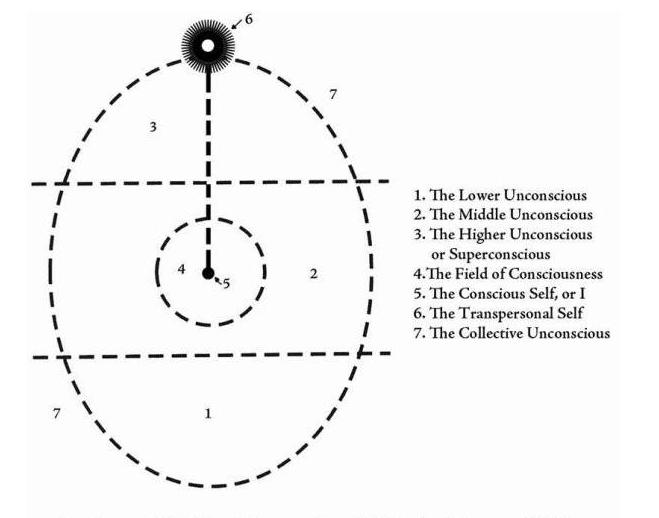
The first distinction is the three main levels of our being: the Lower, Middle and Higher Unconscious, from which continuous influences, or currents of energy, flow into the field of consciousness, which can be considered as the battlefield between all these influences that are diverse in nature, origin, and value. At the center of consciousness is the conscious ‘I’ [personal self], which is generally flooded by these contents and gradually identifies itself with one and the other. Therefore, this center of consciousness has no stability, coherence, nor peace. In the best cases, the influences of the spiritual [transpersonal] Self also reach the ‘I’, which, on the one hand, is a help but, on the other, is also a complication in that the influx of spiritual energies create new problems and conflicts.
We can draw important practical deductions from this. The first is that we must, above all, work to realize our own psychosynthesis; or, more realistically, to gain a certain measure of control and regulation over our contrasting tendencies and of our internal “characters” [or subpersonalities]. Obviously, if there are conflicts or conflicting subpersonalities within us, we cannot be in harmony with another person. In fact, our subpersonality “A” may be in harmony with our spouse, while our subpersonality “B” is in conflict. And the same can be happening for the other partner.
The second deduction is that since the other, the spouse, has the same difficulties and the same problems as we do, we must not blame him or her, but tolerate the situation and accept the consequences. We often tend to expect that others (and not just our spouse!) to be better than we actually are ourselves, and this is not fair. Instead each one of us should help each other to achieve his or her own psychosynthesis—and not only out of affection, but also for our own benefit through mutual understanding.
The second serious difficulty in marriage arises from the great psychological differences between man and woman in general. These differences are the cause of constant misunderstandings and conflicts. They are not sufficiently known or recognized; first of all, because of psychological ignorance. (Psychology, which is the principal science of humanity, is taught little or not at all. Geology, zoology, chemistry and physics are taught more than psychology at all educational levels!) Then there is reluctance to admit that these differences between men and women exist, particularly by women, because this subject raises a suspicion or fear that it implies a devaluation of women or that it justifies a presumed inferiority of women. This has actually happened, especially in the past. The most extreme manifestation of this was the debate that took place during a [Roman Catholic Church] Council on the question of whether women have a soul![1] Fortunately for women—and for the sake of common sense—the majority voted to concede that females have a soul! This is an extreme, I would say a caricatured, example of an attitude that men have held in the past. But in reality, the presumed constitutional inferiority of women has no basis or validity. Scientifically it is wrong, and humanly it is simply stupid. It is not a question of superiority or inferiority, but of differences, and it is good to clearly look at what these differences are at the various levels of the human being. With regard to this, I will quote from an article that I wrote entitled The Psychology of the Woman and her Psychosynthesis: [2]
I consider it useful to pause and examine somewhat the differing characteristics of male and female psychology. I shall speak frankly which, at times, will perhaps seem rude to both sexes.
We can say that between woman and man there exists an “inverted” polarity. In the outer, the physical, world man is positive and woman is negative; man has active, dynamic, constructive functions, whereas woman generally has the function of the family. In the emotional and imaginative sphere, the polarity is different: here woman is more positive, active and better developed, while man is apt to be more easily influenced. In the intellectual field we have another inversion of the polarity: here man is eminently active, logical and rational, while woman in this domain is less developed and active. But there is another sphere often disregarded, that of the intuition, in which woman is often developed and man is not.
Scheme of Man’s and Woman’s Bio-Psychical Characteristics
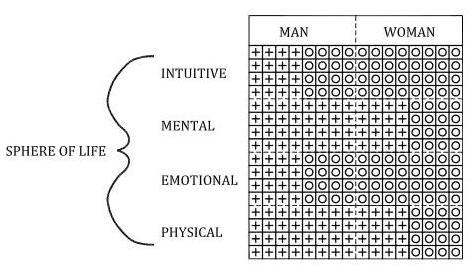
To these different polarities correspond important qualitative distinctions, which can explain many deficiencies, derangements and nervous and psychological troubles. These differences have been keenly and deeply studied by Jung, who has been a pioneer in this obscure and complicated field.
Speaking of man in general,[3] we can say that in the average so-called normal man develops qualities and functions such as combativeness, mental activity and efficiency which manifest to a marked degree, whereas qualities of a feminine type, such as sensitivity, feeling, imagination and intuition remain in an undeveloped and, at times, almost atrophied condition. They do not keep pace with the rest of his growth, and it therefore often happens that man, in this respect remains primitive and barbaric, as it were. His imagination, generally kept deep down in the subconscious, is disordered when it does come to the surface, and often expresses itself in fancies of which he himself is ashamed. His feeling nature tends to remain primitive; he has neither delicacy nor plasticity. He can pass from outbursts of almost savage passion to hardness and insensitivity, and vice versa, or he can pass from insensibility to almost childish weakness and sentimentality. His intuition is generally rudimentary, almost non-existent. He endeavors to solve all ideal and practical problems though mental processes only, and since he does not take into consideration the more subtle and imponderable elements, he is often mistaken. In the various occurrences of life, his cleverly formulated plans and programs often come to naught, and instead of finding fault with himself and his shortcomings, he blames people and events.
The psychological processes of women are the very opposite. Her reasoning is often primitive, childish. Her opinions are usually nothing more than prejudices and superstitions to which she clings obstinately, even in the face of evidence of facts to the contrary. Of course, her opinions are sometimes correct and based on intuition, but only too often they are wrong and the outcome of personal emotion, of imaginings of various kinds, or of blindly accepted traditions.
It is typical of woman that she does not consider the real validity of the problem with which she is faced. Her mental activity consists of examining things in an unanalytical, diffuse and inconclusive manner, with arguments that are often of a personal, and not of an objective character.
It is easy to see how this one-sided development and the deficiencies they engender can cause serious injury. For men and women are in themselves incomplete psychologically almost maimed beings. They can find the solution of their problems only through mutual integration, by combining their qualities so as to constitute together, a psychologically complete human being.
In fact, a man in whom the feminine functions are rudimentary cannot understand and appreciate woman. He feels himself attracted towards her, sometimes irresistibly. Vaguely he is aware that she possesses traits he needs, but he does not know how to approach her psychologically. She appears to him as a strange, elusive, chameleon-like creature. The keenness and changeability of her sensitivity, the wealth and plasticity of her imagination disconcert and confound him; her intuition impresses him, but he cannot understand its nature and origin; it perplexes him and generally he is skeptical concerning it.
Woman, in her turn, is unable to get out of her subjectivity and personal approach to things, lacks understanding of masculine activities and qualities and often does not even try to understand them. She loves man, but with a personal possessive, jealous affection. But although she loves him, she neither understands nor appreciates his world, his interests, his ideals. She is inclined to regard him as a savage who holds a delicate butterfly with a rough hand, who pulls to pieces and destroys perfumed and many colored flowers, as a naughty boy who is inclined to fight with others, as one who risks his life in daring enterprises, who plays with his complicated machines, and who neglects those who love him in order to chase after ancient ruins or rare manuscripts or to construct difficult and useless theories and systems.
I have purposely exaggerated my description of extreme cases in order to drive home my point with greater efficacy and to make clear what I want to establish. Fortunately, in reality, things are better than that, or… at least, less worse!
In fact, in every man and in every woman a certain amount of psychological elements of the opposite sex are developed. This is a great thing; anyone 100 percent male or female could not understand his or her spouse. The proportions of the qualities of the other sex are very varied; in some cases the psychological characteristics of the opposite sex may even prevail. Among the well-known examples of this, I will mention that of [Frederick] Chopin, on the one hand, and George Sand (the pseudonym of Madame Aurore Dudevant), on the other. Chopin was psychologically more feminine than masculine, and George Sand more masculine than feminine; but note that this did not prevent their sexual relations from being normal, as were those of George Sand with Alfred de Musset and others. This is important because it proves that, as in so many other cases, the psychological elements of the opposite sex do not at all indicate a physical inversion, that is homosexuality.
What is desirable is the manifestation of the higher characteristics, the better qualities of the opposite sex. Among men, often poets, artists, and musicians have had and expressed the feminine qualities of sensitivity, subtle feelings, and intuitions. A eminent example, among many, was [Italian poet] Giovanni Pascoli.[4]
Even among women there are illustrious examples. The first is Joan of Arc, who as a young woman had very keen feminine sensibilities, but as an adult became a fighter who commanded armies and achieved victories on the battlefield in which she fought bravely like a man. Another outstanding example is that of Florence Nightingale, who was endowed with a thoroughly feminine sensitivity and a compassionate heart, and who was so moved and indignant at the horrors that took place during the Crimean War between England and Russia that she wanted to create an organization of nurses. These female nurses would, in turn, train the male nurses and change the brutal and insensitive way in which the wounded were being treated. Her initiative raised strong opposition, but Florence Nightingale tackled the objections with courage and energy. Bending generals and ministers to her will, she managed to radically reform the methods used to assist the sick. She personally went into the battlefield to set an example and in this way created the nursing movement.
But apart from these exceptional examples, there are many more that are closer to us, and we all know them. I will mention one because it very much demonstrates my point and allows me to acknowledge her with great gratitude – that of the Countess Gabriella Spalletti Rasponi, who promoted the foundation of this Institute in Rome in 1926. The Countess Spalletti was not only a good wife and mother to her two children, but also a good grandmother—so much so that she took up studying Latin and Greek to help her grandson with his studies. At the same time, she carried out courageous social and educational activities. She was the President of the National Council of Italian Women for a long time, and organized the first national congress on family education. She motivated and directed both male and female collaborators, and her home seemed more like an administrative agency.
The reciprocal qualities of the opposite sex, in their higher aspects, constitute a useful, indeed, necessary common ground of mutual understanding and cooperation and make the psychosynthesis of the couple possible.
A third difficulty is due to typological differences that are independent of gender. I mentioned the four fundamental types, corresponding to the four functions: sensation, feeling, thought, and intuition. In addition, there are also the extroverts and introverts. It was to Jung’s merit that he highlighted this important difference with regard to the direction of one’s vital interests – either towards the external world or towards the internal world.
This distinction, however, must be more fully explained and refined. Both introversion and extroversion can be active or passive. There is a great difference between active and passive extroverts. Active extroverts are typically men of action; by contrast, passive extroversion consists of a special power of attraction which influences objects and persons and a particular receptivity to their influence. Passive extroverts are sensitive, impressionable, and dependent on external circumstances, for example, a person who “agrees with the last one who spoke.” A typical attitude of passive extraversion is reading the newspaper.
No less important are the differences between active introverts and passive introverts. In passive introversion there is a lack of interest in the external world due to self-centeredness and concern for oneself. Active introversion, on the other hand, is a conscious, voluntary detachment from the external world to carry out a positive action in the internal world. A typical example of this is an interest in psychology and activities in this field.
\ But there is a further differentiation and complication: one can be extroverted at one level and introverted at another. For example, one can be extroverted in the level of sensitivity, and introverted in the world of thought; so there is a wide range of combinations, upon which I cannot dwell on now.
All these factors create difficulties in mutual understanding. Sensory and emotional types do not understand mental types. Mental types do not understand intuitive types, and vice-versa. In turn, extroverts and introverts do not understand each other—but above all, extroverts do not understand or appreciate introverts. These great individual differences constitute obstacles to mutual understanding and, therefore, to mutual agreement in general, but especially in the continuous and intimate life of a family.
\ Fortunately, however, it is almost always a question of the prevalence of certain characteristics, not of their exclusive presence or absence. Therefore, there is always a more or less large—or small—common ground or area of similarity or affinity to use as a basis from which to begin mutual understanding and psychosynthesis.
But there is another important fact which is often ignored or not taken into due consideration: no human being exists and manifests itself only in its nature and in its masculine or feminine functions. In every human being there is a part—always the greater the more the person has evolved—which is outside and above those specific functions. Therefore, every human being must be considered and treated first and foremost as a “person,” with his or her dignity, value, and purpose as such. Rightly so, women who have this awareness and affirm it feel offended and angry when considered only, or above all else, as female, as an object of sexual satisfaction. Even at a higher level, there are men who see in every woman only, or almost only, someone who has the function of wife, or mother of his children. But also, inversely, there are women who see in their male partners, only a husband, a father of her children with the duties that come with these roles.
As important and noble these functions are, they do not constitute and must not absorb the whole human being. In each person there are aspects, feelings, and activities other than those functions: there are mental activities, the search for truth, a moral sense, aesthetic sense, social sense, altruistic love, and religious feelings that are independent of gender. All these can be “colored” by one’s gender and they can be areas and occasions in which one’s gender manifest itself, but they are essentially independent of gender.
But there is more. The spiritual SELF, the highest and truest part of us, is free from any polarity that could be called “horizontal.” Its polarization is “vertical;” that is, with the conscious ‘I’ that is a projection or reflection of the Higher Self. And the more the ‘I’, the center of the human personality, approaches the SELF, the more it “recognizes” itself in it, to the point of identifying with the SELF, and the more the human being is then free from the determinations and characteristics of his or her sex, as well as those of his or her own psychological type.
Furthermore, one can confirm a fact, which at first may seem paradoxical to state, that the more a person is released from (not identified with) those psycho-sexual definitions, the better he or she can perform the specific activities of his or her own sex and avoid its limitations and exaggerations. A mother who has her own personal life with cultural, religious, and social interests, is a better mother than one who is exclusively “maternal.” She can dedicate less actual time to her children; but the time that she gives them has a value and dignity, and produces an educational effect that is much greater than the time given by the woman who is exclusively “maternal,” who is often possessive and jealous. This is an important point. There is no opposition or conflict between the parts of the personality that are independent of the psychosexual constitution and the necessary typical activities that everyone performs as a man or woman.
\ All this concerns the broad category of what I have called psychological problems in marriage. But I repeat that they are not specific to marriage; they exist in all interpersonal relationships. They should be known, addressed and at least to some extent, preferably resolved before marriage through appropriate education and preparation of young people; but, if not, then, at least during marriage. In this way, and only in this way, can young people avoid the criticisms, reproaches, and accusations that poison so many marriages; and instead, the spouses can help each other to eliminate the causes of conflicts and to form the psychosynthesis of the couple.
Appendix: Notes on psychological types
It is always important to keep in mind that, when we talk about introverts and extraverts, we are always talking about different proportions; that is, the prevalence of the direction of one’s vital interest. In reality every normal person is to some extent “two-sided” and alternates between the two attitudes: thought and external action; observing oneself (self-analysis), and observing the environment and others.
The same is true of the active or passive disposition. The most dynamic man, the most active woman, when they are at the cinema or watching television, become passive extroverts for that hour or two. Given this, everyone should strive to alternate harmoniously and appropriately between the opposing tendencies, moderating the excessive manifestations of those of his or her own psychological type.
I was asked, which of the two sexes is more extroverted, man or woman? There is no general prevalence, but it could be said that the woman is more extraverted on the emotional level. But that is not entirely accurate, since the woman not only easily manifests her emotions and her feelings, but she observes them and examines them as well.
Rather, it seems that some nationalities are quite clearly differentiated. Italians are typically extroverts. The English are typically introverts on the emotional level, while they are extroverts on the material one. Generally, as an approximation, we can say that Northern Europeans are more introverted and Southern Europeans more extroverted. Especially on an emotional level, Southerners are more expressive and exuberant while Anglo-Saxons tend to repress and inhibit the expression of their feelings.
With regard to the question of whether it is easy to recognize which psychological type a person appears to be, one can say that, yes, in extreme cases, it is easy. “Practical” men, men of action who tend only toward external activity and making money, are evidently, at least predominantly, extroverted. On the other hand, a scholar who chooses to read books of ideas and comment and write about them, is evidently and predominantly introverted. It is more difficult to determine when there is extraversion at one level and introversion at another, or when the differences are not great, for example, in the proportions of 40 / 60 or 45 / 55.
In reality, “assigning labels,” making classifications, has only a relative importance. Instead it is very important to distinguish the lower aspects and the higher aspects of any human characteristic and to use the means and techniques to transmute the lower into higher aspects.
The second part of this text, taken from Lecture VIII, “From the Couple to the Community” (21 March 1965), is already published on this site: see [From the Couple to Community.]
[1] There have been various accounts that have claimed that the Third Council of Mâcon (585 C.E.) debated the question of whether women have souls. Contemporary historians have concluded that this debate did not actually occur, but was alleged by some anti-Catholic writers of later times. But this does not detract from Assagioli’s point concerning male prejudice. —Ed.(JK)
[2] These paragraphs are from the original essay that was published in English by Roberto Assagioli, “The Psychology of Woman and Her Psychosynthesis.” Psychics International Vol.II: 2, pp. 58-61, August 1965. By contrast, we share below some paragraphs from a later version of this essay by Roberto Assagioli, “The Psychology of Woman and Her Psychosynthesis,” which was edited by Frank Haronian with the approval of Dr. Assagioli, and published in the USA by the Psychosynthesis Research Foundation in 1968. This understanding is not easy to acquire because the psychological constitutions of man and woman are deeply different, much more so than we generally realize. One could almost say that they belong to two different species. It therefore seems useful to pause and examine somewhat the differing characteristics of male and female psychology. In speaking frankly, I may at times seem rude to both sexes. Typically, although by no means universally, there exists between a husband and his wife polarities of psychological functions. The man tends to excel in certain vital operations while the woman manifests others. For example, in dealing with the physical world, man has active, manipulative and creative functions while woman, as wife and mother is primarily concerned with maintaining and preserving the life and resources of the family. On the other hand, in the sphere of the emotions and of the imagination, it is the woman who is usually the better developed, more positive and productive of the two. In this area, the husband is apt to be relatively naive and easily confused. So there is an apparent inversion of dominance functions that man and woman need to appreciate, and therefore collaborate with each other in order to form an effective team. Other changes that were made in this later version are the substitution of such phrases as “the average woman” where the original essay reads “woman.” It is important to note that Dr. Assagioli’s thinking and writing about women had already begun to change considerably in the years after the original 1965 essay was published, so much so that he later expressed a desire to remove the original essay from publication. Since Assagioli gave the lecture presented here the same year his original essay “The Psychology of Woman and Her Psychosynthesis” was published, it does not reflect the evolution of his thought—which happened partly as a result of his specific invitations to women to comment on the essay and to help him understand the massive social changes that were currently underway.—Ed (JK).
[3] Assagioli gave this lecture in the 1950s and 1960s, and his observations were probably accurate in terms of the majority of the people in his own Italian culture at the time; which allows space for modern readers to examine his statements to determine how much of them are universally applicable and how many of them are culture-specific and time-specific. —Ed.(JK)
[4] Italian poet (1855-1912)
