

Definition, Examples, Practice
Acting “as if” is one of Roberto Assagioli’s most practical psychosynthesis techniques for the training of the will. Its principle is disarmingly simple: because the will has only limited direct power over feelings and moods, but considerable direct power over posture, facial expression, voice and action, we can approach a desired inner state from the outside in. We assume the bearing, the tone and the behaviour of the quality we wish to cultivate — courage, serenity, benevolence, confidence — and the inner state tends to follow.
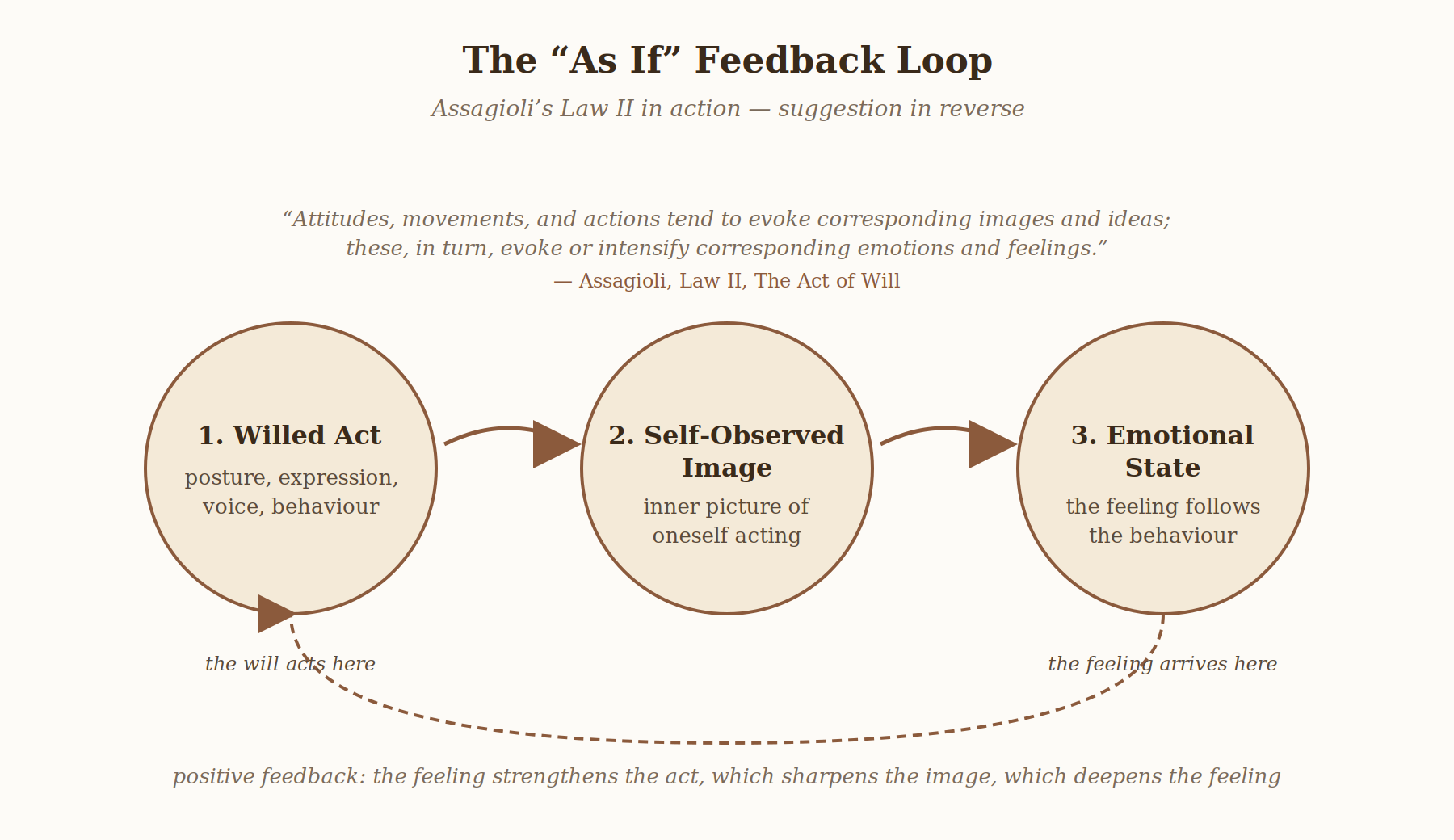
Assagioli grounds the technique in what he formulates as the second psychological law of the will: attitudes, movements, and actions tend to evoke corresponding images and ideas; these, in turn, evoke or intensify corresponding emotions and feelings. He describes the mechanism as a kind of suggestion in reverse: where ordinary suggestion moves from image to feeling to act, acting “as if” moves from the willed act to the self-observed image to the emotional state.
The technique is not a form of pretence or self-deception. Assagioli is explicit that it becomes hypocrisy only when used to deceive others for selfish ends. When the deeper self genuinely wills the quality that the surface personality cannot yet feel, the “as if” is an act of sincerity at a higher level — an alignment of behaviour with one’s true aim rather than with one’s passing mood. The classic illustration is General Turenne, who acted bravely in battle while trembling, and who commanded his body, “Tremble, old carcass, but walk.”
In psychosynthesis practice, acting “as if” is rarely used alone. It combines naturally with the disidentification method, a fundamental approach in Psychosynthesis (which gives the inner observer its freedom), the ideal model (which supplies the image of who one is becoming), evocative words, and imaginative rehearsal. Together these form a small repertoire through which the skillful will reshapes the personality from both the outside and the inside.
For the full Assagioli article on this technique, see Technique of Acting “As If”.
The psychological law behind acting “as if”
In Chapter 5 of The Act of Will, Assagioli formulates ten psychological laws governing the will. The second of these is the operative law for this technique:
“Attitudes, movements, and actions tend to evoke corresponding images and ideas; these, in turn, evoke or intensify corresponding emotions and feelings.” — Law II, The Act of Will
The law works in both directions. Its companion — Law I — states that images and ideas tend to produce the physical states and external acts that correspond to them. Ordinary suggestion, visualisation and affirmation all rely on Law I: begin with the image, and the feeling and the action follow. Acting “as if” reverses the direction. Begin with the willed action, and the image and the feeling follow.
This is why the technique is so useful when the feeling itself is out of reach. A depressed person usually cannot visualise joy convincingly; a frightened person usually cannot imagine calm. But both can still smooth the forehead, lift the head, steady the breath and speak in a measured voice. The feeling that will not come when summoned from the inside can often be coaxed from the outside.
The mechanism: suggestion in reverse
Assagioli describes the psychophysiology of the technique as a feedback loop:
“Every external act requires that it be first imagined or visualized, even if unconsciously. But then during its performance the self-observation that accompanies it creates an image that, in its turn, produces a reinforcing effect, a positive feedback process. It could be said that the ‘as if’ technique makes use of the same dynamic power of images as in suggestion, only in a reverse direction.” — The Act of Will, p. 80
The sequence runs:
- Willed act — the will directs the body into a new posture, expression or behaviour.
- Self-observed image — the act, while being performed, produces an inner image of oneself acting this way.
- Emotional state — the image, acting like a suggestion from within, evokes and intensifies the corresponding feeling.
The loop then strengthens itself: the new feeling makes the willed act easier, which sharpens the image, which deepens the feeling. This is why Assagioli says the emotional change can sometimes be rapid as well as gradual.
Historical examples Assagioli cites
Assagioli draws on a wide range of figures — religious, literary, military — to show that acting “as if” is neither new nor exotic, but a law of the psyche that skilful people have always used:
- General Turenne commanding his body, “Tremble, old carcass, but walk!” while marching at the head of his troops despite feeling afraid.
- Whistling to keep up courage in a lonely place at night — a folk application of the same law.
- Singing, or getting others to sing, as a well-known spur to action, used extensively in military tradition.
- Machiavelli and Buffon donning gala dress before sitting down to write, because the internal tone created by the costume was reflected in the style of their prose.
- Tommaso Campanella imitating the facial expressions and gestures of others when he wanted to know what they were feeling — and finding that the imitation aroused the corresponding feeling in himself.
- St Ignatius of Loyola advising those in spiritual dryness not to abandon prayer but to intensify it, as a means of awakening the feeling that had withdrawn.
- Pascal advising unbelievers to perform the external acts of faith, convinced that faith itself could be awakened in this way.
- Goethe systematically exposing himself to loud drums, dizzying heights and anatomical dissections in order to desensitise himself to vertigo, noise and horror.
Is acting “as if” a form of hypocrisy?
This is the most common objection to the technique, and Assagioli addresses it directly. His answer turns on the motive.
“‘Acting as if’ one had a feeling without having it would be hypocrisy when one did not sincerely want to have the feeling, but acted contrary only out of calculation, for selfish ends. … If we earnestly desire, if we propose to be benevolent, sympathetic toward a person for whom we feel an instinctive dislike, and behave in this way, this is not pretense: instead, it is the way to really eliminate the dislike that we would prefer not to have.” — Assagioli Archive, Doc. #23041
Behind this answer lies Assagioli’s theory of the multiplicity of the self. Within any one person there are many impulses — some lower, some higher — and all of them are, in their own way, “sincere.” To give spontaneous free rein to an impulse of resentment is no more authentic than to act from the aspiration to benevolence that coexists with it in the same soul. Authenticity is not a matter of obeying whichever impulse happens to be loudest; it is a matter of choosing which impulse to identify with.
“The deepest and most real sincerity is voluntary allegiance, the choice to identify with one’s highest and truest being; and thus to master lower tendencies and impulses, even if they exist and stir in us. Thus, in Turenne’s case, it would not have been spontaneity and sincerity to run away, to obey his fear. His true sincerity consisted in being true to his deepest will as a brave general.” — Assagioli Archive, Doc. #23041
Acting “as if,” in this reading, is not pretence about who one is. It is enacted allegiance to who one most deeply wills to be.
Vaihinger, Adler, Assagioli: the three lineages of “as if”
The phrase “as if” has three distinct sources in modern psychology, and readers often confuse them. It is worth distinguishing the three.
Hans Vaihinger (1911) — the German philosopher whose book Die Philosophie des Als Ob (The Philosophy of As If) argued that much of human thought operates through useful fictions: mental constructs that are literally false but pragmatically indispensable. We act “as if” the future were predictable, “as if” moral freedom were real, “as if” the self were a unity. Vaihinger supplied the philosophical root.
Alfred Adler (c. 1929) — the Austrian psychiatrist who drew on Vaihinger and developed “acting as if” as a clinical technique in his individual psychology. In Adler’s use, the therapist invites the client to behave, for a limited period, as if they already possessed the trait they lacked — confidence, sociability, decisiveness — in order to dissolve the feeling of inferiority and discover new possibilities of self.
Roberto Assagioli (1963, formalised 1973) — who integrated the same principle into psychosynthesis as a technique for training the will. Assagioli’s distinctive contributions are (a) grounding the technique in an explicit psychological law of bodily-to-emotional feedback, (b) embedding it in a wider repertoire alongside disidentification, the ideal model and evocative words, and (c) framing it in terms of the will and the choice of which self to identify with, rather than only in terms of therapeutic reframing.
The three approaches are compatible rather than competing, but they are not interchangeable. Vaihinger gives the philosophy, Adler gives the therapeutic intervention, Assagioli gives the developmental and volitional theory.
How to practise acting “as if”
Assagioli gives concrete guidance on how to use the technique well. The following steps are drawn from his “Way of Proceeding” in the 1963 archive paper.
- Begin with disidentification. Sit quietly and remind yourself: I have emotions, but I am not my emotions. I have a body, but I am not my body. This opens the inner space from which the will can act on the personality rather than being submerged in it.
- Clarify the quality you wish to cultivate. Name it precisely — not “feel better” but serenity, courage, benevolence, confidence. A vague aim produces a vague result.
- Build an ideal model. Visualise yourself acting with this quality in a specific situation. See the posture, hear the tone of voice, feel the inner poise. This is the actor’s rehearsal before the performance.
- Enact the bearing of the quality. Smooth the forehead. Lift the head. Steady the breath. Speak in the tone a person with this quality would use. A mirror can help; so can standing in the posture for a full minute before acting.
- Sustain the enactment without fighting the contrary feeling. Fear, sadness or resentment may still be present. Do not try to suppress them; simply do not obey them. Turenne’s formula is the model: Tremble, old carcass, but walk.
- Observe the inner shift. Notice, without demanding it, the moment when the feeling begins to follow the behaviour. Sometimes this takes minutes, sometimes days of repeated practice. Repetition is part of the method.
For situations where the contrary feeling is very strong, Assagioli recommends combining the technique with imaginative training (gradual desensitisation) and external training (gradual real-world exposure). Acting “as if” is most powerful when it sits inside a small team of techniques chosen for the particular case.
Frequently asked questions
Who invented the “act as if” technique?
Three figures shaped it. Hans Vaihinger (1911) supplied the philosophical root in The Philosophy of As If. Alfred Adler (c. 1929) developed it as a clinical technique in individual psychology. Roberto Assagioli integrated it into psychosynthesis as a technique for training the will, describing it in detail in The Act of Will (1973) and in an earlier archive paper of 1963.
Is “acting as if” the same as “fake it till you make it”?
They share the same underlying principle but differ in depth. “Fake it till you make it” is a folk version of the technique that leaves the motive unexamined; Assagioli’s version insists on the distinction between pretending for selfish ends (hypocrisy) and enacting a quality one sincerely wills to develop (authentic self-training). The psychosynthesis version also locates the practice within a wider theory of the will, the self and the personality.
Is acting “as if” a form of hypocrisy?
Not when the motive is right. Assagioli defines hypocrisy as acting contrary to one’s real intention in order to deceive others for selfish ends. When one genuinely wills the quality one is enacting — benevolence, courage, patience — the behaviour is not pretence but a form of self-training aligned with one’s deeper will.
How does Assagioli’s version differ from Adler’s?
Adler used “acting as if” primarily as a short therapeutic intervention to dissolve feelings of inferiority and expand the client’s sense of possibility. Assagioli uses it as one technique in a developmental repertoire for training the will, grounded in an explicit psychological law and combined with disidentification, the ideal model and evocative words. Adler’s emphasis is therapeutic and social; Assagioli’s is volitional and transpersonal.
Can acting “as if” be used against oneself?
Yes, and Assagioli is aware of this. If the contrary emotion is very strong and the technique is used to override it by force alone, the emotion may be repressed into the unconscious and produce symptoms later. The safeguards are honesty about what one is feeling, gradual training rather than violent self-coercion, and combination with disidentification so that the emotion can be acknowledged without being obeyed.
Further reading
- Assagioli, R. (1973). The Act of Will. Chapters 5 and 6, especially pp. 79–84 and p. 141.
- Assagioli, R. (1963). Technique of Acting “As If”. Assagioli Archive, Florence, Doc. #23041. English translation by Jan Kuniholm. Full article.
- Assagioli, R. (1974). Psychology and Human Existence. Assagioli Archive. Full article.
- Vaihinger, H. (1911). Die Philosophie des Als Ob.
