

Alongside the search for the Self — Assagioli on the Superconscious as a region of life already available, and the seven paths that lead there
By Roberto Assagioli
A brief conversation held on January 28, 1968
Assagioli Archives, Florence [i]
Translated and edited by Jan Kuniholm [ii]
Editorial Note
The abstract and contextual subtitle in this online edition have been added by the editor, Kenneth Sorensen, to support readability, navigation, and archival consistency. The original wording has not been altered.
Abstract
In this conversation, Roberto Assagioli reframes the work of spiritual psychosynthesis around the Superconscious rather than around the elusive Self. He sets out seven paths to the spirit: a modern intuitive psychology, the mystical religious way, the aesthetic, the illuminative, the heroic, the ethical-regenerative, and the ritual, and identifies beauty, goodness, and truth as the most accessible qualities of the Superconscious. Distinguishing the Self from the Superconscious, he draws a parallel with the Buddha, who never asserted the Self but pointed instead to a state of bliss, and concludes that one can live a rich and full Superconscious life without ever having the direct experience of the Self. The recurring image is one of refusing to spend all one’s effort cleaning the psychological cellars and instead climbing to the bright terrace where joy, beauty, and a wider life are waiting.
We have to go and see [for ourselves] if there is a “Superconscious” — that is, to have a direct experience of it. There are seven roads, or paths to the spirit:
- A modern psychology: intuitive or cognitive, but not in the “rational” sense, ie, becoming conscious directly in two ways:
- Emptying the field of consciousness of habitual contents and directing the attention and aspiration of feeling to what is impersonal, to what is essential.
- One can also, again experientially, accept the three main keynotes of those who have had this experience; namely: the beautiful, the good, and the true. The truth is that which is essential reality — absent of and beyond all contingent elements. The beautiful is that which is harmony, order, etc. on a Platonic scale: form, morality, idea. The good, that is, the principle of goodness, of love, of union. These are the qualities of the Self, of spirit; they are the most accessible manifestations of “Superconsciousness.”
- The mystical religious way.
- The aesthetic way: aesthetics of external beauty, and ascending from that.
- The illuminative way: that is, the spirit as a dazzling light that descends.
- The heroic way: that of action, cause, ideal.
- The ethical-regenerative way: conversion; abandonment of all imperfections, selfish attachments; ideal of perfection, etc.
- The ritual way: active participation in rituals.
All of these can be pursued. Read accounts from those who have had these experiences that stir something corresponding in us.
* * *
Read the essay “Smiling Wisdom.” [iii]
* * *
It is not just a search for a Self that may seem vague and elusive; the whole area of the superconscious is throbbing with life, it is animated, rich and colorful.
Remember the difference between “Spiritual Self” and “the superconscious.” In general, it must be said: it is not a matter of discovering this almost elusive Self, but of entering into a greater fullness of life; into experiences that the great artists, religious people and heroes have had, who lived a more intense and richer life that, to some extent, is within the reach of everyone. This is the Superconscious, and then if there is a SELF at the summit, you will also see this, but even if you do not find it, this is enough to live a full life. This can attract more. A new way of looking at life: that is, talking mainly about the Superconscious, that is, the superconscious region of life, and putting the SELF as a transcendent background.
Distinguish the Self from the whole region of “Superconsciousness” (see diagram).
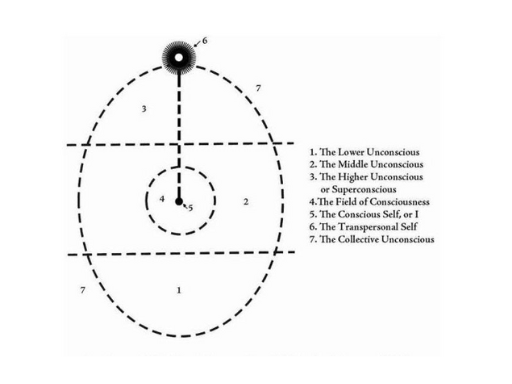
The Buddha never asserted the SELF, but rather a state of bliss called nirvana that is inexpressible and that one must go and seek. The Self is not up for discussion. For spiritual psychosynthesis, the “Superconscious” (joy) is sufficient.
People keep talking about the “Superconscious.” There is so much effort to keep the [psychological] cellars clean — why don’t we go up to the terrace for a while? Why are you here? Because you don’t feel good, because you are unhappy. As long as you are happy to be “earthy” — peace! But if you want something else, I tell you it is there, but it takes a little spirit of adventure to look for it. And there is joy there, there is fullness of life, there is satisfaction, there are new experiences, there is a whole other world that is more beautiful, more satisfying, more grand.
Not only does the search for a SELF seem abstract, vague, elusive — no! You have to distinguish well: the whole area of the Superconscious is throbbing with life — it is animated, full, colorful.
Always remember well the difference between the “Spiritual Self” and the “Superconscious.” In general it must be said: it is not a matter of discovering this elusive Self, but it is a matter of entering into a greater, more intense and richer fullness of life: this is the Superconscious. If then at the summit there is a Self, you will also see this, but even if you do not find the Self, you will encounter this wider sphere of life: it is as if one does not reach the summit of a mountain, but almost.
One can have a rich, full life of the “Superconscious” without having the experience of the Self.
[i] This file is from www.psicoenergetica.com . No comments from others were in the original file. – Oath
[ii] Editor’s interpolations are in [brackets]. – Oath.
[iii] Psychosynthesis Research Foundation Issue #4. Find this at https://kennethsorensen.dk/en/smiling-wisdom-humour/ —Ed.
