

How unfinished lecture notes from 1932 trace the ascent from sensory curiosity through rational limits to intuitive realisation and the thirst to know the true Self
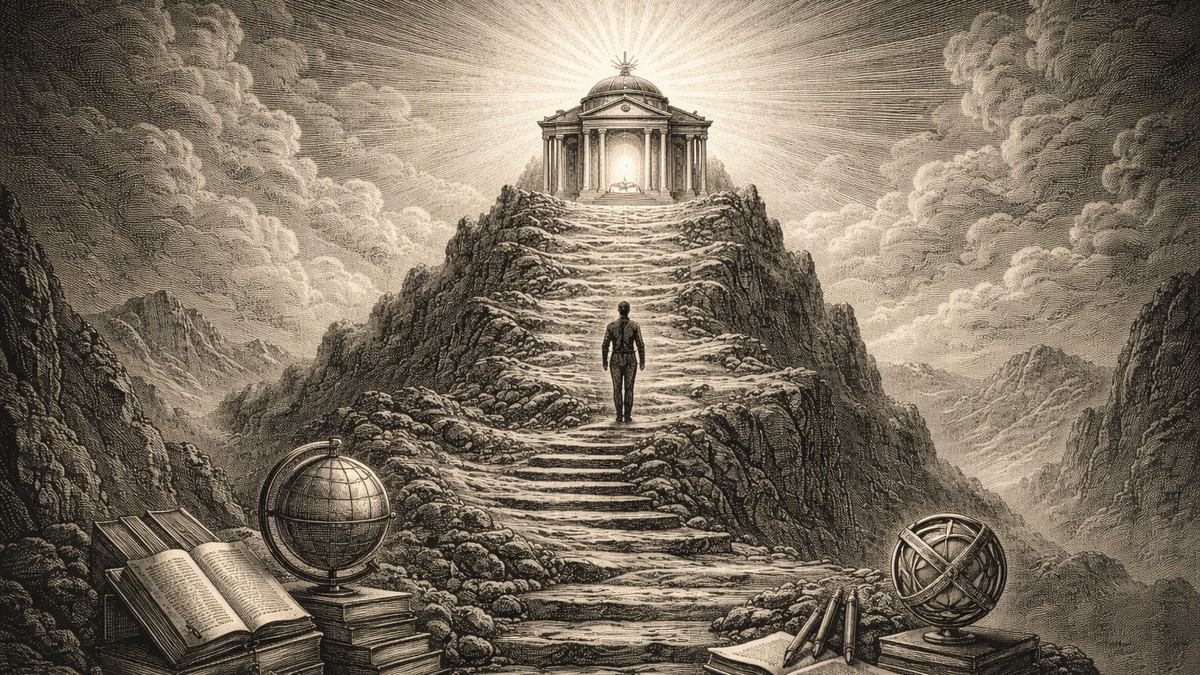
By Roberto Assagioli
Doc. #23249 | Archive: Assagioli Archives, Florence
Original title: Desiderio di sapere e capacità di conoscere
Course of Lectures on Individual Psychology, Lesson XIV (1932) Individual (spiritual) elements in personality
Unfinished Notes: [1]
Translated with notes by Jan Kuniholm
Editorial Note
This text consists of unfinished lecture notes delivered by Roberto Assagioli in 1932 as part of a course on Individual Psychology. The structure reflects outline form rather than finished prose. The abstract and contextual subtitle in this online edition have been added by the editor, Kenneth Sørensen, to support readability, navigation, and archival consistency. The original wording has not been altered. The translation, footnotes, and scholarly editorial commentary are by Jan Kuniholm, who has contributed contextual annotations throughout.
Abstract
In this 1932 lecture outline, Assagioli examines the thirst to know as a defining spiritual element within human personality. Beginning with the child’s instinctive questioning, he maps successive levels of cognition: sensory perception, rational understanding, philosophical inquiry, intuitive illumination, and liberating realisation. Each level reveals both its reach and its limits. The lecture draws on Kant’s critique of reason, Vedāntic teaching, and contemplative traditions to argue that genuine knowledge culminates in disidentification, the recognition of the true Self, and conscious unity with the Universal Spirit. Discipline and self-mastery are presented as the necessary conditions for this ascent.
We have begun to consider the individual elements that exist in personality, the energies [2] that descend from the spiritual “I,” or Self, and penetrate in a more or less attenuated, discolored and refracted form to the level of our conscious personality. We considered (in the previous lecture) what reveals itself to us as moral consciousness. Let us examine today what manifests itself as the desire for knowledge and the capacity to know.
The thirst to know constitutes one of the clearest differences between man and animal. Animals do not have a desire to know anything other than what directly relates to their needs and instincts: the search for food, defense, etc. Only humans have the yearning to know for the sake of knowing. This tendency is already evident in children. The famous “why’s” of children must be wisely used by educators. Children must never be depressed or discouraged, never laughed at; they must not be given answers in a way that “talks down” to them, because they grasp and intuit far more than they are given credit for. Their minds are concrete; one should never speak to them in abstract terms. They are free of obstacles and preconceptions. It is appropriate to respond to children with symbols, analogies and parables.
- On the surface
a. Knowledge of the outside world. It is the first step (the “Ulysses”) for boys and young people; explorers of the earth’s surface, the depths of the sea, the air, the stratosphere.
b. Intimate knowledge of nature, natural phenomena; Laws, scientists; noble passion; ascetics and heroes of Science (such as Pasteur).
- In depth
Desire to know the secret “meaning of life.” Why? How? What are we? Where do we come from? Why are we here? Where are we going? The problem of pain. The problem of evil (included in the problem of creation). Philosophical search (Philosophy means Love of and search for Truth).
Desire to know, to understand, first the external world, then the laws that govern it, then its origin. From here one is drawn to search for the First Cause, the invisible Reality behind everything; the Power that created everything, the Spirit, God.
Everyone, even the farmer, the worker and the unassuming woman, has their own conception of life, albeit unconscious, unformulated and rudimentary.
The importance of the conception of Life; the importance of recognizing it clearly in ourselves. It determines our actions and our most important decisions: it gives us faith and strength, or skepticism and discouragement. Certain pessimistic conceptions have led to suicide.
Notes:
[1] It appears that the author used these notes to speak extemporaneously to his audience. -Oath.
[2] “rays” in the original, here interpreted as “energies”. — Tr.
[3] “Gnoseology,” also known as gnoseology or gnostology, is the philosophical study of knowledge, its nature, and its limits. It is broader in scope than the philosophical study of “epistemology.” -Oath.
[4] Plotinus (204-270) was a Greek philosopher who was born in Egypt and later lived in Rome and Sicily. -Oath.
[5] Henri Bergson (1859-1941) was a French philosopher. -Oath.
[6] Edward Carpenter (1844-1929) was an English poet and philosopher. -Oath.
[7] Richard Maurice Bucke (1837-1902) was a Canadian psychiatrist and author of Cosmic Consciousness. -Oath.
[8] PD Ouspensky (1878-1947) was a Russian philosopher and esotericist. -Oath.
[9] Vedanta is a school of Hindu philosophy that emphasizes ultimate Reality (Brahman) and the individual soul (Atman). Among its most important texts are the Upanishads, the Brahma sutras, and the Bhagavad Gita. -Oath.
[10] Jnana Yoga, also called the “path of knowledge,” is a spiritual practice focused on achieving self-realization through wisdom and understanding. It is one of the four main paths of yoga in Hindu philosophy. -Oath.
[11] Swami Vivikananda (1863-1902) was an Indian philosopher, teacher and disciple of the Indian mystic Ramakrishna. He was a major figure in the introduction of Vedanta and Yoga to the western world. -Oath.
[12] Ramacharaka was a pseudonym of William Walter Atkinson (1862-1932), an American writer, occultist and pioneer of the “New Thought” movement. -Oath.
[13] Raja Yoga is considered by some to be a distinct form of yoga. This is also the modern term for the practice of yoga presented in the 1896 book Raja Yoga by Swami Vivekananda in his interpretation of the Yoga Sutras of Patanjali, which date to the second century BC —Ed.
[14] Alice A. Bailey (1880-1949) was a British and American theosophist and writer, author of 24 channeled books of esoteric knowledge. She founded the Arcane School and was a colleague of the author in esoteric work. Her publishing company, Lucis Publishing Co., issued the first monograph on psychosynthesis. Her book From Intellect to Intuition, first published in 1932, contained instructions for developing the mind to open to higher consciousness. -Oath.
