

Why Carlyle’s vision of society built on veneration and Emerson’s account of enrichment converge in a psychosynthesis of the worship of heroes and ideal models
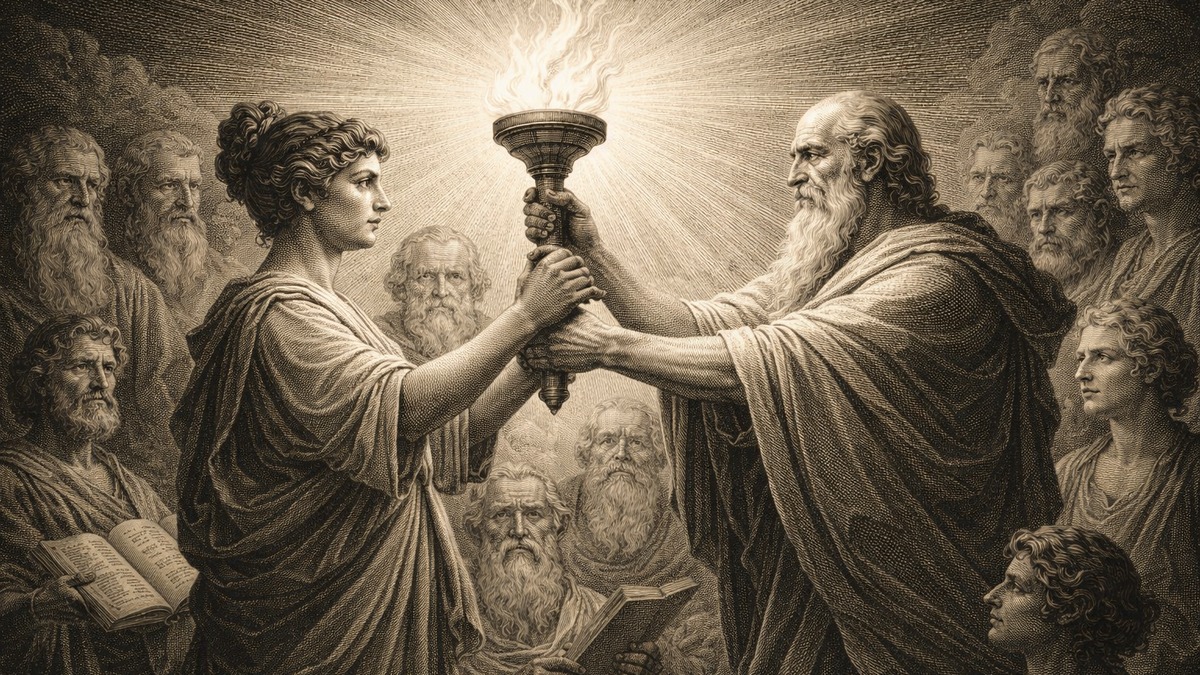
By Roberto Assagioli
Doc. #23320 | Archive: Assagioli Archives, Florence
Translated and edited by Jan Kuniholm
Editorial Note
The abstract and contextual subtitle in this online edition have been added by the editor, Kenneth Sørensen, to support readability, navigation, and archival consistency. The original wording has not been altered. The translation, footnotes, and scholarly editorial commentary are by Jan Kuniholm, who has contributed contextual annotations throughout.
Abstract
In this essay, Assagioli examines the worship of heroes and great historical figures as a powerful mechanism for psychological development. Drawing on Thomas Carlyle’s thesis that society rests on veneration of exemplary individuals and Ralph Waldo Emerson’s account of how contact with greatness activates latent capacities, he analyses admiration through the twin processes of projection and introjection. The essay critiques materialistic attempts to reduce genius and holiness to pathology, arguing that higher manifestations cannot be explained by lower instincts. Assagioli identifies three dangers in the worship of heroes: being overwhelmed by spiritual intensity, projecting qualities outward without assimilating them, and mechanical imitation that copies form rather than spirit. The essay concludes with a distinction between personality and the spiritual message it conveys.
In our examination of the effectiveness of “ideal models” in promoting and bringing about psychosynthesis, we have spoken of the various types of activities, functions and missions in which men and women can converge and unite their various energies, tendencies, and psychic and spiritual faculties into a creative and fruitful expression; that is, in other words, carry out their own psychosynthesis. It now remains for us to mention another type of “ideal model,” which has a special importance and effectiveness. It is that of great historical and mythical personalities, heroes, great people. The worship of heroes, the admiration and veneration for great men, is a natural and irrepressible tendency of the human soul and at the same time one of the most powerful springs of its inner elevation.
Thomas Carlyle[1] — who more and better than any other writer felt and expressed the value of this worship and examined its various manifestations in his well-known and admirable essays On Heroes — goes so far as to say that society is based on the worship of heroes.
All the dignities of rank on which human society is based are what we may call a “Hero-archy,” or Hierarchy…Duke is Dux, which means Guide; the Anglo-Saxon word King, comes from Konning, the man who knows and who can. The Latin word Rex, means “he who rules.”
Social stability depends, according to Carlyle, on those who are in charge of peoples not being too unworthy of their function. He says, wittily:
They are all as bank-notes, these social dignitaries, all representing gold; —and several of them, alas, always are forged notes. We can do with some forged false notes; with a good many even; but not with all, or the most of them forged! No: there have to come revolutions then; cries of Democracy, Liberty and Equality, and I know not what:—the notes being all false, and no gold to be had for them, people take to crying in their despair that there is no gold, that there never was any!—’Gold,’ Hero-worship, is nevertheless, as it was always and everywhere, and cannot cease till man himself ceases.[2]
Carlyle finds confirmation of this in the strange paradox that men have been able to admire with enthusiasm even the prototype of incredulity, irony and persiflage; he recalls the exaggerated, almost ridiculous homages paid to old Voltaire.[3]
This perennial veneration that great men inspire is for Carlyle the sure foundation, the cornerstone on which one can continue to build after every ruin. Indeed, the formative and uplifting efficacy of Great Men is enormous and incalculable, and they indeed deserve the worship of which they have been the object. They have been regarded as liberators, as saviors. In India the Gurus, the Spiritual Instructors, have been and are the object of a passionate and venerated cult by their chelas or disciples. Interesting examples of this can be found in Romain Rolland’s Vie de Ramakrishna and Vie de Vivekananda.[4]
The Indians have a very beautiful saying in this regard, “The Ganges purifies when it is seen and touched, but the Great Beings purify even if they are only remembered.” And a great Chinese, Mencius, said, “A sage is the Master of a hundred centuries; when we hear of his customs, the stupid become intelligent, and the indecisive become resolute.”
In the classical century, Plutarch’s Lives of Illustrious Men have powerful efficacy as models and examples of high human virtue, an efficacy that has continued to the present day.[5] In Christianity, we have the sublime figure of Jesus, who served as an ideal model for so many of his noble imitators, leading them to admirable spiritual heroism and elevating them to the heights of holiness.
In our days, this imitation has taken on — among some Anglo-Saxons — a more concrete and practical character, in keeping with their mentality. Indeed, they propose and adopt the method of asking themselves, when they must act, and especially in cases of doubt or conflicting tendencies, “How would Jesus act, if he were in my place?” And they say they derive great help and elevation from this.
In modern times, however, there has been a materialistic and positivistic tide that has attempted to overwhelm every manifestation of superiority, not only spiritual, but also intellectual and moral.
Thus there has been a series of slanderers of man who, with doggedness worthy of the best cause, have tried in every way to demolish and cover with mud every human figure. They have insisted on the pathology of genius and holiness; they have tried, for example, to “illuminate” — or rather to obscure — the figure of St. Francis with the methods of anthropology, looking for degenerative signs in him; they have complacently pointed out the hysterical symptoms presented by various saints, without understanding that (as I had occasion to write in another Lecture)
the intellectual and moral value of a personality is entirely independent of the morbid symptoms which may afflict it and which it may have in common with other lesser and truly degenerate personalities. If it is true that St. Teresa, St. Catherine of Genoa and many other noble religious women were affected by “hysteria,” this should not in the least diminish our admiration for their spiritual gifts; instead, we must modify our opinion of the character of “hysterical women.” If St. Francis had — as has been claimed — “degenerative somatic stigmata,” this certainly does not diminish our veneration for the Poor Man of Assisi, but instead shows that those stigmata do not always have the “degenerative” meaning attributed to them and may cause us to modify our concept of “degeneration.” Finally, if it were true — as a certain French doctor[6] has claimed to prove — that Jesus, that sublime ideal of humanity, was a madman, that would only mean that madness would sometimes be infinitely superior to the sanity of normal people, including psychiatrists.”[7]
This crude anthropologism is now in full decline and has been defeated even in the strictly scientific field. But a more subtle and more ingenious “pathologism” has arisen in the psychological field, which also shows a great misunderstanding of spiritual values, and tends to explain the highest manifestations of the human soul as mere derivations or transformations of lower instincts and tendencies. But what is higher cannot be “explained” by what is lower.
Let us return to the Great Men. Their beneficial effect on us deserves to be more precisely analyzed. It is a twofold and diverse function; indeed, somewhat opposite. The first and most obvious, is the direct action of the higher being. The Great Man vivifies us, enriches us and radiates us with his warmth, like the sun extracting all its secret virtues from the seed. This action of Great Men has been well highlighted and magnified by a great friend of Carlyle, R. W. Emerson, in his book Representative Men, which I highly recommend reading.
Here are a few excerpts from the chapter “The Uses of Great Men” (p. 11-12):
Activity is contagious. Looking where others look, and conversing with the same things, we catch the charm which lured them. Napoleon said, “You must not fight too often with one enemy, or you will teach him all your art of war.” Talk much with any man of vigorous mind, and we acquire very fast the habit of looking at things in the same light, and, on each occurrence, we anticipate his thought.
Men are helpful through the intellect and the affections. Other help, I find a false appearance. If you affect to give me bread and fire, I perceive that I pay for it the full price, and at last it leaves me as it found me, neither better nor worse : but all mental and moral force is a positive good. It goes out from you, whether you will or not, and profits me whom you never thought of. I cannot even hear of personal vigor of any kind, great power of performance, without fresh resolution. We are emulous of all that man can do. Cecil’s saying of Sir Walter Raleigh, “I know that he can toil terribly,” is an electric touch . . . We cannot read Plutarch, without a tingling of the blood . . .[8]
The other, opposite function, however, is as follows: the Great Man is like a fulcrum, an “image” that we project onto his personality. This phenomenon of “psychological projection” is most evident when the object is most inadequate, almost a puppet. For example, the case of the man in love, who sees in the beloved object a perfect ideal being. A typical case: Don Quixote, who idealizes the woman he loves, who is actually just a crude commoner. But even such a projection onto an inadequate object is useful, because it arouses our higher energies. This is part of the function of myth. Myth is a highly effective psychological reality. It becomes something powerful in social life; remember the general strike myth of Sorel, who developed it as a theory.[9] All the easier is the projection onto adequate and elevated ideal models, such as Great Men. Thus a Great Being results as a mixture of reality and added qualities, projected by the faith of those who admire him. It is interesting that projection is, or should be, followed by introjection, that is, by “taking up in ourselves” the projected ideal, and implementing it in ourselves.
Projection and introjection of the other sex’s undeveloped, or unconscious, qualities is often the easiest way to develop them. Maeder says that the relationship between man and woman signifies the projection between two opposite poles by which we arrive at the integration of the self, the ego, because each carries within itself the projection of the other.
In his essay “Marriage and Self-Development” in The Book of Marriage Alphonse Maeder has shown that the external relationship between husband and wife means the projection in the form of symbols of two complementary poles in man, inherent in every human being, and that marriage can frequently lead to the integration of self because the individual, whether husband or wife, draws the projection back into himself and by its means develops into a complete soul.[10]
There is an unconscious introjection by which we relive in ourselves the qualities of the Great Beings, without being conscious of them; but alongside this unconscious assimilation there may also be a conscious and intentional imitation, attempted with all one’s might, in order to possess the qualities we admired in those Great Ones. It is appropriate to recognize this benefit that the worship of heroes brings to people — spontaneous imitation as well as conscious and active imitation.
There are dangers, however: the first is that of being overwhelmed, dazzled by the greatness of the Heroes of the Spirit. The Light of the Spirit can also blind the beholder. Recall the admirable allegory of the cave in Plato’s Republic. This explains fanaticism and idolatry.
The second danger is projection without introjection. That is, one admires the qualities of another being, but without experiencing them in ourselves; that is, we put our own center into the being who is admired, and thus remain “outside ourselves.” The greatness of a Great Being should not overwhelm us in this way, but it is our own fault if this happens, because, as Emerson well says, “true genius cannot impoverish, but liberate.”
A third danger is mechanical, formal imitation. This occurs mainly in literature (examples: Petrarchists,[11] D’Annunzians,[12] etc.), but also in politics (Napoleonic, etc.). It is an external, exaggerated aping of the characteristics of a given personality, to the point of caricature.
How to avoid this? It is necessary to clearly distinguish the spirit from the form, and from the manifestation in which it is expressed and limited. And then do not forget that every Great Being is a variable mixture of reality and idealization. We must also distinguish the spiritual message from the personality of man; for a person is a conduit, an instrument of something larger and higher. It is not the empirical person, but it is Spirit itself — in its attributes of Beauty, Goodness, Energy, Wisdom and Love — that we must worship in the great man. Spirit is always limited by its personal manifestations. We must not imitate these, but trace them back to the former; that is, distinguish, as has been said, the spiritual message from the human personality. Love the Flame and not the lamp.
Notes:
[1] Thomas Carlyle (1795-1881) was a Scottish essayist, historian and philosopher, considered one of the greatest British writers of the 19th century. Among his many works is On Heroes, Hero-Worship, and the Heroic in History (1841). —Ed.
[2] Taken from page 12 of the 1906 edition published by Longman’s English Classics of Carlyle’s On Heroes, and available online at Internet Archive.org. —Ed.
[3] Voltaire (1694-1778) was a French enlightenment writer, philosopher and satirist, famous for his wit, his criticism of the Catholic Church and of slavery. His career involved a literary tearing down of idols and false heroes. He lived many years in exile from France. His best-known work, Candide, was a satire on the optimism of the philosophy of Leibniz which ridiculed religion, theologians, governments, armies, and philosophers. —Ed.
[4] French writer Romain Rolland published his Life of Ramakrishna in 1928, and his Life of Vivekananda and the Universal Gospel in 1930. English translations are available online. —Ed.
[5] Plutarch (c.40-c.120) was a Greco-Roman philosopher. He wrote a series of 48 biographies of illustrious Greeks and Romans, sometimes called Lives of the Noble Greeks and Romans, or Parallel Lives. The English translations of the surviving biographies runs four volumes and is available online. —Ed.
[6] Charles Binet-Sanglé in his book La Folie de Jésus (1910). —Tr.
[7] Roberto Assagioli, “Mysticism and Medicine,” in Ultra, March 1925, pp. 1-2; originally published in Italian as “Psicoligia e Psicoterapia,” in Psiche, II, 1913 n.3 p.195.—Ed.
[8] Emerson, Representative Men, Boston, Phillips, Sampson and Co. 1850 pp. 11 – 12. —Ed.
[9] Georges Sorel (1847-1922) was a French political theorist and historian. His developed a theory of myth in collective agency and his work included a defense of violence. He believed that the victory of the proletariat in class struggle could be achieved only through the power of myth and a general strike.—Ed.
[10] Keyserling, Hermann, America Set Free, p. 280. Assagioli originally quoted from the French translation of this work; we have quoted from the original English edition of 1930. Alphonse Maeder (1882-1971), whom Keyserling quotes, was a Swiss physician who specialized in psychiatry and psychotherapy. The author met him during his training in Switzerland. —Ed.
[11] “Petrarchists” are writers who imitate the style and themes of Petrarch and adopt his conventions and symbolism. —Ed.
[12] Gabriele D’Annunzio (1863-1938) was am Italian poet, playwright and journalist whose work was also imitated. —Ed.
