

How a psychosynthesis dialogue reveals the path from conditioned reactions through disidentification to authentic freedom, tracing the developmental relationship between will and desire
By Anja Bjørlo and Kenneth Sørensen
First published on the YouTube channel Psychosynthesis Self-Mastery Channel, 2025.
Editorial Note
This piece began as an online conversation and has been edited for clarity, precision, and flow while remaining faithful to the original exchange. Section headings have been added for readability.
Abstract
This dialogue between Kenneth Sørensen and Anja Bjørlo examines free will through a psychosynthesis lens. The central theme is Assagioli’s distinction between will and desire: will belongs to the conscious self, while desire arises from psychological functions such as drives, emotions, and habits. Three conditions for genuine freedom are proposed: real alternatives, self-origination of choice, and deliberate reflection. The conversation traces how conditioning, repetition compulsion, and identification with subpersonalities constrain volitional capacity, while disidentification opens a path toward authentic agency. A developmental arc moves from the will to power, through the skilful will, to the will to serve. The discussion culminates in the transpersonal dimension, where individual volition aligns with Universal Will as the deepest ground of identity.
Will and Desire: Clarifying the Distinction
Anja: Today, we’re looking at a fascinating question: do we have free will, or are we merely the playthings of our desires? I think we need to begin by clarifying the difference between will and desire. How do I recognize that something comes from my will rather than from impulse?
Kenneth: That’s a big and difficult question. Assagioli wrote an entire book on the will, yet interestingly, he does not engage in a philosophical debate about “free will” in the classical sense. Still, the issue is unavoidable: are we free, or are we determined by conditioning, family, culture, biology, unconscious patterns? Many people today argue that we have no free will at all — that we are simply the result of impulses, drives, and social constructs.
But Assagioli makes a very clear distinction. He defines the self — the conscious “I” — as a point of pure consciousness and will. That is crucial. The self is not made of thoughts, emotions, or impulses. It is consciousness and will. We can also say that the self is a consciousness-force.
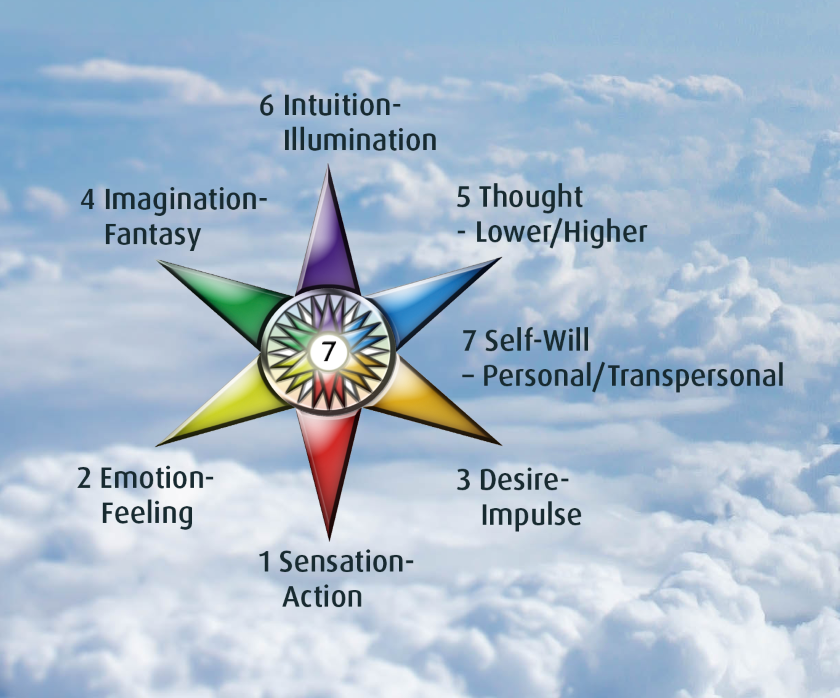
Anja: But how do we differentiate will from desire? Because he also has his star diagram, where he shows the different psychological functions. We can see that he clearly differentiates between desire and will here.
Kenneth: Yes. In his star diagram of psychological functions, desire and impulse appear as one function among several — sensation and action, emotion-feeling, imagination, intuition, thought — while the will belongs to the center. At the center (point 7) are Self and Will: personal and transpersonal, present as a potential in all people, but not developed in most.
The key distinction is this: desire pushes towards an object, whereas will coordinates the functions towards a consciously chosen aim. Will presupposes disidentification, awareness, and genuine choice. If we are compelled by impulse, conditioning, or external pressure, we are acting from desire rather than will. So two conditions must be present for will to be active: there must be real alternatives — a genuine choice — and the impulse must originate from myself. If something is forced upon me from outside, I am not exercising will. I am reacting.
Freedom as the Condition of Will
Anja: So, you’re saying there is no will unless it is free? So basically, there is no will other than free will?
Kenneth: Exactly. If it is not free, it is not will that controls our actions; it is desire, or fear, which is another form of desire: the desire to avoid pain. There is always a potential will, but it is not actualized in most people. Many people appear strong-willed because they are driven. But consider a person consumed by ambition who cannot stop, who devotes all his energy to becoming rich, intensely focused, wholly absorbed in a single objective. If he is not free to step back, to choose otherwise, then he is not exercising will. He is being driven by a powerful desire. That is not Assagioli’s understanding of the term.
Will, by definition, is free because it belongs to the personal self — the conscious I — and to the Higher Self, of which the personal self is a reflection. The self is defined as a center of pure consciousness and will. It is the observer. And in order to observe, there must be a certain elevation, a capacity to stand behind what is being observed, to remain detached. You are not your emotions, your thoughts, your impulses, or your desires; you are the witness of them. Freedom is therefore inherent in the self.
But let us be clear: this is a potential. In actuality, the self has often lost its freedom by identifying with the various psychological functions — believing itself to be the body, the emotions, the thoughts, the roles it plays. This identification is the illusion that enslaves the will.
Anja: Wow. Yeah… It really does make you think. Even though I’ve worked with the concept of the will in psychotherapy for years, I’m not sure I’ve fully understood it in this way. If something does not arise from the Self, then it isn’t will in the strict sense—it’s an expression of the desire function. And that leads me to another question. In psychosynthesis, we often work with subpersonalities. We sometimes speak loosely about the “will” of a subpersonality. But if we follow your definition, that wouldn’t be accurate, would it? Subpersonalities don’t actually have will; they have desires. Would that be the correct way to put it?
Kenneth: Yes — one might speak of an “instinctive will” or a “desire-driven will,” because both desire and will move forward with energy and direction. But the essential difference remains: the will of the self is always free. It retains the capacity to choose otherwise. It can step back. It can reconsider. It can redirect. We could go further into what Assagioli calls the strong will, the good will, and the skillful will — but we don’t have time to explore those nuances. The foundational principle must be grasped: without freedom, there is no will.
Three Requirements for Free Will
- Choice and Real Alternatives
Kenneth: So we have three key principles. First: choice is a prerequisite for will. There must be a genuine possibility of choosing. If there is no real choice, there is no freedom — and without freedom, there is no will.
- Self-Origination
Kenneth: Second: self-origination. The impulse to act must come from myself. It cannot be imposed by external forces. And this is where the will becomes something we have to develop rather than simply exercise. Very often we are heavily influenced — sometimes dominated — by other people’s expectations, cultural norms, family conditioning, social roles. As long as we are identified with these influences and simply follow them, we do not have freedom. And without freedom, we do not have genuine choice.
- Deliberation
Kenneth: Third — and equally important — is deliberation. Deliberation is the will making use of the mental function to understand competing motives. If we act only because “it feels right,” we may simply be following impulse. Free choice requires that we be able to articulate why we chose this rather than that. If I am choosing between staying home and going out, deliberation clarifies the needs on each side so the will can choose deliberately rather than being pushed by the strongest desire in the moment.
Anja: That reminds me of Assagioli’s title, The Act of Will. It sounds like it must be expressed in action.
Kenneth: Yes, and it’s a process. First, there is a goal or need. Then deliberation. Then the choice. After that comes affirmation, planning, and execution. Will is not just choosing — it is a conscious process that may be swift when the ground has been prepared, or long and effortful when the stakes are high and the inner landscape is complex.
The Function of the Will
Kenneth: To understand the difference between will and desire, we also need to see what kind of function the will performs. In Assagioli’s understanding, the will operates through the psychological functions — it directs emotional, desire, and mental energy towards a chosen aim. If we use the analogy of a captain on a boat, the captain sets the course and chooses the direction the boat must go to fulfill its mission. Behind the captain is the owner of the boat — the one with the overarching purpose. That is the Self. All the sailors are the various subpersonalities and psychological functions that help steer and manage the boat until it reaches its destination.
The will, when developed, can coordinate the psychological forces within us. That is a high goal. Many of us cannot yet master ourselves. We are governed by fears, desires, and inner subpersonalities that limit our capacity to direct our lives.
Anja: So what you’re saying is that the most important step in getting in touch with the will is to clear away the noise—the competing desires and the many voices of our subpersonalities—and to understand what is really driving us. And I imagine that isn’t easy. It must be quite difficult.
Conditioning, Relationships, and Repetition Compulsion
Kenneth: Exactly. And we are back to the central question: do I really have free will? At a superficial level, it often feels as if we do. I can choose to lift my arm. I can choose between coffee and tea. In everyday matters, freedom appears obvious. But when we move to larger life decisions — choosing a partner, a vocation, a way of living — the question becomes far more complex.
Why do we sometimes end up in relationships that are not good for us? If we truly had developed free will, we should be able to choose partners who are genuinely good for us. But one crucial element is self-awareness. If we lack awareness of what is actually good for us — of our needs, wounds, and patterns — then we make choices that are not truly free . The will cannot be free in the absence of awareness.
We know that our parents influence our later choice of partner. What we experienced in childhood — especially in relation to attachment — shapes our expectations and attractions. Someone who grew up with a distant or absent father may unconsciously repeat that pattern in adult relationships, repeatedly choosing partners who are emotionally unavailable. This repetition is not a conscious decision. It is an unconscious pattern. And although we may feel that we are freely choosing, we are often deeply conditioned by our past. In such cases, we are not acting from free will — we are reenacting conditioning. We become, in a sense, the playthings of our history.
Anja: Yes, there’s a very precise term for that: repetition compulsion.
Kenneth: Exactly.
Anja: And that concept really highlights the absence of free will in those situations. Because what’s operating is not a conscious choice—it’s compulsion. We are repeating a pattern, and repetition by its nature is not free. We may believe that we have freely chosen a partner, but in reality, it can be an unconscious repetition compulsion at work. And it can be quite painful to recognize that within oneself—to see how these patterns have shaped one’s life choices and created recurring situations over the years.
Kenneth: Yes. We often live with the illusion of freedom. What actually drives us, in many cases, is desire — but often not simply the desire for connection. It is the desire to heal something from the past. We may unconsciously believe that being with this particular person will repair an old wound. But that is not freedom. That is the pull of conditioning — an attachment to a pattern that seeks resolution.
Anja: Yes. And before we move on, I’d like to pause here, because I think this is an important distinction. You’re describing it almost from a growth-oriented perspective—as if we are trying to heal something from the past. But when I think of repetition compulsion, I feel something slightly different. It feels less like a conscious attempt to heal, and more like being governed by patterns. It’s the pattern itself that controls us—the “devil we know.” We return to what is familiar, even if it’s painful. We repeat the same structures, the same emotional dynamics, the same relational configurations. And when we are simply repeating a pattern, there isn’t really a choice. Repetition leaves no room for freedom.
Kenneth: Yes. And what is a pattern, really? A pattern is a self-image — an old identification absorbed from childhood or culture. It is not just a single thought but a whole configuration: a thought-form, an emotional atmosphere, certain recurring desires, vivid inner images, scenes and roles we have rehearsed since we were young. In other words, a combination of psychological functions — thought, feeling, desire, imagination — woven together into a structured formation. And in psychosynthesis, we call such a formation a subpersonality : a patterned organization of psychological energies that behaves like a semi-autonomous personality within us.
Anja: Yes, exactly. So in order to access—perhaps not simply “get in touch with,” but actually recognize—our will, we first need to become aware of our patterns, our subpersonalities. That’s really the starting point, isn’t it?
Disidentification and the Gap Between Stimulus and Response
Kenneth: Exactly. And this brings us to the most central technique in psychosynthesis for developing free will, disidentification. There can be no free will as long as we are identified with our patterns. If a pattern is fully fused with our sense of self — whether we are living as the victim in a relationship or as the one who dominates — then there is no freedom. We are simply living out past conditioning.
In psychosynthesis, we therefore work systematically with disidentification. We train the client to step back — to take an inner step away from the pattern. We might, for example, place the pattern on an empty chair and say: “This is the old part of you — the one that carries this pattern. You are sitting here, in a more centered position. Now look at it. Describe it to me.” Or we might ask the client to draw the pattern — to give it shape and form. In doing so, something crucial happens: what was previously a subject becomes an object. Once it becomes an object of awareness, it no longer completely governs us. That is the beginning of freedom.
Anja: What you’re saying now feels very important. In order to disidentify from a pattern, you first have to identify it—consciously. Because we are already identified with it, but unconsciously. So, to disidentify, we first have to bring it into awareness. Isn’t that correct?
Kenneth: Yes, exactly. And that awareness of a pattern, this identification of it, is the first stage in disidentification.
Anja: So when we work in therapy—whether through chair work, drawing, free associations, or other methods—what we are actually doing is helping the client to identify the pattern. To name it. Because if the pattern is operating unconsciously—if it is “up here” and unseen—then it simply is you. There is no distance. There is no recognition. But the moment a person says, “I see that I am a slave of this pattern—and I don’t know what to do about it,” something shifts. A small gap appears. There is now a conscious observer who can identify the pattern. That gap is the beginning of distance. For the first time, there is a separation between the observing self and the pattern itself. And from there, we try to widen that gap.
Kenneth: Yes.
Anja: And that’s where choice comes in—where you speak about the will. When there is even a tiny space between identification and action, something new becomes possible. Let me make it very concrete. Suppose I realize: “I keep choosing the wrong relationships because I am identified with this pattern.” When I truly see the pattern, a small space opens between me as observer and the pattern itself. That’s what we’re talking about, right?
Kenneth: Yes, that is exactly my understanding.
Anja: I’m thinking of our psychotherapy work. When clients want to change certain behaviors or recurring life situations, the first breakthrough is recognition. They begin to see the pattern. And then, when the same situation arises again, there is a moment of awareness. In that moment—between the impulse and the habitual reaction—there is a gap. And it feels like that gap is where the will enters. That is where we can act from will rather than from compulsion.
The Struggle for Mastery Over Our Desires
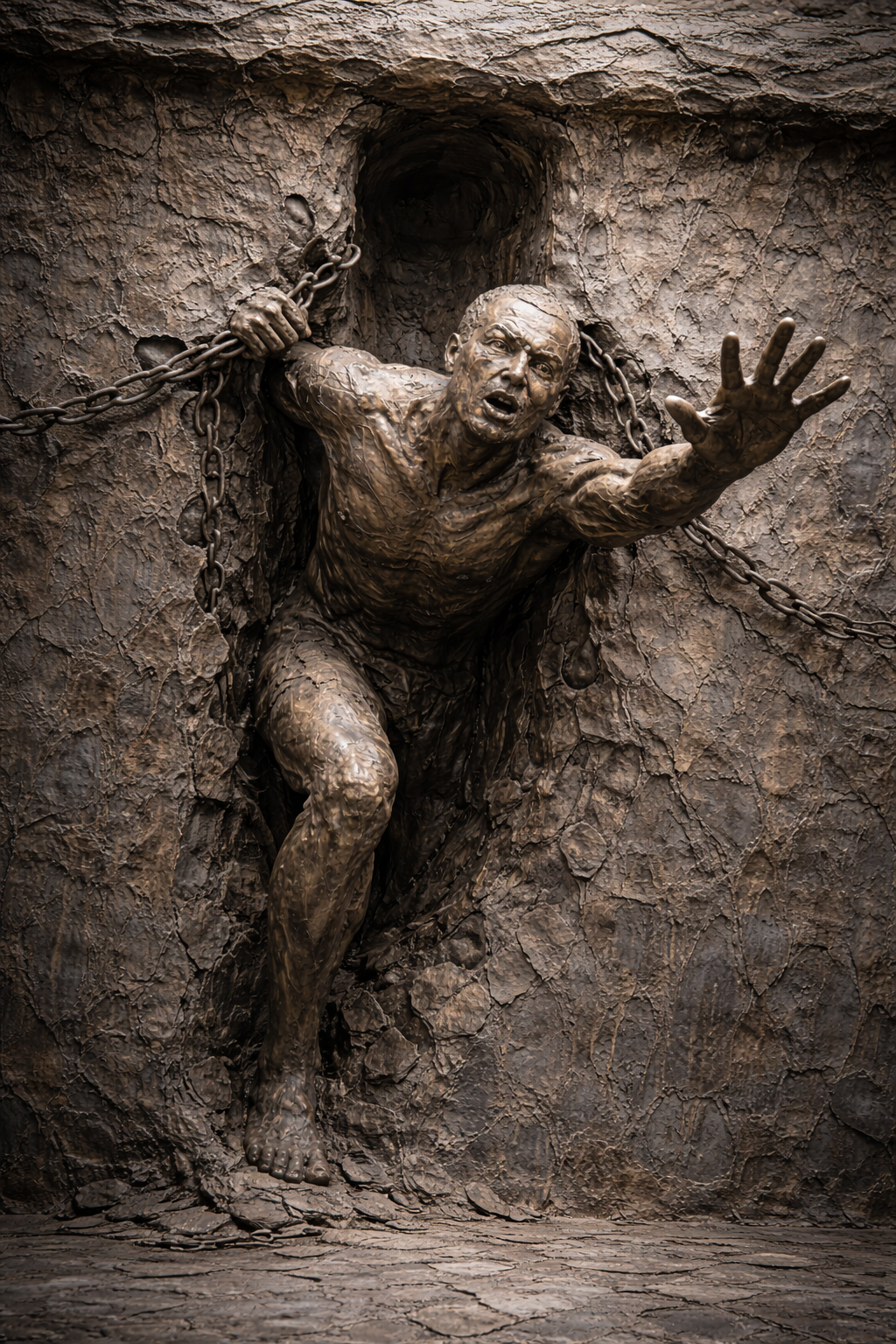
Kenneth: Yes — but very often something else happens first. When we become aware of a pattern, we may enter a painful phase. We suddenly see: “I am not free. I can see that I am a slave of this conditioning.” And even though we recognize the pattern, we may still be unable to change it. We know the behavior is not in our best interest. We know we are attached to it. Yet we cannot choose otherwise.
So awareness creates the gap — but it does not immediately grant mastery. Sometimes it first reveals how deeply conditioned we are. And that realization can be both sobering and transformative.
We could say that the will is the function within us that chooses which desires we will follow. We are not meant to blindly follow our desires; our desires are meant to follow us. The will evaluates and selects among competing needs, values, and impulses. We will always have desires — all the psychological elements will always be present. But the will is the part of us that can step into awareness and ask: Which of these impulses serves my deeper aim? Which leads to the best outcome?
Of course, the will is often overpowered by old conditioning. We fall back into familiar patterns, and the old forces take over. Yet the will can re-emerge. As conscious individuals, we can say: “I see what is happening. I can make a plan. I can seek psychotherapy. I can work through this conditioning.” Through that work, we gradually create the conditions in which we can act more freely. The will may not always be free — but it can become freer through conscious effort and development.
Subpersonalities, Inner Conflict, and Integration
Anja: Two things come to mind. First, I have to say—the image of the conductor and the orchestra keeps returning to me. If the will is active, it’s like a conductor standing before the orchestra, coordinating all the instruments into a coherent whole. But if the will is not present, then each instrument simply plays its own part. Everyone is following their own impulse, and instead of music, you get noise. There’s no harmony. And the second thing I’d like to explore further is this: what happens when you’re faced with a situation in which certain subpersonalities are simply too powerful? Their desires are overwhelming. You intend to act differently, but before you know it, you’re pulled back into the old pattern again. So how do you deal with that? It seems to me that you really have to engage with the subpersonalities themselves. Isn’t that the first and most important step? Because if their desires are that strong, you can’t just override them. You have to understand them and work with them in order to handle the force and power they carry.
Developing the Psychological Functions
Kenneth: Yes — and I would say that it depends very much on the goal you are aiming for. If your goal is to run a marathon and you have never run before, you must work with your body — train, strengthen, and prepare it so it can actually perform. This illustrates an important principle: it is not enough simply to choose something. The question is whether we have the capacity to execute that choice. If the relevant psychological functions are not sufficiently developed, they will not be able to carry out their intention. The will is therefore limited by the level of development of the functions it must work through.
If I decide to become a doctor, that demands a highly developed mental function — sustained intellectual discipline, accumulated knowledge. Without those, the intention remains a wish. So when the will chooses a future aim, that choice immediately demands the discipline and development of the appropriate functions. The will sets the direction, but the functions must be trained to achieve the goal. In that sense, the will and the development of the personality are inseparable.
Anja: Yes. But if your psychic energy is tied up in a pattern—for example, a deep lack of self-belief—then that goal isn’t going to materialize.
Kenneth: Exactly. If I decide to become a doctor, but a self-doubting part of me constantly generates negative thoughts — “You will never succeed,” “You are not capable,” “You will fail” — then we have to address that part. In the orchestra metaphor, these subpersonalities are like musicians who refuse to play the chosen piece. The conductor may set the direction, but if certain musicians rebel and insist on playing their own tune, there can be no harmony — and no mastery.
Anja: Yes. So then you have to go to that musician and ask, in a sense, “What is your concern? Why don’t you want to play?” That engagement with the subpersonalities feels crucial in psychotherapy. But especially if you want to connect with your will. You have to understand what is tied up in that subpersonality—what energy, what fear, what belief—so that it can be released and eventually used in alignment with what truly matters to you.
Kenneth: Yes. And this brings together everything we have said. The will faces two interconnected tasks. First, it must work to clear the lower unconscious — the realm of past conditioning, repressed material, and unintegrated subpersonalities. This is the work of personal psychosynthesis. Second, it must develop the psychological functions through which it acts: body, feeling, mind, imagination, intuition. Weak or undeveloped functions constrain what the will can accomplish, however clear its intention.
So do we have free will? We have the potential for it. But that potential is limited by past conditioning and by the underdevelopment of the functions that the will must work through. Freedom is not given; it is built. We build it by clearing the lower unconscious of its accumulated weight and by developing the capacities through which our choices can actually be carried out. The will, in this sense, is both an act and an achievement.
The Will to Power and the Will to Serve
Anja: What are your thoughts on the concept of will to power?
Kenneth: The will to power, as I understand it, is the will identified with ambition — and ambition is a strong desire connected to the instinct of self-assertion. This is the drive to stand out, to dominate, to be recognized, to be number one. It fuels the pursuit of status, influence, and power. It is a central driver of ego development — of “making it” in the world.
In that sense, the will to power represents a personality organized around a powerful desire for self-assertion. The will serves that desire unconsciously. But this orientation often comes into collision with another possibility: the will to serve. The will to serve arises from a deeper level of identity — what we might call the soul or the Higher Self. Here, the motivation is not self-assertion but contribution; not elevating the ego, but identifying with something larger than personal interest. In the will to power, we identify with the separate self. In the will to serve, we identify with the whole. And at some point in development, there is often a collision between these two orientations — the ambition of the ego and the will of the soul.
Anja: So perhaps it would be useful for all of us to recognize that our most powerful desires often arise from the ego, and that these are closely connected to what we might call the will to power.
Kenneth: Yes, exactly.
Can We Change How We Feel?
Anja: Some would argue that we have no free will precisely because we cannot choose our feelings, emotions, and thoughts, which seem to arise on their own, without our permission. How do you respond to that?
Kenneth: It is true that we do not directly choose the content that arises in consciousness — a feeling of dread, a sudden memory, an irrational desire. But psychotherapy consistently shows that desires and emotional patterns can change when we work with their unconscious roots. What appears to be spontaneous inner experience is rarely random; it reflects the accumulated impressions, conditioning, and patterns — the subpersonalities — that have been shaped within us over time.
The question, therefore, is not whether inner content arises unbidden — it always will. The question is whether we can relate to it with awareness and choose our response. That capacity to pause, to observe, and to choose is exactly what develops through the kind of work we have been describing. The content of consciousness is not always free. But our relationship to that content — the stance we take towards it — is where freedom lives, and where it can grow.
Authenticity, the Will to Be, and the Transpersonal Dimension
Kenneth: When we speak about the will at its most basic level, I would say that the deepest will we have is the will to be who we truly are. There is a powerful inner force within us that urges us towards authenticity — to become and express our unique nature. And this draws us into the deeper inquiry: who am I, really?
I like to think of the transpersonal will of the Higher Self as a guiding force — a great hand, so to speak — that gently but persistently pushes us forward, urging us to bring our originality and authenticity into the world. At the most fundamental level, there is the will to be and the will to live. We each face, in a very basic sense, a primordial choice: do we say yes to life? If we choose to live, we also choose to inhabit a personality with its desires, thoughts, instincts, and vulnerabilities. To say yes to life is to accept the full range of human experience. Our work is not to eliminate these forces but to bring them under the increasing guidance of awareness and will.
Anja: We are moving into somewhat metaphysical territory here. But it seems to me that the will is not merely a psychological function—it is, in some sense, a transpersonal identity. It is connected to authenticity, to the expression of our deeper uniqueness. The will, at its highest, aligns us with that which we most truly are and by doing that becomes in service of the whole.
The Universal Will
Kenneth: Exactly. And now we arrive at perhaps the deepest perspective of all. From Assagioli’s point of view — particularly in The Act of Will, in the chapter on the Universal Will — there is ultimately only one will: the Universal Will. This Universal Will expresses itself through all human beings. We are not separate from it; we participate in it. In that sense, we are spiritual beings having a human experience. The deeper dimension of who we are seeks expression through our humanity — through our thoughts, actions, and relationships.
This raises an important question: if there is only one Universal Will, are we truly free? Are we merely instruments of a larger divine energy? The answer, in this perspective, is that in our deepest essence, we are not separate from that Universal Will. It is not something acting upon us — it is what we most truly are. The Universal Will is not external to us; it is our deepest identity.
Anja: So then freedom would consist in expressing that authenticity, bringing forth our unique contribution in service of the greater whole. That act of expressing our uniqueness—that would be free will.
Kenneth: Yes — because in that moment, we are aligned with our deepest nature. In what Assagioli calls peak or height experiences, we may briefly touch that unity directly: a sense of being one with universal life, a witness consciousness in which the experience of separation dissolves. This is the testimony of the great mystics across traditions — that at the deepest level of our being, there is unity. Our task is to awaken to that reality and to express it through our lives.
Anja: I think that’s a beautiful way to conclude—not so much a summary, but a way of framing it: free will as the expression of our uniqueness in service of the whole.
Kenneth: And yet we become entangled in conditioning. From the moment we are born into a family, a culture, a social structure, layer upon layer shapes us. Part of the work of the will is to discern what is authentic and what is merely conditioned. Every choice shapes our character. When we choose from conditioning that is not truly ours, we bring inauthenticity into our lives. But when we choose from that deeper inner source — when we feel, “This is truly me” — then we express originality. Then we begin to shine as we are. And I think that is the beauty of the will: it aligns us with our true nature. And I believe we do have one.
Conclusion: Freedom Begins with Recognition
Kenneth: Okay. Have we come full circle on free will and what blocks it?
Anja: I think it’s been quite interesting because we started off by saying we would discuss the nature of the will from a psychosynthesis point of view. And I found it striking how vague my understanding really was—especially the difference between will and desire. Through this conversation, it becomes clearer. And towards the end—to see free will as the will expressing authenticity, expressing our uniqueness in service of the whole—that has been a very useful perspective for me.
Kenneth: And for me, what stands out is how central freedom is. Whenever we are in a situation where we have to choose something important, the first question to ask is: Am I free? And if I am not free, what is pulling me? What is conditioning me? That question — about the reality of one’s freedom in a particular situation — may be the most important question the will can ask.
Anja: And that gap between stimulus and reaction—that feels important as well. When you have that recognition, that awareness—”Ah, I can choose”—that’s a very powerful moment. When we notice, “I’m in this situation again. I could respond in the old way, or I could choose something different.” For most people, that moment is very powerful. And perhaps it’s the first taste of actually recognizing that they have a will.
Kenneth: Yes. And this is actually the first revelation: “I am a slave of this.” And that recognition — strangely — is the first freedom. It may sound discouraging, but it is a reality. A ray of light enters. And from that point, something can begin to change. That is where the will awakens. That is freedom — not yet complete, but real.
