

The Origins, Institutional Development, and Global Spread of Psychosynthesis from 1906 to 1974
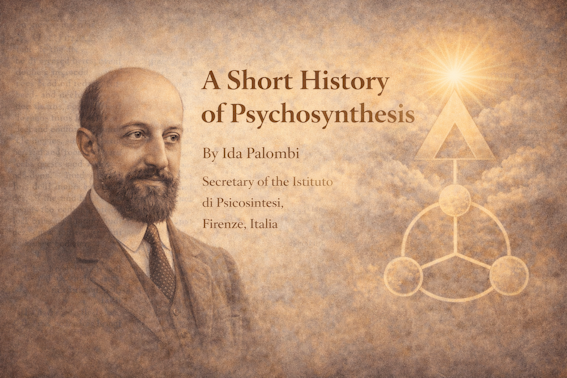
By Ida Palombi
Secretary of the Istituto di Psicosintesi, Florence, Italy
c. 1974
Reformatted and copyedited by Jan Kuniholm [1]
Editorial Note:
The abstract, contextual subtitle, and cross-sections have been added for clarity and navigation. The original wording, sequence, and structure of the text have been preserved. No conceptual edits have been made to the author’s original writing.
Abstract
Written by Ida Palombi, Secretary of the Istituto di Psicosintesi in Florence, this institutional history traces the origins and global dissemination of psychosynthesis from Roberto Assagioli’s earliest publications in 1906 through to the early 1970s. Beginning with Assagioli’s pre-medical writings, his founding of the review Psiche in 1911, and the establishment of the first Institute of Psychic Culture and Therapy in Rome in 1926, the text chronicles a progressive expansion of the psychosynthesis movement across Europe and the Americas. Key milestones include the post-war revival of activities in 1946, the founding of the Psychosynthesis Research Foundation in New York in 1957, the reconstitution of the Florence Institute in 1961, the publication of Psychosynthesis: A Manual of Principles and Techniques in 1965, and the establishment of centers in Greece, England, France, Canada, California, Argentina, and beyond. The article also articulates what distinguishes psychosynthesis from other psychotherapies — including its appeal to the superconscious, its use of the will, disidentification, and anagogic symbols — and concludes with Assagioli’s five-field framework for the application of psychosynthesis to individual, therapeutic, educational, interpersonal, and social life. The document draws on two archival versions of the manuscript, one of which bears hand-written corrections in Assagioli’s own hand.
The history of the birth, development and dissemination of the branch of psychology known as Psychosynthesis is in large measure linked with the life-story of its originator and founder, Dr. Roberto Assagioli. Even before he came to give the principles of psychosynthesis definite form he was already writing and publishing articles on psychological disciplines and therapy, some of them dating back to as early as 1906, previous, that is, to his obtaining his medical degree in 1910.
He had been preparing the ground by lecturing on Psychology and Art of Living to the Anglo-American Association of Rome, and by participating, in 1908, in International Conferences of The History of Religions and Moral Education held at Oxford and in London respectively. His contributions were reported in the review Scientia. [2]
In 1911, he founded the review Psiche, in which appeared various articles that produced a somewhat “explosive” effect, the period and contemporary conditions being what they were. Drawing on his experiences, as doctor and as lecturer and writer, he then gradually elaborated the conception and methods of psychosynthesis.
In 1926 he established the Istituto di Cultura e Terapia Psichica (Institute of Psychic Culture and Therapy, later called Istituto di Psicosintesi) in Rome, with the purpose of developing, applying and teaching the techniques of psychotherapy and psychological training: techniques designed to create a synthesis in a patient and to foster new guidelines in the field of education.
1927 saw the appearance of a booklet in English entitled A New Method of Healing: Psychosynthesis, which was followed by various other writings on psychosynthesis. Here is an extract from the prospectus of the Institute’s program and aims:
The Institute addresses itself to everyone, since the methods of psychic culture can serve anyone as a means of preserving and promoting health, increasing personal efficiency, developing and improving the personality, and exerting a more forceful and beneficial influence on others. In addressing itself in particular to all who suffer in mind and body, and whose latent curative psychic energies need awakening, our Institute offers assistance especially to:
- Sufferers from any type of physical disease, who are able to bring about a profitable integration of appropriate psychotherapy with whatever other treatment they are undergoing. (It is to be noted that psychotherapy in no way excludes ordinary therapy, but combines with it.)
- Sufferers from nervous and psychic disturbances for whom special methods of psychotherapy suited to respective cases often constitute the most effective treatment.
- The shy, the sensitive, the emotionally polarized, the despondent and the discouraged who aspire to become calmer, stronger and more courageous.
- Those who desire to learn how to achieve mental concentration and strengthen the memory.
- Those governed by passions and impulses they desire to control.
- The weak-willed.
- All those who would rid themselves of some habit or vice (excessive smoking, addiction to alcohol, drugs, etc.).
- Those harassed by suicidal impulses.
- Those desirous of learning now better to educate their children or their pupils.”
The basic principles and methods outlined above still continue to characterize today’s activities of the Institute of Psychosynthesis. With the passage of the years, however, they have been enriched by new contributions, reviewed in the following pages, while maintaining a full rhythm of development through the practical fulfillment of the Institute’s wide-ranging program.
Since the early days the diffusion of psychosynthesis has been fostered mainly by means of annual courses of lessons given at the Institute, and this practice is still in operation today. The 1928 Course merits particular notice, having had as its theme The Energies Latent in Us and Their Use In Education and Medicine. The basic purpose of these courses was and is to teach the use of psychosynthesis as a unifying agent of the best elements of other methods, and as a means of harmonizing the conflicting aspects of the human personality in a higher synthesis.
Principles Distinguishing Psychosynthesis from Other Therapies
As regards its application in psychotherapy, the specific characteristics of psychosynthesis, differentiating it from other psychotherapies, may be indicated as follows: Exploration and activation of the superconscious – Appeal to the Self – Deliberate, conscious disidentification – Development and use of the will – Active cooperation on the part of the patient based on a program of exercises and the strengthening of his creative activities – Choice and active use of anagogic symbols – Reduction of the tendency to dramatize; smiling wisdom, humor; the techniques of joy, the technique of the Ideal Model, etc. In addition, the range of psychosynthesis includes the body as well, making application of various techniques of physical culture and appropriate sports.
During the Second World War ail the activities of the psychosynthetic movement had to be suspended. They were resumed in 1946, with lectures and courses of lessons in psychosynthesis, psychological types and other related subjects. These were given in Italy, Switzerland, England and the United States in the respective languages. Concurrently new articles and pamphlets were published.
Post-War Revival and International Expansion (1946–1961)
In 1957 the cooperation of a group of friends paved the way for the foundation of the Psychosynthesis Research Foundation with offices in New York, [3] where it continues to perform the invaluable function of disseminating information about psychosynthesis through publications, seminars, etc., in various languages. In 1958 and 1959 Paris and London provided the venues for conferences held by Dr. Assagioli and co-workers.
In 1960 the Athens Center was established under the direction of Dr. T. Triantafyllou, who provided for the publication and printing in Greek of various writings; their distribution has been and is being carried on with the approval of the Minister of Public Instruction.
In September 1960 the first International Week of Psychosynthesis took place in Switzerland, with the participation of representatives of nine countries. Organized by the Principal of the Institut Bleu Leman of Villeneuve, near Montreux, the Week aroused great interest among the participants.
1961 turned out to be a year of considerable importance for the development of psychosynthesis. In June of that year the Istituto di Psicosintesi [Institute of Psychosynthesis] was constituted, with headquarters in Florence, Italy. Its purposes, as set forth in the articles of Constitution, are stated to be: To disseminate the knowledge and promote the development of psychosynthesis, as an integral conception of the human personality; to foster the functioning, development and continuity of activities of an educational and psychotherapeutic nature, especially through the training of new co-workers who have previously undergone “didactic psychosynthesis” in the use of psychotherapeutic techniques.
International Congresses and Growing Global Recognition (1961–1965)
In August of the same year the Institute took an active part in the Fifth International Congress of Psychotherapy in Vienna, to which Dr. Assagioli contributed a paper on Psychosynthesis and Existential Psychotherapy. He also chaired a Symposium on Psychosynthesis. The impact produced by the Institute’s contributions was considerable, and the repercussions attracted in particular the interest of colleagues in the two Americas, who continue to keep contact and distribute writings on psychotherapy.
The Second International Week of Psychosynthesis was held at Villeneuve in September of the same year. In 1962, during conferences in London, the idea of establishing a Center for spreading psychosynthesis in England was mooted. This Center was to develop the educational and self-cultural side in line with psychosynthetic methods; but its activity has been limited. In September a Semaine de Psicosynthese took place at Viry-Châtillon, near Paris, which focused on the principles and methods of inter-individual psychosynthesis.
In the following year the Institute of Psychosynthesis organized a conference on problems presented by young people and super-gifted children, and on the best ways of coping with them. Some fifty persons of various nationalities attended, and valuable contributions were made towards solving the wide range of questions associated with this task.
Both in 1963 and 1964 the Psychosynthesis Research Foundation of New York sponsored a series of monthly meetings under the chairmanship of Dr. Jack Cooper, an American doctor who had undergone a didactic psychosynthesis with Dr. Assagioli. During the course of them the possibilities of the clinical applications of the techniques used in psychosynthesis were amply examined. In 1964, the Institute took part in the Sixth International Congress of Psychotherapy in London, at which was given on Synthesis in Psychotherapy. At the end of the Congress a Symposium on Psychosynthesis was organized at the St. Ermin’s Hotel and attended by 20 medical doctors and psychologists of different nationalities. Case histories came up for discussion in which psychosynthetic techniques had been adopted as a method of treatment. The cases presented by Dr. Cooper aroused particular interest, as did those provided by Dr. Weiss, also of New York, whose interest relating to psychosynthesis was maintained up to the time of his death about a year later.
Key Publications and Institutional Milestones (1965–1968)
1965 also marked an important date for developments in the field of psychosynthesis. It was in that year that the Institute was recognized by the Italian state as having legal status, with all the resultant prestige and the moral advantages accruing to this standing. Furthermore, the book written in English by the Institute’s president, Dr. Roberto Assagioli, was published in the United States. Entitled Psychosynthesis – A Manual of Principles and Techniques, it had great success not only in the scientific field. It has gone into several editions totaling more than 20,000 copies and been widely distributed among students in English-speaking countries. Again in 1965 conferences were held in London and at Glion, above Montreux in Switzerland, for which the techniques of psychosynthesis provided the main topic. The Glion conference was followed by an “International Week of Psychosynthesis”, attended by representatives of ten countries.
Dr, Assagioli’s first book in Italian, Per l’Armonia della Vita (For Harmony in Life), appeared in 1966. Its emphasis was laid on the application of psychosynthesis in the educational field and as a means of self-realization. It was accorded a very appreciative reception. A second edition under the title Psychosynthesis – Harmony in Life was subsequently issued in 1971 by the publishing house Edizioni Mediterranee of Rome.
In August 1966 a Symposium on Psychosynthesis was held in London at the Basil Street Hotel, with the participation of Dr. Assagioli and the President of the Psychosynthesis Research Foundation of New York. The theme of the symposium was the possibility achieving a harmonious synthesis between the different bodily and psychic functions. Another topic that came in for discussion was the necessity of group work in hospitals and clinics involving the house physician, a psychotherapist or clinical psychologist, a social worker and a nurse, etc. The theme of the will was also considered and the groundwork laid for the establishment of an Argentine Center of Psychosynthesis and for the preparation of a book on the will.
The Rome Centre of Psychosynthesis was officially opened in January 1967, and in September psychosynthesis occupied an important position on the agenda of the First International Psychosomatic Week, at which Dr. Assagioli both spoke on Psychosomatic Medicine and Bio-psychosynthesis and chaired an International Symposium on psychosynthesis. Other speakers included representatives of the movement from Italy, England, France, the United States and India.
New Centers and the Nature of Psychosynthesis as a Movement
During these meetings the question was raised about the relations between the different Centers of Psychosynthesis in existence, in the course of formation and to be constituted later. This gave an opportunity to explain the true nature and “spirit” of psychosynthesis. Neither a doctrine, nor a “school” of psychology, nor an exclusive method of self-culture, therapy and education, it could be defined principally as a general attitude, a tendency towards, and a series of activities aiming at, integration and synthesis in every field. No one can claim to be its exclusive representative; it cannot therefore be represented by any “super-organization”. Its external structure cannot be regarded as a “solar system:, but rather as a “constellation”.
During September of 1968 the Seventh International Week of Psychosynthesis was held in Rome. Organized by the Rome Center, it provided an opportunity to hear a number of reports which dealt, as fully as the occasion permitted, with the principal branches studied and applied in psychosynthesis: therapy, education, self-culture, interpersonal and social relations. In 1969, while courses and training activities proceeded regularly in Florence (as in past years), a new Center of Psychosynthesis was located in Bologna. Promotion of psychosynthesis in education was to be its principal activity. The same year saw the inauguration of a California Center of Psychosynthesis of which the development has been so rapid and productive as to warrant its present constitution as an Institute of Psychosynthesis. Located at Redwood City, it provides instruction in psychosynthesis and trains new workers.
The Perugia Centre was established in January 1970. In the summer of the same year the Centre Recherche et Rencontre of Paris organized a conference on psychosynthesis. The heads of all the Italian Centers were present, as were representatives from the United States, Switzerland and France. Much interest centered on reports giving accounts of how psychosynthetic methods of therapy and education were being applied in various European and non-European countries.
The years 1971 and 1972 were taken up with the preparation of material for publication, besides the work of organizing more satisfactorily the activities associated with the training and courses offered at the Florence Institute. The library there has now been arranged systematically and is at the disposal of the Institute’s members. In the Autumn of 1972 the Canadian Institute of Psychosynthesis was officially set up in Montreal and is now engaged in a program of cultural activity and psychosynthetic applications.
1973 was an important year for psychosynthesis. The Rome publisher Casa Editrice Astrolabio issued an Italian translation of the English-language book on the psychosynthetic techniques. Revised and amended by the author, Dr. Assagioli, and entitled Principi e Tecniche della Psicosintesi Terapeutica (Principles and Techniques of Therapeutic Psychosynthesis), it has had and is having a wide circulation throughout Italy, meeting with favorable response, as witness the numerous letters from doctors, psychologists and educators asking for more detailed information on psychosynthesis and about the Institute. In addition, Dr. Assagioli’s book, The Act of Will was issued [in English] by the Viking Press of New York. An Italian edition is in preparation. Again in 1973, psychosynthesis was represented at various national and international conferences, held at San Remo, Messina, Oslo, etc. At a Conference on Futurology at Crans, Switzerland, psychosynthesis was referred to as the “Science of the Future”.
1974 promises to be a very productive year as regards the dissemination and increased recognition of psychosynthesis, which will be given a vigorous impulse in Northern Italy by the establishment of a new Centre at Padua. England meanwhile is to have a Center with branches located in London and elsewhere.
Turning now to the activities of the Florence Institute — whose summer location is the “Villa Ilario”, in Capolona (Arezzo) — it is worth remarking that from the time of its foundation until today it has not ceased to make a significant contribution in the didactic field, having prepared a number of doctors and psychologists to follow the vocation of psychosynthetic therapist or educator. Furthermore, it has been active culturally, both locally and in liaison with the Italian and foreign Centers, in order to foster their development, organize a frequent exchange of specialized material to assist their work, and help them in having their written matter printed or mimeographed.
The Five Fields of Psychosynthesis and a Vision for Humanity
An interesting feature of the evolution and spread of psychosynthesis is the manner in which its conception and spirit have undergone a progressive expansion from the individual to the global, so to speak. This is illustrated by the wording of the Institute’s motto at the time of its foundation in Rome in 1926, which was “Know thyself — Possess thyself — Transform thyself.” On the reopening of the Institute of Psychosynthesis in Florence in 1961, Dr. Assagioli decided to discard this motto and expand the work in five fields differentiated as follows:
- Individual Psychosynthesis, personal and transpersonal , constituting the necessary preparation for functioning in all other fields.
- Psychotherapeutic field , catering to doctors and psychologists desirous of applying psychosynthetic methods in the practice of their profession, and willing to complete their training.
- Educational field , keyed to the needs of educators, parents and all those willing to experiment with better and more modern educational methods, in both family and school.
- Field of interpersonal relations , with its focus on the troublesome problems of the couple, as well as relations between parent and child, teacher and pupil, therapist and patient.
- Field of group and social relations , concerned with the psychosynthetic approach to the treatment of polarities and conflicts between the individual and the group, and between different social groups, having in view the psychosynthesis of the whole of humanity .
In each of these fields the problems of the young are accorded special importance and attention.
They are invited to collaborate in reducing the widespread aggressiveness between generations prevalent today and in the creation of a new and world-wide civilization and culture.
…
[1] This editor located two versions of this document, which was probably originally prepared in 1974. The first is Doc. #24252, a typed manuscript at the Assagioli Archives, and the second is a cleaner typed copy from the records of the Psychosynthesis Research Foundation. The two are substantially the same, but the first has hand-written corrections in Dr. Assagioli’s handwriting that was incorporated into the second document. Minor typographical errors and some errors of fact have been corrected, but otherwise the language and format of the original have been retained. -Oath.
[2] Scientia was an Italian journal that was published from 1907 to 1988, and published articles by many famous scientists including Nobel prize winners. Collections of its issues are held in many libraries including being posted online by the University of Bologna. -Oath.
[3] The Psychosynthesis Research Foundation was originally situated at the Valmy Estate in Delaware, where the first Psychosynthesis Conference in North America was held in May of 1958. Its offices were moved to New York in 1960. The Foundation was dissolved in 1976. —Ed.
—Pub.
