

What is Free Will?
And The Three Conditions for Free Will
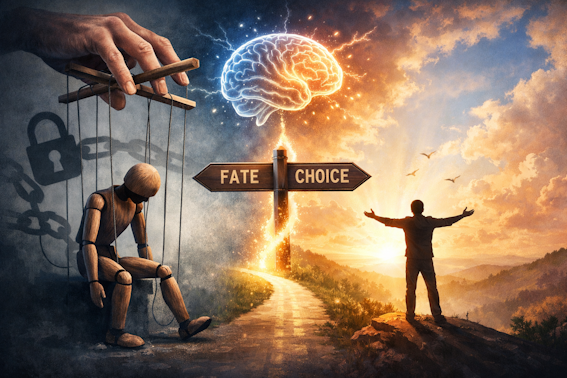
Free will is the capacity of the conscious self — the personal “I” — to choose and act from genuine inner freedom, rather than from conditioning, impulse, or desire. In psychosynthesis, free will is not treated as a given philosophical debate but as a developmental achievement that can be progressively won through self-awareness and inner work.
Will and desire are not the same thing. In Assagioli’s star diagram of psychological functions, desire and impulse belong to the periphery — one function among sensation, feeling, imagination, intuition, and thought. The will belongs to the center, at the point of the self. Desire pushes towards an object; the will coordinates all the functions towards a consciously chosen aim. A person driven by powerful ambition who cannot stop or choose otherwise is not exercising will — they are being driven by desire. Will, by definition, is free. If it is not free, it is not will, as we discuss in the full dialogue on free will in psychosynthesis.
Three conditions are required for free will to be real:
- Genuine alternatives — there must be a real possibility of choosing otherwise.
- Self-origination — the impulse to act must come from within, not be imposed by external pressure, expectation, or social conditioning.
- Deliberation — the will uses the mental function to weigh competing motives, so that choice is conscious rather than a surrender to the strongest desire of the moment.
Free will is blocked by identification. When we are identified with a pattern — a subpersonality, a repetition compulsion, an old conditioning from family or culture — there is no inner distance, and therefore no freedom. The repetition simply runs. The first step towards free will is not the ability to choose differently but the recognition that, in this situation, we are not yet free. That recognition — “I am a slave of this pattern” — is paradoxically the first freedom: a gap opens between the observing self and the pattern, and in that gap, choice can begin.
Disidentification is the central technique. By stepping back from a pattern — naming it, placing it at a distance, making it an object of awareness rather than an unconscious subject — the self begins to recover its capacity to direct rather than merely react. The will then faces two tasks: clearing the lower unconscious of its accumulated conditioning, and developing the psychological functions through which its intentions must be carried out. Undeveloped functions limit what even a clear intention can achieve.
At its deepest level, the will is the drive towards authenticity — the force within us that presses towards the expression of our unique nature. Assagioli’s concept of the Universal Will suggests that at the highest level of development, the personal will aligns with something larger than personal interest: a will to serve rather than a will to dominate. Freedom, in this sense, is not the absence of all constraint but the alignment of one’s choices with one’s deepest nature — the moment when one can say, from the inside: “This is truly me.”
« Back to Glossary Index
