

A Personal Reflection on Psychosynthesis and Its Founder
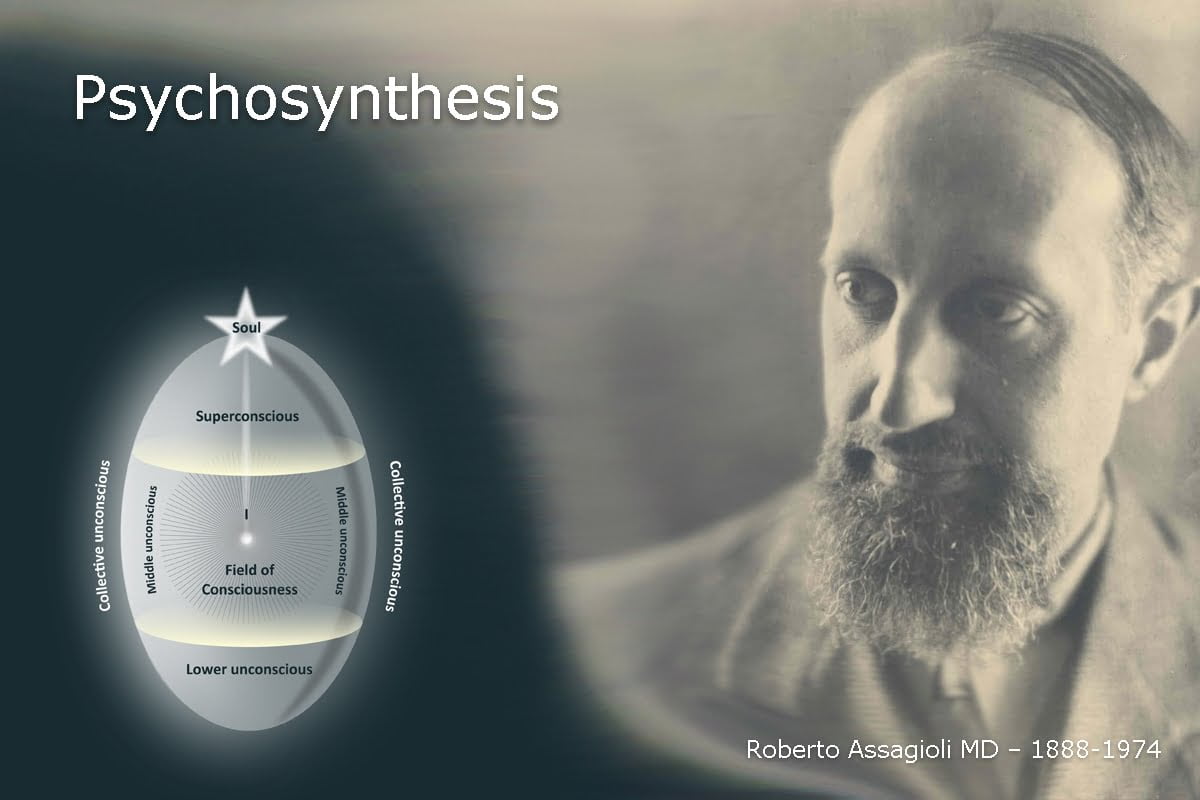
By Stuart Miller ,
First published in the United States by Popular Psychology (date uncertain).
Archival source: Assagioli Archives, Doc. #24343 (dated 1972).
Re-formatted and edited with notes by Jan Kuniholm (2024).
Editorial Note
This essay is a personal recollection by Stuart Miller. The abstract and subheadings have been added by the editor, Kenneth Sørensen, for clarity and navigation. They were not part of the original publication and do not alter the author’s text.
Original abstract by Popular Psychology: In the article below on his personal experience, Stuart Miller, a Director of the Esalen Institute, [i] describes the impact and effect on him of Psychosynthesis and Roberto Assagioli, its inventor. Miller is one of the people chiefly responsible for guiding Esalen in new directions and seeking out those disciplines of personal growth that seem most effective. Both he and Michael Murphy, Esalen’s founder, having worked with literally hundreds of systems for personal development, feel that psychosynthesis presents certain advantages that will make it useful on an ever-wider scale for the millions of Americans who are turning to the task of developing themselves as people. They don’t claim that it’s the answer, but they do say it provides a framework for getting more and larger answers. As Murphy recently wrote: “After years of exploration with countless approaches to personal growth and education, we have felt an increasing need for a unifying understanding of human nature and a comprehensive discipline. Psychosynthesis promises to fill that need.” Their idea is not that psychosynthesis will replace other techniques but, rather, that it will provide a framework for using them.
We asked Stuart Miller to introduce his personal account by giving our readers some more objective answers about psychosynthesis in an interview with Popular Psychology. — Editors, Popular Psychology.
First Encounter with Assagioli in Florence [iii]
Michael Murphy, the President of Esalen Institute, my wife and I were in England in the summer of 1970 looking into new developments that might be of interest to Esalen. In many ways it had been a disappointing visit. The English had greeted many of the things we brought to them with great excitement — encounter, sensory awareness, forms of meditation, the theory of developing the human potential. But I had hoped to find something new for Esalen and myself. How annoying, after all the work I had done on myself with the help of Esalen, to be still so dissatisfied. And then, of course, I wondered a lot in the muggy June weather of London if the enthusiasm with which the English were greeting us would last. What we had brought them was exciting and important, but there was also something missing in what Esalen had to offer.
We got a letter from Jim Vargiu [iv] inviting us to do a week of didactic psychosynthesis with Roberto Assagioli. I didn’t know anything about psychosynthesis, but I knew Assagioli’s name as one of the founders of the Association of Humanistic Psychology. I thought it was proper, since we were in Europe, that we met him. The three of us flew down to Florence, and shortly after our arrival we met with Assagioli for a brief welcome. He impressed me: a tall man, slightly bent over at the shoulders with age, his eyes seemingly endless like Fritz Perls’ eyes had been, endowed with the same statement of spiritual authority, but cheerful. He was very cheerful. So many of the teachers I had met, including Fritz himself, had not had this air of light gaiety.
I was intrigued by the, to me, paradoxical combination of deep authority and lightness. We began visiting him once or twice a day and he would give us little seminars. We would write our questions on a pad and show them to him, because he was deaf. He was incredibly alert and would pounce down his answers with a twinkle in his eyes,
Acting from the Best Center: A Philosophical Challenge
Some of the things he said disturbed me very much. He said that the basic method of psychosynthesis was to develop a person’s ability to act from his best center. This sounded, to me, so opposite to the teachings of encounter and gestalt that I accused him of being unfaithful to the human experience. I told him that he was recommending ”phoniness.” Then he explained to me that there might not be any contradiction between psychosynthesis and such methods as encounter and gestalt, but that, to begin with, it is important to get straight what was “phony” and what was “real.” To be real, he explained, is not the same as being true to one’s neurosis, or one’s negativity. These, he said, cannot be ignored or repressed. But they are not real in the same sense that our true “Self” is real — the part of us which is the seat of our consciousness and our highest aspiration and knowledge.
The Higher Self and the Reorientation of Purpose
Of course, you will say. But you had forgotten. Lost in some of the methods of self-improvement, I had forgotten the purpose of many of the techniques associated with Esalen. The purpose was, presumably, to develop myself into a better human being. It was for this reason that I would learn to contact my anger in an encounter group or investigate my demons in Gestalt therapy. But I had forgotten the purpose and gotten lost in mere technique. The first important thing that psychosynthesis did for me was to liberate me from the thralldom of my negative emotions and thoughts. It recalled to me what I always knew, namely, that at the heart of my being, as well as everyone else’s, there was divinity, however latent to a degree. Since these first meetings, Assagioli and psychosynthesis have helped me to remember who, essentially, I really am, although I must confess that I still forget more frequently than I would like.
Integration Rather Than Rejection of Techniques
What with all this emphasis on the positive aspects of my self, the marvelous thing, from the very beginning, was that psychosynthesis didn’t seem to ask for really important sacrifices. I did not have to give up the explorations that techniques like encounter, gestalt and bio-energetics had led me to. Instead, I could use these but this time without losing sight of my higher self and my pervasive aim which is to develop my personality in tune with what is highest in me. As the days went on in Florence I began to see, in talking with Assagioli and reading his work, that psychosynthesis showed me a framework in which I could find liberation from the personal nonsense which torments me, without denying the existence and the peculiar reality of that nonsense. I began to feel that I had a new direction without having to exclude what I had already learned.
A Framework for Synthesis
Furthermore, psychosynthesis had a generous quality; just as it did not exclude aspects of the psyche, so it did not exclude other techniques and approaches. I had heard so many irritated teachers denounce the work of other teachers. And that had been hard, because I had seen value in all of them. Assagioli excluded no plausible technique, but he did seem to know of a place from which one could judge when and where and for whom a technique might be valuable. His openness towards the myriad of Esalen approaches seemed predicated on some steady vision of the nature of human development. I began to think that his approach could provide a framework for the synthesis of Esalen techniques.
Spiritual Development Within Ordinary Life
So you can see that it didn’t take me very long to be impressed with his wisdom and tremendous insight. It didn’t take me long to be impressed by the magic of his presence. But there was more than that. Here for once was a guru who wore a tie, who had an office, a gentle sense of humor, who lived in a city. There was no white robe, or silver chalice, drums, gongs, beads, and incense in his house. I have nothing against such items, but they are really not my personal trip. I want as much enlightenment as I can get and I want to live in a city, have a job, be socially useful, have a family, wear conventional clothes, and all the rest of it. His presence then and ever since has always assured me that it is possible to develop one’s self in very, very high ways and still to stay in the world and be in other ways rather conventional.
The Normality of the Spiritual Quest
As time went on and I read more of what he had written and studied with him, I came to see that this allowing of the normal was part of the spirit of psychosynthesis. There was an implication that, for some people it was normal to do rather strange things in their spiritual pursuit, and that for many others it was normal to be rather normal in many ways, and also that it was normal for them to have spiritual pursuits, too. The quest was normal for all and the means need not be far-out. The means could be gradual. Ten minutes a day of meditation was not the same as committing oneself to a monastery, but it might still be a very good thing in helping oneself and the world along in just a small way. Pursuing the synthesis of one’s own psychic functions a few minutes a day and then as an increasingly pervasive attitude in one’s life is, after all, a little step forward, and, in fact, such little steps may be enough for most of us. I felt a permission from Assagioli and his writings to stay myself, remain Stuart Miller, and still go on.
Psychosynthesis as a Natural Process
I have since come to understand and agree with some of the deeper insights of psychosynthesis, finally seeing it not even as a master discipline but rather as a natural process, pervasive in all men, which Assagioli has only named and given us a strategy for assisting. It is a process that is integral, unifying the personality in more and more harmonious ways, and lifting that integration to higher and higher levels. One can, if he looks, see it happening everywhere, not unaccompanied by obstacles, backslides, and enormous resistances. The achievement of Psychosynthesis, with a capital “P,” is to suggest the outlines of a comprehensive method for assisting this natural process by using all that we know about human development. It is not a work which Assagioli has exhausted. In fact he likes to say that Psychosynthesis (again with a capital “P”) is only just beginning. I tend to think he is right.
Closing Reflections
Laura Huxley, Aldous Huxley’s widow, told me long after my first visit to Dr. Assagioli that she thought much of what he had to say was “good Latin common sense.” She has a point. And perhaps common sense derived from the collective wisdom of the Mediterranean people is one thing many of us can use as we plunge into the heady stuff of the human potential movement. Then there was a lot that was ordinary about Assagioli and that was a great comfort to me. Perhaps I can say one last thing which may be of help, and that is that the depth and subtlety of Assagioli’s work and that of his students is often not immediately apparent because they write with deceptive simplicity. I have learned that it takes very careful reading and slow reading to catch the magic.
NOTES
[i] Esalen Institute is a non-profit retreat center and intentional community located in Big Sur, California, founded in 1962 by Michael Murphy and Dick Price.
[iii] We have included Stuart Miller’s personal account as being relevant to the interview which follows. -Oath.
[iv] James Vargiu was founder and director of the Psychosynthesis Institute, of Palo Alto and then San Francisco, CA. Vargiu had studied psychosynthesis with Assagioli. -Oath.
[v] The Assagioli Archives lists the date of this interview, which is Doc. #24343, as 1972. Internal evidence supports this, because the end note of the published interview lists Assagioli’s book The Act of Will, as “an Esalen book, The Viking Press, to be published in Spring, 1973.” -Oath.
[vi] In the original publication of this interview, Stuart Miller’s questions to Assagioli and his own reflections based upon earlier conversations are often mixed in the layout and typeface of the interview. We have attempted to distinguish Miller’s “live” questions by setting them entirely in italics, and attempted to distinguish Assagioli’s actual responses from Miller’s reflections and commentary. – Oath.
