

Higher octave is how Assagioli explained telepathy and precognition: not anomalies but the ordinary senses running further up the scale, with dangers he took seriously.
By Kenneth Sørensen, MA
2026
Abstract
In this introduction, the archive of Assagioli’s writing on the parapsychological faculties is set out, with an account of why it belongs inside a psychology at all. Assagioli held that these faculties are not anomalies but the ordinary psychological functions at a higher octave, and that psychosynthesis includes them without reservation. The introduction gives his definition of metapsychic faculties, the five types he distinguished, his answer to the determinism that precognition seems to imply, and the dangers he named: nervous exhaustion, invasion by the psychic environment, inflation, and the confusion of psychic ability with spiritual maturity. It closes on the power of irradiation, and on love as its fullest expression.
What is Parapsychology? Assagioli’s Definition
The word “parapsychology” refers to phenomena that lie beyond the reach of the ordinary senses and the conventional frameworks of scientific explanation. Roberto Assagioli preferred to speak of metapsychic faculties — a term common in his time — but he was precise about what he meant. He defined these as:
“Capacities of perception and action that transcend the limits of space and time within which man’s normal faculties operate.”[1]
This definition is deliberately broad. It covers the full range of what we now call parapsychological phenomena — telepathy, clairvoyance, precognition, psychometry, and what Assagioli called the power of irradiation — while leaving the interpretation of their ultimate nature open to continued investigation. For Assagioli’s own definition of the term, see also the parapsychology glossary entry.
For Assagioli, the existence of these faculties was not in doubt. Speaking at the Second National Congress of Metapsychics in Salerno in October 1952, he stated:
“Metapsychics has now collected such a vast harvest of well-documented facts and has performed such a sum of experiments, that the existence of various supernormal faculties in man can now be said to be definitely proved.”[2]
He was equally clear that the field had moved beyond the question of whether these phenomena exist to the more difficult question of how they work and how they can be responsibly developed.
Why Assagioli Took Parapsychology Seriously
Assagioli’s engagement with parapsychology was not a late interest or a peripheral hobby. It ran through his entire intellectual life, from his earliest articles in the journal Psiche in 1913 to his experimental work with the Florence Centre for Metapsychics in the 1950s and 1960s.
His interest was grounded in both personal experience and empirical research. Historian Francesco Baroni, in his scholarly introduction to the ebook Psychosynthesis and Parapsychology (Kentaur Publishing, 2023), documents that Assagioli personally witnessed psychometric experiments with the medium Roberto Setti, who accurately described landscapes and memories associated with a ring belonging to Zoe Alacevich with a “richness of detail” that left the Croatian noblewoman moved to tears; founded and directed the Florence Centre for Metapsychics from 1952, conducting systematic Rhine card experiments yielding results he described as “distinctly positive”; and maintained scholarly friendships with figures including C.G. Jung — a connection cemented, in Paola Giovetti’s words, “not only by the interest of both of them in psychoanalysis, but also by their interest in paranormal phenomena, astrology and Oriental philosophies.”[3]
His rationale for taking the field seriously is stated most directly in the 1961 lecture Psychosynthesis and Parapsychology, Part Two:
“There is a great need to enlighten and orient the public regarding the nature of paranormal phenomena, the serious dangers of the imprudent and uncontrolled use of parapsychological faculties, but also the opportunity, one could indeed say the duty, to cooperate in the serious and scientific investigation in this field, in the development and beneficial use of the higher faculties latent in the human mind.”[4]
Piero Ferrucci, who studied with Assagioli personally in the early 1970s and contributed the preface to the second edition of Psychosynthesis and Parapsychology, confirms that Assagioli approached these matters with characteristic caution: he was interested, he was willing to experiment, but he consistently warned against enthusiasm without preparation and against confusing paranormal development with genuine spiritual progress.
Parapsychology Within Psychosynthesis
Assagioli’s most important theoretical claim about parapsychology is that it belongs, without reservation, within an integral psychology of the whole person. He states this explicitly in Psychosynthesis and Parapsychology, Part Two (1961):
“Psychosynthesis includes parapsychology without reservation in its integral conception of the psyche and in its techniques of strengthening all functions: bio-psycho-spiritual. This inclusion is one of the characteristics that most differentiate Psychosynthesis from other psychological conceptions and from other methods of psychotherapy.”[5]
This is a striking and deliberate claim. Where Freudian psychoanalysis recognised telepathic dreams only “incidentally,” as Assagioli notes, and where mainstream psychology treated parapsychological phenomena as anomalies to be explained away or ignored, psychosynthesis placed them within its integral map of the human being.
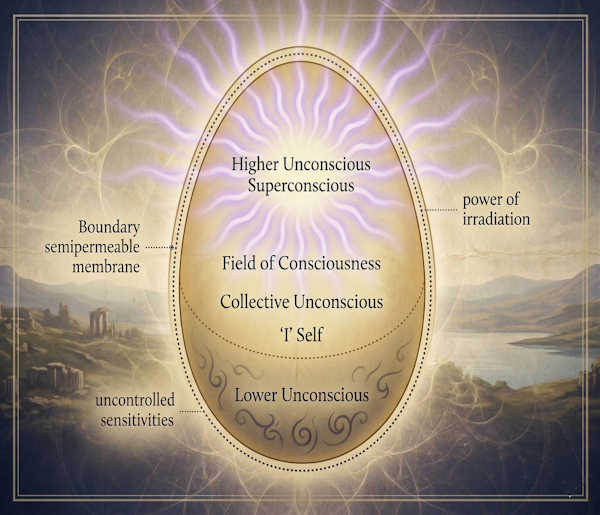
Assagioli’s egg diagram — his model of the psychological constitution of the person — is the key to understanding where parapsychology fits. The lower unconscious contains, among other things, “certain uncontrolled sensitivities of a parapsychological nature.” The higher unconscious or superconscious is the source of inspiration, illumination, and what Assagioli regarded as the highest parapsychological expressions: the spiritual love and irradiation that he considered the most powerful of all the paranormal faculties.
Between the personal unconscious and the collective unconscious, the boundary is “dotted” — like a semipermeable membrane. Assagioli uses this analogy in Psychosynthesis and Parapsychology, Part One (1961) to explain the continuous, largely unconscious exchange of parapsychological influences between individuals:
“Many facts, certainly established, induce — I would say indeed oblige us — to admit that there is a continuous and normal interpsychism, that is, a continuous exchange of parapsychological influences, both between individuals and between each individual and the ‘psychic environment’, what Jung calls ‘the collective unconscious’.”[6]
The practical implication is that we are not closed systems. We are, as Assagioli puts it, like fish swimming in a psychic sea — continuously receiving and transmitting influences of which we are largely unaware. The task of psychosynthesis, as applied to parapsychology, is to bring this unconscious exchange into awareness and eventually into mastery.
See the full texts: Psychosynthesis and Parapsychology – Part One | Psychosynthesis and Parapsychology – Part Two
The Parapsychological Faculties: Five Types
In his 1934 text Metapsychic Faculties (first published in the journal Scienze del Mistero in 1946), Assagioli identifies five principal types of parapsychological faculty. He warns from the outset that this is:
“The most difficult field that exists… because of the very nature of the phenomena studied. The metapsychic faculties are eminently plastic, changeable, highly sensitive, not only to every conscious and unconscious influence, to every inner attitude of the subject in which they are produced, of the experimenters, of the spectators, but also to ‘currents’ and psychic influences from people and causes far away in space and time.”[7]
The five types he identifies are:
- Supernormal calculation. Mathematical prodigies who produce correct answers to complex problems without conscious reasoning. Assagioli notes the significant and disturbing fact that this faculty sometimes appears more strongly in people of mediocre intelligence than in geniuses, suggesting it is not a product of superior rational capacity but of something else entirely.
- Telepathy. The transmission of thoughts, images, emotions, and impulses between individuals, independent of the known sensory channels. Assagioli argues that in this field “harmony seems to have more importance than distance” — telepathic communication is easier between people who are inwardly similar and emotionally connected, regardless of physical separation.
- Clairvoyance and psychometry. The perception of material objects, physical conditions, and events at a distance. Assagioli gives documented examples of psychometric experiments in which subjects accurately described landscapes, biographical details, and physical characteristics associated with objects they held — with results far beyond statistical probability.
- Supernormal perception of people and events. The direct intuition of another person’s psychological state, character, or future, including through practices such as palmistry and graphology. Assagioli suggests that even the rapid, seemingly rational diagnoses of skilled clinicians may partly involve unconscious parapsychological perception.
- Premonitions. The foreknowledge of future events, often with precise and verifiable detail. This is the faculty Assagioli examines most carefully in philosophical terms, because it raises the question of determinism. His position, as developed at length in the Two Lectures About Precognition (1957), is that premonitions demonstrate predisposition, not fixed destiny — and that human freedom operates as a genuine causal force within the architecture of the future.
A critical point runs through all five categories: these faculties are latent in everyone. As Assagioli states in the 1959 text Parapsychological Faculties — Why They Are Interesting, the Dangers of Their Use, and How to Avoid Them:
“In all likelihood, these faculties are latent in all of us, and are often active to some degree without our realising it.”[8]
See the full texts: The Parapsychological Faculties | Parapsychological Faculties — Dangers and Potentials
Precognition and the Question of Free Will
The phenomenon that most unsettles people about parapsychology is precognition. If someone can foresee the future, does that not mean the future is already fixed? Does it not reduce human choice to an illusion?
Assagioli addresses this directly in his Two Lectures About Precognition (lectures delivered March 10 and 17, 1957, Florence Centre for Metapsychics; Docs. #23754 and #24234, Assagioli Archive, Florence). His argument is philosophically careful. He rejects both a naive determinism and a naive libertarianism, proposing instead a model of graduated freedom operating at multiple levels of reality:
“Precognitions, or premonitions, constitute the type of phenomena that most impress and indeed disturb those who become aware of them… The first natural and spontaneous reaction is to say: but then is everything determined?”[9]
His answer is no — but the reasoning is subtle. Premonitions, he argues, reveal tendencies and predispositions, not fixed outcomes. He uses the analogy of an architect’s blueprint: seeing the plans in the architect’s office allows you to predict the villa’s design, but many forces might intervene before construction is complete. The future is being shaped but not yet sealed.
What can modify the trajectory of events? Among the new causes, Assagioli is unequivocal:
“Among the new causes that can modify or cancel, neutralizing them with equal and opposite forces, the effects of the previous ones, there is precisely the intervention of the free will of man, of his independent, spontaneous, unpredictable decisions.”[10]
This is the psychosynthesis position: the world is neither rigidly determined nor randomly chaotic. Freedom is real, but it is graduated — greater at the psychological and spiritual levels than at the physical level, and achievable through deliberate inner development.
See the full text: Two Lectures About Precognition (1957)
The Relationship Between Normal and Parapsychological Functions
One of Assagioli’s most important and least known contributions to the theory of parapsychology is his insistence that parapsychological faculties are not separate, exotic additions to the human repertoire. They are natural extensions of the ordinary psychological functions, operating at a higher octave.
He states the principle clearly in Psychology and Parapsychology (undated; original title: Psicologia E Parapsicologia; Assagioli Archive, Florence):
“There is no clear difference between the normal psychological functions and activities on the one hand and the parapsychological, supernormal and spiritual faculties on the other. This is a fundamental principle, which it is good to realise.”[11]
He then maps the correspondences:
- Normal sight → parapsychological clairvoyance → spiritual enlightenment
- Normal hearing → parapsychological clairaudience → spiritual perception of cosmic harmony
- Normal muscular action → parapsychological telekinesis
- Normal psychological understanding of others → parapsychological direct intuition of the soul
- Normal rational prediction → parapsychological precognition
The practical consequence of this framework is fundamental: you cannot safely or reliably use the higher octave of a faculty if you have not developed the normal octave first. This is the foundation of Assagioli’s caution, stated in Psychosynthesis and Parapsychology, Part One (1961):
“One cannot pretend or delude oneself to know how to govern and use parapsychological faculties and energies, if one does not know how to govern and use the normal ones!”[12]
See the full text: Psychology and Parapsychology
The Dangers of Parapsychological Development
Assagioli is one of the few figures in the history of transpersonal psychology who addresses the psychological dangers of parapsychological development with clinical specificity and without either dismissing the phenomena or romanticising them.
His central analogy, drawn from Parapsychological Faculties — Why They Are Interesting, the Dangers of Their Use, and How to Avoid Them (1959), is vivid:
“Those who have a passive, receptive, and mediumistic constitution. They can be considered as houses in which windows and doors are always left open. We know that unfortunately in the city, even when doors and windows are kept closed, thefts and attacks can occur… But, of course, it is much easier for thefts and assaults to occur when access is free and unsupervised.”[13]
The dangers he identifies fall into several categories:
Nervous exhaustion. The use of parapsychological faculties requires significant expenditure of nervous energy. Assagioli documents a case of an investigator who, after excessive use of his bio-radiant faculty, “suffered severe exhaustion with a sense of vertigo, so much so that he lost consciousness.” He also notes the phenomenon of “repercussion” — healers who absorb the symptoms of those they treat.[14]
Emotional invasion. Subjects with high parapsychological sensitivity and insufficient inner structure can be overwhelmed by influences from the psychic environment. Assagioli documents a woman who, after excessive use of her radiesthetic sensitivity, experienced “an invasion of psychic impressions that she could not master, such as threatening voices, visions of fearful scenes.”[15]
Psychological inflation. The possession of parapsychological faculties can produce a dangerous sense of superiority and special status. Assagioli is blunt:
“These faculties are not proof of any superiority on the part of those who possess them and are possessed by them, as not a few people mistakenly deceive themselves or claim. This is obvious, if we just remember that many animals also have them, and that they are very common among primitives. Therefore, in this field, any presumption of a sense of superiority is a sign of ignorance and ridicule.”[16]
Confusion with spiritual development. Perhaps the most important warning: parapsychological ability is not the same as spiritual maturity. Piero Ferrucci, recalling Assagioli’s teaching, makes this distinction sharply: one can have paranormal experiences without any spiritual motivation, and conversely, one can follow an authentic spiritual path without any paranormal experiences. Confusing the two is, in Assagioli’s view, “one of the great deceptions and obstacles on the spiritual path.”[17]
See the full texts: Parapsychological Faculties – Dangers and Potentials | Parapsychological Faculties and Nervous Disorders
Parapsychology and Spiritual Development
Despite his warnings, Assagioli does not conclude that parapsychological faculties should be suppressed or avoided. On the contrary, he argues that suppression is both impossible and counterproductive — that unconscious and passive parapsychological activity is more dangerous than conscious, trained engagement.
His positive vision centres on what he calls the power of irradiation — the capacity to project beneficial energies, qualities, and states of consciousness into the surrounding psychic environment. This is, in his view, a genuine parapsychological faculty available to everyone. As he states in the lecture Parapsychological Faculties and the Power of Emanation (7 May 1961):
“Each of us should consider ourselves as a transmitting station of vibrations, emanations and influences… everyone transmits continuously — whether they realise it or not, whether they want to or not — at all levels of their being.”[18]
At its highest expression, this faculty becomes identical with spiritual love. In a memorable passage from the same lecture, Assagioli makes a claim that surprised even his students:
“Among them, LOVE is the most powerful parapsychological faculty, which can pervade everyday life. It is a wonderful power that can give meaning and value to every day, every moment of life, transfiguring it.”[19]
He grounds this in the Buddhist teaching of the four brahmaviharas — loving-kindness, compassion, sympathetic joy, and equanimity — presenting them as systematic practices for the parapsychological projection of beneficial energies. This is not metaphor or devotional language for Assagioli. He regards the radiating power of love as a demonstrable psychological force with measurable effects on people and the environment.
The path to mastering both the receptive and projective parapsychological faculties runs through the psychosynthesis practice of disidentification. By developing the capacity to observe inner phenomena without being possessed by them, the practitioner gains what Assagioli calls “the witness consciousness.” As he states in Parapsychological Faculties and Nervous Disorders (1961):
“We are dominated and enslaved by everything with which our self identifies. We can master everything from which we disidentify.”[20]
See the full text: Parapsychological Faculties and the Power of Emanation
Parapsychology and Science
In Science and Parapsychology (9 March 1958, Doc. #23906, Assagioli Archive, Florence), a conversation held at the Florence Centre for Metapsychics, Assagioli lays out what a genuinely scientific approach to parapsychological investigation requires. He identifies four stages:
- Collection of facts — observation and experimentation. He argues this first stage is already substantially complete: “Those who deny them, either out of a priori reasoning or ignorance, are simply far behind. They are now 50 years behind.”[21]
- Investigation of conditions — understanding how phenomena are produced and verified. This is the most difficult and critical stage, and the one where the most important work remains.
- Interpretation — situating the facts within a broader understanding of the human psyche and cosmos. Here, he argues, the more mature sciences can assist parapsychology.
- Application — with “the utmost seriousness and great caution.” Assagioli is particularly concerned about what he calls the “internal enemies” of parapsychological science: enthusiasts and fanatics who exploit the field for personal gain or sensationalism.
His discussion of psychometry as a methodological example is illuminating. He draws attention to the symbolising function of the psyche — the tendency of the human mind to represent reality through images and symbols rather than realistic pictures. A subject doing psychometry may receive both realistic impressions and symbolic ones, and the challenge for scientific investigation is to learn to discriminate between the two. This is not a reason to dismiss the faculty; it is a reason to develop more sophisticated methods for studying it.
See the full text: Science and Parapsychology (1958)
Survival After Death
One of the most far-reaching implications of parapsychological research, in Assagioli’s view, is its bearing on the question of survival after death. His response to a survey conducted by the journal Parapsicologia — published here as On Survival After Death (Doc. #16677, Assagioli Archive, Florence; original title: Risposta all’inchiesta della rivista “Parapsicologia”) — addresses this directly. He concludes, based on the cumulative evidence of parapsychological research, that “the independence of the psyche from the physical body can be deduced from all these paranormal phenomena.”[22]
This is not a leap of faith for Assagioli. It is a conclusion he regards as consistent with the evidence when that evidence is examined without preconceptions — and as consistent with the testimony of mystics, yogis, and spiritual teachers across traditions and centuries.
About This Archive
The articles collected here were translated from the Assagioli Archive in Florence, primarily by Gordon Symons and Jan Kuniholm, and edited by Kenneth Sørensen. They were first brought together in the ebook Psychosynthesis and Parapsychology (Kentaur Publishing, 2021; Second Edition 2023), which includes a preface by Piero Ferrucci and a scholarly historical introduction by Francesco Baroni. All of Assagioli’s texts on this site are archival primary sources; they are not summaries or paraphrases.
All Assagioli Parapsychology Texts — Complete Archive
| Year | Title | Description |
| 1957 | Two Lectures About Precognition | Assagioli on precognition, determinism, and graduated freedom |
| 1958 | Science and Parapsychology | Scientific method applied to parapsychology; psychometry as a methodological test case |
| 1961 | Psychosynthesis and Parapsychology – Part One | Introduction to psychosynthesis and its relationship to parapsychological phenomena |
| 1961 | Psychosynthesis and Parapsychology – Part Two | The case for parapsychology as integral to psychosynthesis |
| 1961 | The Parapsychological Faculties | Five types of parapsychological faculties and how to study them |
| 1961 | Parapsychological Faculties and the Power of Emanation | Love as the highest parapsychological faculty; the irradiation of beneficial energies |
| 1961 | Parapsychological Faculties – Dangers and Potentials | Defining the faculties, their dangers, and how to develop them safely |
| 1961 | Parapsychological Faculties and Nervous Disorders | Why parapsychological development can trigger nervous disorders; the psychosynthesis therapeutic approach |
| Undated | Psychology and Parapsychology | Parapsychological functions as natural extensions of normal psychological functions |
| Undated | On Survival After Death | Assagioli’s response to a survey by the journal Parapsicologia on survival evidence |
| — | Roberto Assagioli and Parapsychology (Baroni) | Scholarly historical introduction to Assagioli’s parapsychological work |
| — | Roberto Assagioli, Psychosynthesis, and the Esoteric Roots of Transpersonal Psychology (Mankoff) | Assagioli’s esoteric sources and their relation to transpersonal psychology |
The E-Book: Psychosynthesis and Parapsychology (Second Edition)
Most of Assagioli’s texts collected here are also available in the ebook Psychosynthesis and Parapsychology (Second Edition, Kentaur Publishing, 2023), edited by Kenneth Sørensen. The book includes a preface by Piero Ferrucci — who knew Assagioli personally — and a scholarly introduction by Francesco Baroni, a psychosynthesis counselor and historian who traces Assagioli’s parapsychological work from its earliest roots to the Florence Center for Metapsychics.
Notes
[1] Roberto Assagioli, “Metapsychic Faculties” (written 1934; first published in Scienze del Mistero, 1946; original title: Le Facoltà Metapsichiche), translated by Gordon Symons, in Kenneth Sørensen, ed., Psychosynthesis and Parapsychology, 2nd ed. (Kentaur Publishing, 2023), 57.
[2] Roberto Assagioli, paper delivered at the Second National Congress of Metapsychics, Salerno, Italy, October 4–6, 1952, as cited in Francesco Baroni, “Introduction to the Parapsychological Work of Roberto Assagioli,” in Sørensen, Psychosynthesis and Parapsychology, 17.
[3] Paola Giovetti, Roberto Assagioli: La vita e l’opera del fondatore della psicosintesi (Rome: Mediterranee, 1995), 30, as cited in Baroni, “Introduction,” in Sørensen, Psychosynthesis and Parapsychology, 12. For the account of the Setti experiments, see Enrico Ruggini as cited in Baroni, “Introduction,” 21–23.
[4] Roberto Assagioli, “Psychosynthesis and Parapsychology: Part Two” (lecture delivered June 7, 1961, Tiberina Academy, via S. Eligio 10, Rome; original title: Psicosintesi E Parapsicologia II), translated by Gordon Symons, in Sørensen, Psychosynthesis and Parapsychology, 52.
[5] Assagioli, “Psychosynthesis and Parapsychology: Part Two,” 52.
[6] Roberto Assagioli, “Psychosynthesis and Parapsychology: Part One” (lecture delivered June 7, 1961, Tiberina Academy, via S. Eligio 10, Rome; original title: Psicosintesi E Parapsicologia I), translated by Gordon Symons, in Sørensen, Psychosynthesis and Parapsychology, 46.
[7] Assagioli, “Metapsychic Faculties,” 57.
[8] Roberto Assagioli, “Parapsychological Faculties: Why They Are Interesting, the Dangers of Their Use, and How to Avoid Them” (1959; Assagioli Archive, Florence, ID DOC 23403; original title: Le Facoltà Parapsicologiche – Perché Interessano – Pericoli Del Loro Uso, E Come Evitarli; published in Uomini e Idee, Year III, No. 1, January 1961), translated by Gordon Symons, in Sørensen, Psychosynthesis and Parapsychology, 73.
[9] Roberto Assagioli, “Two Lectures About Precognition” (lectures delivered March 10 and March 17, 1957; Docs. #23754 and #24234, Assagioli Archive, Florence; original title: La Precognizione; Seguito della Conferenza del Dott. Assagioli), translated and edited by Jan Kuniholm, published at kennethsorensen.dk/en/two-lectures-about-precognition/.
[10] Assagioli, “Two Lectures About Precognition.” The architect analogy and the free will argument appear in the second lecture (Doc. #24234). Corresponding passage in Sørensen, Psychosynthesis and Parapsychology, 66 (within the “Metapsychic Faculties” section on premonitions).
[11] Roberto Assagioli, “Psychology and Parapsychology” (undated; original title: Psicologia E Parapsicologia; Assagioli Archive, Florence), translated by Gordon Symons, in Sørensen, Psychosynthesis and Parapsychology, 69.
[12] Assagioli, “Psychosynthesis and Parapsychology: Part One,” 47.
[13] Assagioli, “Parapsychological Faculties: Why They Are Interesting,” 76.
[14] Roberto Assagioli, “Parapsychological Faculties and Nervous Disorders” (published in Uomini e Idee, Year III, No. 1, January 1961; Assagioli Archive, Florence, Doc. #23408), translated by Jan Kuniholm, in Sørensen, Psychosynthesis and Parapsychology, 96.
[15] Assagioli, “Parapsychological Faculties and Nervous Disorders,” 96.
[16] Assagioli, “Parapsychological Faculties: Why They Are Interesting,” 74.
[17] Piero Ferrucci, “Preface,” translated by Jan Kuniholm, in Sørensen, Psychosynthesis and Parapsychology, 6.
[18] Roberto Assagioli, “Parapsychological Faculties and the Power of Irradiation” (lecture delivered May 7, 1961; original title: Le Facoltà Parapsicologiche; Assagioli Archive, Florence), translated by Gordon Symons, in Sørensen, Psychosynthesis and Parapsychology, 80.
[19] Assagioli, “Parapsychological Faculties and the Power of Irradiation,” 88. The sentence also appears as an epigraph in Baroni, “Introduction,” 9, attributed to Assagioli’s text “Parapsychological Faculties and the Power of Irradiation.”
[20] Assagioli, “Parapsychological Faculties and Nervous Disorders,” 100.
[21] Roberto Assagioli, “Science and Parapsychology” (conversation, March 9, 1958; Assagioli Archive, Florence, Doc. #23906; original title: Conversazione del Dottor R. Assagioli), translated and edited by Jan Kuniholm, published at kennethsorensen.dk/en/science-parapsychology-assagioli-1958/.
[22] Roberto Assagioli, “On Survival After Death” (Assagioli Archive, Florence, Doc. #16677; original title: Risposta all’inchiesta della rivista “Parapsicologia”), published at kennethsorensen.dk/en/on-survival-after-death/. The specific claim regarding the independence of the psyche from the physical body is also recorded in the minutes of the Florence Centre for Metapsychics meetings of February 23, 1955, as cited in Baroni, “Introduction,” 19.
