

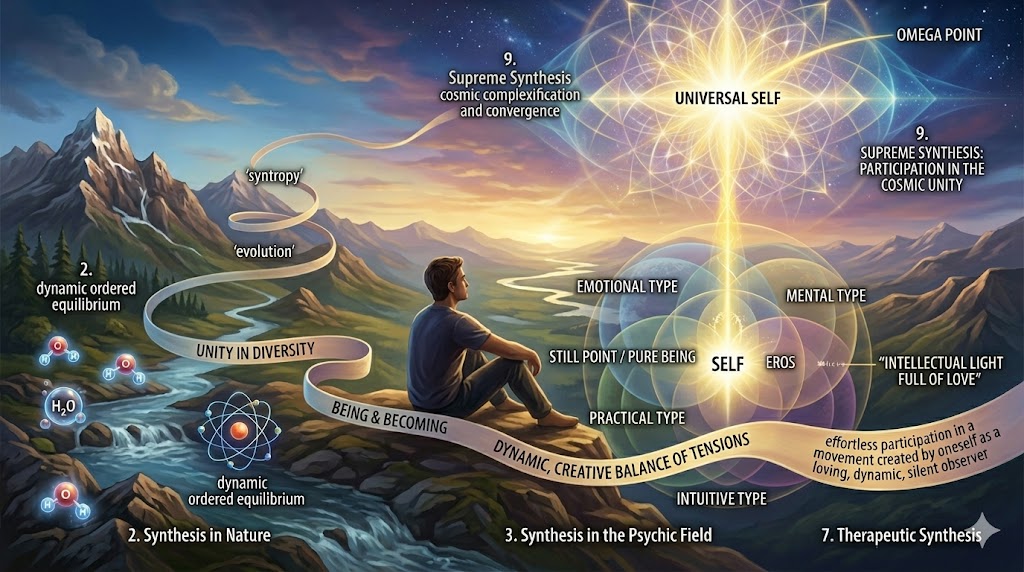
Synthesis in psychosynthesis runs from the atom to the Supreme Synthesis. This article gathers the whole of Assagioli’s teaching on it, including archive pages never brought together before.
By Kenneth Sørensen, MA Psychosynthesis
2026
Editorial Note
Research and drafting assistance provided by Claude (Anthropic). All archival sources, citations, interpretations, and the final text are the author’s own responsibility.
Abstract
In this essay, Assagioli’s teaching on synthesis is gathered from his books, the research foundation monographs, the four Italian lectures on types and degrees, and typescripts still held only in the Florence archive. Two principles organise it: unity in diversity, which is what synthesis produces, and the distinction between being and becoming, which is what the synthesising centre is. Ten sections follow the principle from the atom and the living organism, through four methods of resolving opposites, the coordination of differing psychological types, six stages of the synthetic process, the partial syntheses ordinary life supplies, the clinical work, and the still centre behind the movement, ending at the Supreme Synthesis.
1. What Synthesis Means in Psychosynthesis
Synthesis is the operative principle from which Psychosynthesis takes its name. The word derives from the Greek syntithenai — from syn (“together”) and tithenai (“to put, to place”) — and corresponds literally to composition: the placing-together of elements to form a new whole. But for Assagioli, synthesis is not simple aggregation. It is a fundamental principle at work throughout the natural world, a philosophical principle that resolves the dialectic of opposites, a therapeutic orientation that coordinates the elements of the personality, and a spiritual process that elevates the human being toward a higher unity. These are not separate phenomena. They are the same principle operating at different levels of reality.
Unity in diversity
The structural principle of synthesis, in Assagioli’s own formulation, is unity in diversity. In Unity in Diversity — a paper translated from the Florence archive by Gordon Symons — he writes: “In order to establish proper relations between human beings and human groups, it is necessary to understand, accept and practice a great principle or truth, which is at the basis of life itself in all its manifestations: that of Unity In Diversity.”[1] This principle governs the relationship between what Assagioli calls the substantial unity of reality — the One, the Absolute, intuited by all the great philosophers and experienced by the mystics — and the boundless multiplicity in which that unity is expressed. Unity, on this understanding, is not uniformity and not the absence of differentiation. It is functional, dynamic, and organic unity, realised through the coordination of diverse elements into a living whole.
Assagioli identifies two regulating principles by which unity and multiplicity are related to one another: polarity (the relationship of opposites) and diversity of functions (the relationship of differentiated but non-opposed elements). Both operate throughout nature, biology, psychology, and social life. Synthesis is the name for the dynamic process by which both kinds of multiplicity are coordinated into organic unity. Sections 3 and 4 of this article treat each principle in turn.
Being and becoming
The ontological principle of synthesis is the distinction between being and becoming. In an archival note dated 20 September 1937, Assagioli offered one of his most precise working definitions of synthesis: “Synthesis is regulation — control — direction — ordered expression and co-operative utilisation of energies of units of different orders.”[2] The five terms — regulation, control, direction, ordered expression, co-operative utilisation — describe the activity of synthesis. But the principle that performs this activity must be different in kind from the elements it coordinates. In later conversations Assagioli would draw the distinction explicitly:
All of these [illumination, intuition, cosmic consciousness, peak experiences] are processes, living processes. They belong to the world of becoming. But the Self, in contrast, is stable, firm, permanent — to use the philosophical word — ‘ontological’. It is Pure Being. Pure Being is not becoming and becoming is not Pure Being.[3]
The synthesising centre is still. The elements it synthesises are in process. Aristotle’s formulation of the Immovable Mover — which Assagioli cites approvingly — captures the structure exactly: the principle that sets everything in motion is itself unmoved. Synthesis as activity is dynamic, continually renewing itself. Synthesis as principle is ontologically stable. This paradox — motion organised around stillness, becoming oriented toward being — is not a flaw in Assagioli’s thought but its philosophical backbone. Every subsequent section of this article applies one or both of the two governing principles: unity in diversity, and the being–becoming distinction.
One of the seven core experiences of Psychosynthesis
Synthesis is not only a theoretical construct in Psychosynthesis; it is one of the fundamental experiences that, in Assagioli’s own words, “constitute the sine qua non of psychosynthetic training.” In his Training — A Statement — dictated to Piero Ferrucci on 19 May 1974, a brief but important document in which Assagioli set out what he considered the essential curriculum of Psychosynthesis — he enumerated seven core experiences: disidentification, the personal self, the will (good, strong, skilful), the ideal model, synthesis (“in its various aspects”), the superconscious, and the Transpersonal Self.[4] These are not the only concepts in Psychosynthesis. They are the concepts that, according to Assagioli, must be experienced directly — not merely understood intellectually — if Psychosynthesis is to be transmitted with authority. Synthesis is therefore not an optional philosophical garnish to a therapeutic method. It is one of the seven pillars without which Psychosynthesis does not stand.
This has a consequence for the scholar and the practitioner alike: to teach Psychosynthesis is to have experienced synthesis — to have felt, in one’s own personality, the movement by which multiplicity is coordinated around a unifying centre. The present article is in this sense an attempt to render the conceptual architecture of synthesis as clearly as possible, knowing that concept must be accompanied by experience for the teaching to come alive.
The scope of Assagioli’s teaching
The full scope of Assagioli’s teaching on synthesis has never been gathered in one place. The material survives across his published books — Psychosynthesis (1965) and The Act of Will (1974) — across the Psychosynthesis Research Foundation monographs, in the four-part lecture series Tipi e gradi della psicosintesi, in papers circulated through the Psychosynthesis and Education Trust, and in several archival typescripts, worksheets, and fragments preserved in the Florence archive. This article brings these sources together for the first time.
2. Synthesis in Nature: From Atom to Organism
Assagioli’s essay What is Synthesis? — with revisions dated 29 December 1953, originally conceived as a chapter of a projected larger work — opens with a claim that synthesis is not primarily a psychological or spiritual phenomenon but a natural one. It appears first in the inorganic world and ascends through biology into the life of the psyche.
The claim opens onto the difference between mixture and chemical combination. A mixture is a simple juxtaposition of substances in contact with one another, each retaining its own properties. Air is a mixture of oxygen, nitrogen, and water vapour; each element can be separated out again by ordinary means. A chemical combination is different in kind. When oxygen and hydrogen combine to form water, a new substance comes into being whose properties are not merely the sum of the properties of its components. Hydrogen and oxygen are gases at room temperature; water is liquid. And to separate water back into its elements requires laboratory procedures and a substantial expenditure of energy.[5]
A chemical combination, Assagioli observed, often releases powerful energy — used by humanity for engines, and also for destructive ends. The analogy in the psychic field is exact: the synthesis of two hitherto isolated elements of the personality often releases energy that can be directed constructively or destructively depending on how the synthesising principle governs the combination.
Assagioli pushed the analysis further into physics. Even the atom — once thought to be the simplest indivisible unit of matter — reveals itself under modern physics as a dynamic synthesis. It is a balance of attractive and repulsive forces, of centripetal and centrifugal motions, of a nucleus and orbiting electrons in continual relation. The projection or displacement of a single electron is enough to alter the properties of the atom, to release radiation, to produce electromagnetic vibrations. At the smallest scale of physical reality, the structure of things is already synthetic: a delicate ordered equilibrium of forces. Assagioli illustrates the point with a passage from the astronomer Sir Arthur Eddington on the behaviour of calcium atoms in the solar chromosphere, where electrons are continually projected into distant orbits by solar radiation and fall back into their former positions twenty thousand times per second. The entire phenomenon of stellar radiation depends on this “continuous, extremely rapid play of forces.”[6]
Biological synthesis
Organic life, for Assagioli, appears at once as a synthesis. The organs of an animal body are coordinated by a superior unity — a vital unifying principle that makes possible the life of the organism. Biological life is a dynamic equilibrium of antagonistic systems: the parasympathetic against the sympathetic nervous system, anabolism against catabolism, the life of expenditure against the life of reconstruction. These opposing phases alternate rhythmically. Their most obvious manifestation is the cycle of waking and sleeping. When one phase prevails excessively over the other, illness results.
A still more revealing sign of the unifying principle is what happens when it fails. In a healthy organism, every day thousands of cells die and are replaced by approximately the same number of new ones — a quantitative and qualitative equilibrium. When this balance is broken, when certain groups of cells begin to proliferate rapidly beyond regulation, a tumour is formed: rebellious cells that do not obey the normal rhythm of growth. Violating the law of self-regulation, the tumour provokes the destruction of the organism and with it its own destruction. At the moment of death, the action of the unifying principle ceases altogether. Every cell then acts individually, and the dissolution of the organism follows.
The implication is that life itself consists in the continual presence and activity of a regulating synthetic principle. In a handwritten addition to the 1953 typescript, Assagioli posed the question directly: what is this regulating principle? The mechanists of his time held it to be the product of blind physico-chemical reactions. The vitalists, drawing on Hans Driesch’s concept of entelechia and the work of Wagner, Mackenzie, and Jennings, insisted on the presence of a vital principle showing purpose, direction, and some kind of intelligence.[7] What Assagioli took from the debate was the fact of the unifying principle — whatever its ultimate metaphysical nature — and its evident operation throughout organic life.
Syntropy and the direction of evolution
Assagioli’s own vocabulary connects the synthetic principle to the twentieth-century scientific concept of syntropy. In conversations with American students in 1973 he stated this explicitly: “Physicists, up to recent times, spoke as if there was entropy only, that is the degradation of energy until everything was dead. A very tragic picture, fortunately completely false. Now they have discovered, with the new research, and both in sub-atomic physics and astronomy, that there is indeed a process of syntropy, of increasing the potential, the tension. It is what Teilhard de Chardin calls the Omega Point.”[8] The mathematician Luigi Fantappiè developed the formal articulation of syntropy as the universal counter-principle to entropy: a pattern of convergent, progressive orderliness drawing multiplicity toward coherent order.[9] For Assagioli, syntropy is the scientific name for the same principle he had been tracing from the atom through organic life and into the psyche. The synthetic tendency is not metaphorical. It is continuous with a principle operative throughout the cosmos.
3. The Synthesis of Opposites
The first of Assagioli’s two regulating principles — polarity — governs the relationship between opposing elements. The synthesis of opposites is the structure of synthesis most characteristic of psychic life. The human psyche is not merely a multiplicity; it is a multiplicity of opposing tendencies: extraversion and introversion, desire and aversion, activity and rest, the drive toward expression and the drive toward reconstruction. Assagioli’s insight, developed from a long philosophical tradition and given its most systematic treatment in the monograph The Balancing and Synthesis of the Opposites (Psychosynthesis Research Foundation, Issue No. 29), is that such oppositions are not to be abolished but synthesised — and that there is a precise typology of methods by which this can be done.[10]
Vertical and horizontal polarity
Before the typology, one orienting distinction. Assagioli notes that polarity can be conceived in two ways. Herman Keyserling conceived the “tension” between Spirit and the various manifestations of life as existing in a vertical direction, which he called the “dimension of intensity.” Jung conceived polarity more as a horizontal relationship — a lateral opposition between equally primary tendencies.[11] Both conceptions are valid, Assagioli held, and they apply to different kinds of polarity. Some oppositions (pleasure and pain, attraction and repulsion) are horizontal in Jung’s sense. Others (Spirit and matter, the personal self and the Transpersonal Self) are vertical in Keyserling’s sense. Recognising which kind of polarity is in play in any given synthesis is a precondition for knowing which method of synthesis to apply.
The philosophical lineage
The synthesis of opposites was intuited by Plato and first clearly expressed by Nicholas of Cusa, who affirmed that unity exists before duality, and that the coincidence of opposites occurs before their schism. It was taken up by Cusa’s great disciple Giordano Bruno, who proclaimed the synthesis of opposites as the principal tenet of a forgotten philosophy that ought to be revived:
He who desires to fathom the deepest secrets of nature, consider and contemplate the least and greatest of the contraries and opposites. It is great magic to extract the contrary after having found the point of union.
— Giordano Bruno, as cited by Assagioli[12]
The principle was developed most fully by Hegel, who made it the keystone of his philosophic system under the name of dialectic. For Hegel, opposites are opposed to one another but are not opposed to the unity that contains them. Real concrete unity is the union and synthesis of opposites. The two abstract elements taken in isolation Hegel calls moments — an analogy drawn from the moments of the lever. The relationship of the first two with the third, synthesis, is expressed by the verbs resolve and surpass. The two antithetical opposites are resolved and surpassed in the synthesis. They are not annulled; they are preserved within it, raised to a higher level.[13]
Assagioli’s four-part typology of methods
In The Balancing and Synthesis of the Opposites Assagioli enumerates four methods by which polar tensions can be resolved. The typology is worth reproducing directly because it organises what would otherwise appear as a miscellany of solutions into a systematic schema:
Fusion of the two poles, involving the neutralisation of their charges of energy. In the simplest physical case, the fusion of positive and negative electric charges produces either a spark (when unregulated) or useful work (when channelled through appropriate resistance). In the psychic field, the neutralisation of opposed drives can produce release, but also stagnation if the energies are not further directed.
Creation of a new being or reality. The paradigm case is sexual polarity: the union of masculine and feminine elements produces not merely the neutralisation of their tension but the birth of a new organism. This type of synthesis is generative rather than equilibrative. Its product is ontologically new.
Adjustment of the opposite poles through an intermediary centre or higher principle. This can occur in two sub-modes. The first is the moderation of extremes toward a happy medium, diminishing the amplitude of the oscillations toward a point of relative equilibrium. The second is the conscious and wise direction of the alternations, so that the oscillations themselves become harmonious and constructive — the method taught by Chinese philosophy in the I Ching. The first mode is essentially conservative; the second is essentially rhythmic.
Synthesis proper, brought about by a higher element or principle which transforms, sublimates, and reabsorbs the two poles into a higher reality. This is analogous in a certain sense to a chemical combination: the two elements are included and absorbed into a higher unity endowed with qualities differing from those of either of them. This is the method that corresponds most fully to the ontological structure of the synthetic principle as Hegel and Bruno understood it.
The four methods are not in competition. They correspond to different kinds of polarity and different contexts. Electrical polarity is typically resolved through fusion. Sexual polarity produces new being. Mild psychological oppositions may be resolved through moderation or rhythmic alternation. Genuine spiritual and philosophical oppositions require synthesis proper — the emergence of a higher principle under which the opposites are raised. The skill of the practitioner — whether in therapy, in personal development, or in the social and political sphere — consists in part in recognising which method is appropriate to the situation at hand.
Rhythm and the rhythmic alternation of opposites
Applied to psychic life, the principle of rhythmic adjustment takes the form Assagioli described as the rhythmic alternation of extraversion and introversion. Extraversion — the turning of vital interest outward, to the external world — corresponds in organic life to catabolism, the life of expenditure. Introversion — the turning of vital interest inward — corresponds to anabolism, to reconstruction, to the inner life. A harmonious succession of these movements ought to constitute the rhythm of life. But to attain such a rhythm requires, as Jung observed in a passage Assagioli cites from L’Inconscient, a very superior art of living.
Extraversion and introversion are the opposition of two natural psychological tendencies, of two contrary movements which Goethe designated as diastole and systole. A harmonious succession of these movements should constitute the rhythm of life. But to attain this rhythm, either we should be completely unconscious, so that natural law could not be broken by any conscious act; or else we should reach a far higher level of consciousness in order to be able to will both these movements and to produce them when we choose. Since we cannot go back to a state of animals, the only way left open to us is that toward a higher state of consciousness.[14]
Logos and Eros: the Dante image
Assagioli’s chosen example of the synthesis of opposites at the level of the personality is the polarity between Logos (reason) and Eros (feeling). This polarity is regulated in the first place by the recognition of their respective functions, so that neither dominates the other. This can be followed by a mutual and increasing cooperation and interpenetration, finally arriving at the synthesis so well expressed by Dante in the phrase luce intellettüal piena d’amore — “intellectual light full of love.”[15] The image is exact. Pure reason without love is cold; pure love without reason is blind; the synthesis is neither a compromise between them nor their neutralisation, but a new quality in which each is fully itself precisely because the other is fully present.
The noble middle path
In the closing passages of the 1953 typescript of What is Synthesis?, Assagioli reached by hand for a formulation that captures the affirmative character of synthesis against the quietist misreadings with which it is often confused. Synthesis is not compromise — he specifies in the margin, not the compromise and toleration that W. H. Sheldon would have it. It is not the uniform grey produced by mixing black and white. Much better, he wrote, is the designation given by the Buddha, who preferred the noble middle path. The word path suggests a dynamic progress toward a goal. Assagioli closed with a citation:[16]
By blending the pair of opposites, the middle path is gained that leads straight to the heart of the citadel.[17]
Synthesis, on this understanding, is not the midpoint between extremes — which would be static and lifeless — but the dynamic elevation of opposites into a unity that both contains them and carries them forward.
4. The Synthesis of Diverse Functions
The second of Assagioli’s two regulating principles is diversity of functions — the coordination of differentiated but non-opposed elements into organic unity. Not all syntheses are syntheses of opposites. Many of the most important — the body, the social group, the civilisation, the psychological types — are syntheses of elements that are not polarised against one another but distinguished from one another by role. In Unity in Diversity, Assagioli treats this principle as coequal with polarity in the governance of unity and multiplicity.[18]
The body as the exemplar
The human body is for Assagioli the paradigmatic case of diversity of functions. The unitary life that animates the organism requires the harmonious cooperation of well-differentiated organs — the heart, the lungs, the liver, the kidneys — coordinated in functional processes such as circulation, respiration, and digestion. Each organ has its own specific task. None of them is opposed to the others. The synthesis that keeps the organism alive is the synthesis of these diverse functions around the unifying principle of life itself. In The Act of Will, Assagioli formulates the point directly: the body is “a perfect demonstration of unity in diversity.”[19] The body is not merely an instance of synthesis. It is the image — the visible and accessible image — of what synthesis is.
Psychological types
At the level of the personality, the principle of diversity of functions finds its most important application in the theory of psychological types. Assagioli gives a memorable phenomenological illustration. Imagine four people — one of the practical type, one of the emotional type, one of the mental type, one of the intuitive type — observing the same landscape from a height. The man of the practical type will turn his interest to the agricultural and commercial aspect, calculating the area of the fields and the profit they might yield. The musician, the emotional type, will feel the soul of the landscape and hear in it a symphony waiting to be composed. The mental type will attend to the natural factors — the climate, the geological constitution of the soil, the fauna and flora — and may produce a scientific monograph. The intuitive type, induced by the beauty of the scene to turn the soul to God, will feel the unity of life and approach ecstasy. If each of the four then wrote what he had perceived, there would scarcely be a sentence in common among their accounts — and it would be hard to believe that all four had been inspired by the same landscape.
The point is not that one type is right and the others wrong. The point is that each type perceives genuine aspects of the same reality, and each contributes to a more complete picture than any one alone could give. A synthesis of the types is possible — and in civilisation, necessary. Without it, the types live side by side in different worlds, and the misunderstandings between them generate “an incalculable quantity of unnecessary suffering.”[20]
Civilisational synthesis
Assagioli extends the principle of diversity of functions to the level of humanity as a whole. He writes:
A world composed entirely of ‘practical’ types would be a very dry and gray one; a humanity composed of pure artists could hardly survive; a community made up of scientists alone would be too one-sided; the strong-willed ones, desiring domination and isolated from each other, would destroy each other, and the same would happen for every other kind, without the integration brought about by others.
— Assagioli, Unity in Diversity[21]
Human civilisation is — or ought to be — analogous to a healthy human organism: an assembly of differentiated groups, each with its own function, coordinated around common life. A society of only one type is as deformed as a body of only one organ. The practical implication is that the knowledge, appreciation, and cooperation among the various human types are not optional for civilisation; they are its precondition. And since the same principle that governs civilisational synthesis governs individual psychosynthesis, the development of the individual toward inner wholeness requires the integration of all the typological functions — practical, emotional, mental, intuitive — within the personality.
The conflict of conservatives and innovators
Assagioli applies the principles of synthesis to what he calls “one of the most acute problems afflicting humanity” — the conflict between conservative tendencies and revolutionary-innovative tendencies. The conflict is real and its outcome matters: the excessive preponderance of either tendency is destructive. Undisputed conservatism leads to fossilisation and death; undisputed innovation leads to anarchy and dissolution. The horizontal solution — mutual moderation on the same plane — is available but insufficient. The vertical solution, which Assagioli recommends explicitly, consists in the intervention of a regulatory principle operating from a higher plane: a synthetic and spiritual conception of history as the unfolding of human evolution toward a higher Goal, in which the intellectual, moral, aesthetic, and social values achieved in the past are not disowned but liberated from old forms and integrated with new values. This is an example of Method Four — synthesis proper — applied to a political and historical polarity. It is also a demonstration that the methods of synthesis are not confined to the intrapersonal sphere. They apply to the structure of human social life as such.
5. The Stages of Synthesis
Synthesis, in Assagioli’s understanding, is not an event but a process — and not an undifferentiated process but one that unfolds through recognisable stages. An undated archival worksheet from the Florence archive records Assagioli’s own enumeration of these stages, ordered from least to most fully realised.
- Interrelation — bringing into contact; eliminating barriers, chasms, insulating factors, dissociations; bridging.
- Interplay, even conflict: better than complete lack of contact, dissociation. Conflict is the most frequent form of incipient interplay. From conflict to more or less regulated tension.
- Regulation (regulated tension).
- Blending and fusing — Attraction, Love, tendency to blend and fuse, Law of Attraction.
- Cooperation, ordered activity.
- Subordination, Organisation, Hierarchy — Principle of coherence.[22]
The schema repays close attention. The first stage — interrelation — is the bare precondition of any synthesis whatsoever. Elements that are completely dissociated, sealed off from one another by insulating barriers, cannot enter into synthetic relation. To bring them into contact, to eliminate the chasms between them, is the first movement. This is the stage at which the technique of disidentification operates: by ceasing to identify with any single content of consciousness, the practitioner brings the contents into a common field where they can be observed together.
The second stage is striking in its implications. Interplay, even conflict, Assagioli notes, is better than complete lack of contact. Conflict itself is the most frequent form of incipient interplay. This inverts the common assumption that conflict is the enemy of synthesis. In the archival schema it is the initial form of synthetic relation — the necessary beginning from which regulated tension can develop. Clients in therapy who enter conflicted relations with split-off parts of the personality are, on this view, at an earlier stage of the same process that will eventually issue in synthesis. Conflict is not to be suppressed but shepherded through successive stages toward its resolution.
The third stage — regulation or regulated tension — is the emergence of coordination. The opposites remain in tension but the tension has become disciplined, held within a framework that prevents it from becoming destructive. The fourth stage — blending and fusing — introduces a new principle. Assagioli specifies it explicitly: Attraction, Love, the tendency to blend and fuse, the Law of Attraction. At this stage the opposites are not merely regulated from above but begin to move toward one another of their own accord. This is the turning-point in the synthetic process. Before it, the unifying work is chiefly corrective. After it, the elements participate in their own integration.
The fifth stage — cooperation, ordered activity — is the functional synthesis of elements now working together toward common ends. The sixth and final stage — subordination, organisation, hierarchy — is the full principle of coherence, in which a hierarchy of ordering relations coordinates the whole. Note the word hierarchy: Assagioli does not shrink from it. In the mature synthesis there is an ordering principle, a higher unity, under which the elements find their place.
These six stages are not a rigid sequence that every synthetic process traverses in order. Real processes move back and forth between them, progress in some respects while regressing in others, and frequently display elements of several stages simultaneously. But the schema provides an orientation. It allows the therapist, the student, and the practitioner of meditation to locate where a given process stands, what stage it is approaching, and what the next movement might be.
6. Partial Syntheses: The Art of Synthesis
The complete psychosynthesis — in which all the elements of the psyche are coordinated and unified in a stable manner — is, Assagioli wrote, an ideal concept to which we must try to get as close as possible but which cannot be perfectly implemented. In many cases we can and must be content with much less. And yet, he insisted, even a partial and imperfect psychosynthesis constitutes a great progress against the anarchy, disorientation, and inner storms in which so many find themselves.[23] It can be a satisfactory solution: eliminating suffering, conflicts, nervous disorders, and moral confusion, giving meaning, purpose, and value to a life.
In the four-part lecture series Tipi e gradi della psicosintesi (Types and Degrees of Psychosynthesis), translated into English by Gordon Symons, Assagioli examines four partial syntheses that form spontaneously in the life of most people and that can be cultivated into more deliberate forms. Each is organised around a different unifying principle — a principle that is part of the personality rather than superior to it.
Passion as synthesising centre
The simplest and most frequent unifying principle in ordinary life is a dominant tendency — a passion. Passion, as Ribot defined it, is a desire in a violent and chronic state: in the active order what the fixed idea is in the intellectual order. An ardent and fixed desire of this kind tends to absorb all internal energies and to direct all external activities. Passion, Assagioli observed, is a demanding and jealous despot who does not tolerate opposition or deviation; it exploits every faculty and ability of the person for its own purposes. In a passionate individual, physical forces, intelligence, imagination, and memory are all placed at the service of the passion.[24]
Yet this is, for all its narrowness, a genuine synthesis. It confers unity where there was scatter. It makes a person do things of which they had not thought themselves capable. Ambition drives men into a real asceticism; greed sustains feverish and exhausting lives; amorous passion transforms apathetic people into courageous ones; patriotic passion has made humble heroes out of simple people. Passion awakens and activates latent energies. It has, Assagioli wrote, “an extraordinary unifying power.”
But it is a firm, rigid, and restricted synthesis. It is at once clairvoyant and blind — clairvoyant in what serves its goals, blind to everything else. It is at once constructive and destructive. For a passion to be beneficial, two things are needed: its aim must be noble, and it must not be excessive. Even a noble and idealistic passion, when it becomes excessive, produces its own characteristic dangers — proselytism, fanaticism, intolerance, pride, harshness. It is therefore vital that we be masters and not slaves to any passion, even the best. This requires the presence and activity of a centre superior to the passion itself: a wider vision, an awake and powerful will that knows how to take the passion in hand and make it the element and instrument of a wider individual and super-individual synthesis.
Vocation and social role
A second unifying principle is the particular task or function a person has in life — a creative or practical task, an absorbing profession such as that of the artist, writer, or physician, or a vital human function such as that of a parent or partner. These can capture the attention, interest, and energies of a person and produce a corresponding psychosynthesis.[25] The value of such a synthesis depends not on the dignity of the role itself but on what Assagioli, quoting Keyserling, called “the inner spiritual level at which one stands.” It is not what we do that matters, but how we do it.
The East, Assagioli observed, has a deep concept that illuminates this form of synthesis: the Indian notion of Dharma. Dharma is both law and life, individual duty and a particular ideal to be implemented within one’s condition. In the Bhagavad Gita, Krishna teaches Arjuna that action performed as Dharma — as duty for the sake of others and in cooperation with the Supreme — becomes a path to union, provided that one acts without attachment to the fruits of action. Karma Yoga — the yoga of action — takes its place alongside Bhakti Yoga, Jnana Yoga, and Raja Yoga as a path to the synthesis of the personality.
Motherhood and the feminine syntheses
In the third and fourth lectures of the series, Assagioli turned to syntheses specifically organised around feminine roles — not as essentialist claims about women’s nature but as observations of the unifying principles around which, in his time and place, many women’s lives were structured. He examined the role of the wife, the mother, the grandmother, and what he called the “inspirational woman.”[26]
Motherhood, understood in its broadest and deepest sense, Assagioli held to be not merely a human function but a cosmic principle. The substance that receives the creative impulse of the Spirit and expresses it in worlds and myriads of beings is, in his terminology, universal motherhood — the principle that makes manifestation possible. The grandmother’s role offers the mature woman a renewed form of motherhood, often wiser and more composed than the mother’s active function. The role of the inspirational woman integrates masculine and feminine elements: the inspiring function is itself dynamic, active, propulsive, and has been served across history by figures from Beatrice in Dante to the women who have formed the poetic and spiritual imagination of the men around them.[27]
Why partial syntheses are partial
All four partial syntheses — passion, vocation, motherhood, inspirational function — share a common feature: their unifying centre is an element of the personality rather than a principle superior to it. A passion is part of the emotional life; a vocation is part of the social life; a role is part of the identity. These centres can produce coherent, meaningful, even heroic lives. They cannot produce a complete psychosynthesis. In The Self: A Unifying Center, Assagioli states the principle precisely:[28]
These centers are not apt to produce either a complete psychosynthesis, in which every single element in us is coordinated and harmonized in a living unit, or an entirely independent psychosynthesis, one not based, that is to say, on elements foreign to our own being. To realize such a complete and independent psychosynthesis another kind of Unifying Center is needed. In the first place this Center must be of a different nature from that of all the single elements which constitute our psyche. It must be different from and superior to them because only then can it have the power to dominate and rearrange them in an organic unity.[29]
The complete synthesis requires a centre that is not itself one of the elements it coordinates. This is the point at which the partial syntheses of ordinary life give way to the therapeutic synthesis of clinical practice — which prepares the ground — and ultimately to the transpersonal synthesis in which the centre of coordination is the spiritual Self itself.
7. Synthesis in Psychotherapy
In August 1964, Assagioli addressed the Sixth International Congress of Psychotherapy in London on the theme of synthesis in psychotherapy. The address — published shortly afterwards as Synthesis in Psychotherapy (Psychosynthesis Research Foundation, Issue No. 24) — represents his clearest statement of the clinical application of the synthetic principle.[30]
Assagioli observed that the psychotherapy of his time was divided into two broad families of method, often in apparent conflict with one another. The first he called existential psychotherapy — the depth-psychological traditions that emphasise the significance of the patient’s existential life-problem and the living relationship between therapist and patient. The second he called the specific techniques — suggestion, autosuggestion, hypnosis, autogenic training, and similar active procedures aimed at eliminating specific symptoms. Both approaches, Assagioli held, have their respective uses and limitations. The existential approach goes deep to the core of the patient’s problem but does not actively help the patient implement insight. The specific techniques are effective against symptoms but do not go deep enough; the causes of disturbance remain. A complete synthetic treatment must combine both, selected according to the patient’s actual needs rather than the therapist’s prior doctrinal commitments.
The five aims of synthetic treatment
Assagioli enumerated five aims of a complete synthetic treatment: first, the discovery and elimination of the direct causes of disturbance and the consequent healing of symptoms; second, the elimination of the conditions — physical, psychological, environmental — that might cause the symptoms to recur; third, the elimination of the consequences of the illness itself; fourth, helping the patient to make constructive use of the drives already active in them, which if left unregulated might produce new inner conflicts; and fifth, the arousal and utilisation of the patient’s latent gifts and possibilities, particularly the higher potentialities latent in the superconscious.[31]
The phases of treatment
The clinical process, Assagioli held, moves through recognisable phases: thorough assessment of the patient’s personality, recognition of the solution on the part of the patient, planning of the steps and means of achieving the goal, active cathartic work to eliminate obstacles and dissolve complexes, and — most demanding — control and utilisation of drives and of the energies released by the removal of complexes. Control, Assagioli was careful to specify, does not mean condemnation or repression: it is a matter of regulation, of channelling energies either into harmless expression or into constructive transformation and sublimation. Running alongside these phases is the development of deficient functions. Very often part of the patient’s problem is a lack of balance — the underdevelopment of the feeling function in some, the mental function in others, and often the regulating and synthesising will itself.
Synthesis and the wider relational field
Individual psychosynthesis, Assagioli insisted, inevitably includes right and harmonious interpersonal and intergroup relations. No individual lives in isolation. The therapist therefore has to help the patient to establish such relationships — a difficult task, because it depends not only on the patient but also on the people and groups that exert pressure on them. The therapist cannot change the general inharmonious condition of today’s society, which Assagioli described as being itself in a pathological state. But every therapist can work, through personal influence, lectures, and writings, to indicate the psychological diseases of modern society and to point toward their solutions. One immediate task lies within reach of every therapist: the establishment of harmonious relationships and right cooperation among psychotherapists themselves. This means, first of all, the recognition that each partial view may be considered — as Leibniz said of the various philosophies — “true in what it affirms and false in what it excludes or denies.” Each school, movement, and technique has both its value and its limitations. The knowledge, appreciation, and utilisation of all or most of them is therefore required. This, Assagioli concluded, is the scope and aim of synthesis in psychotherapy.[32]
8. The Dynamic Organic Unifier: Being, Becoming, and Flow
Having traced synthesis through nature, through the synthesis of opposites, through the synthesis of diverse functions, through the stages of the synthetic process, through the partial syntheses of ordinary life, and through the therapeutic synthesis, we arrive at the question of what the synthesising principle is. This section addresses the ontological structure of synthesis directly. It draws together what has been implicit throughout: the distinction between being and becoming that was named in Section 1 as the second of Assagioli’s two governing principles — and it closes with the experiential signature of achieved synthesis in ordinary life.
The dynamic character of synthesis
Synthesis in Assagioli’s understanding is never static. In a note preserved in the “Synthesis” folder of the Florence archive, he described synthesis as “a dynamic, creative balance of tensions” — a phrase that captures both the activity and the fragility of the synthetic state.[33] The tensions that animate synthesis do not subside into rest. They are held in an ordered, productive relation that continually renews itself. Aristotle’s formulation of the Immovable Mover — the principle that is itself unmoved while setting everything else in motion — captures the paradox: the synthesising centre is still, while what it coordinates is in ceaseless motion.
Three further implications deserve to be drawn out. First, synthesis is not merely the resolution of two opposites but the coordination of multiplicity. Real completeness requires the coordination of many heterogeneous elements into one organic unity. This is why the body is for Assagioli a particularly apt image of synthesis: the human organism coordinates not two but countless diverse elements, producing what Assagioli calls, in The Act of Will, “a perfect demonstration of unity in diversity.”[34]
Second, synthesis is never final. Each synthesis achieved becomes an element within a more comprehensive synthesis; the process does not terminate. Personal psychosynthesis is not the summit but a stage. The synthesis of the personality around the self opens onto the greater synthesis of the self with the Transpersonal Self, and that synthesis opens onto the cosmic synthesis of which we are part. Pierre Teilhard de Chardin — whom Assagioli cites — provides the evolutionary vocabulary for this: the fundamental pattern of evolution combines complexification (the increase in complexity of structures) and convergence (the drawing together of complex elements into higher unities). The universe is not merely becoming more complex but becoming more unified in its complexity.
Third, the essential place of will in the synthetic process. “Will,” Assagioli wrote, “is a synthetic power. It dominates multiplicity and wields it into unity.” The will is not simply one faculty among others. It is the specifically synthetic faculty — the one by which multiplicity is held together and directed toward unity. This is why the development of the will is so central to Psychosynthesis. Without it, synthesis cannot be willed; it can only be hoped for.
Being and becoming: the ontological structure
But the dynamism of synthesis is not the whole story. The principle that coordinates is ontologically different from what is coordinated. Assagioli states this most precisely in his 1973 conversations with American students, Talks on the Self:[35]
The basic difference is that all of these [illumination, intuition, cosmic consciousness, peak experiences] are processes, living processes. They belong to the world of becoming. But the Self, in contrast, is stable, firm, permanent — to use the philosophical word — ‘ontological’. It is Pure Being. Pure Being is not becoming and becoming is not Pure Being.[36]
The distinction is critical. Peak experiences, illuminative states, transpersonal awareness — these are processes. They arise and pass. They belong to the dimension of becoming. The synthesising Self is not a process. It is not one more state of awareness, however elevated. It is the still point around which all states arise and pass. Assagioli uses an astronomical image: we say we see the sun, but we do not see the sun itself. We see the radiation emitted by the sun, which is of an entirely different order from the sun that emits it. The sun stands invisible behind the curtain of its radiations. Likewise the Self stands behind the radiations that reach the personality — the energies, qualities, and illuminations that the personality experiences as peak states.
Aristotle’s Immovable Mover is the Western formulation of the same principle. The Buddha’s Dharmakaya, the Upanishadic Atman, Tao in its transcendent sense — each of these traditions names what Assagioli names: a centre that does not move but around which everything moves. Synthesis as activity is dynamic. Synthesis as principle is ontologically still. The synthesising centre is Being; what it synthesises is becoming.
Pain as instrument of synthesis
The dynamic character of synthesis has a sobering practical consequence: the synthetic process typically requires suffering. In the editorial introduction to Conflict, Crises, and Synthesis, I have gathered Assagioli’s scattered remarks on this theme and identified four functions of what Assagioli calls “good pain.”[37] First, pain awakens latent energies by shaking the human being out of passive inertia, comfortable routines, and narrow egocentricity. Second, pain disengages the human being from excessive attachments, purifying and releasing what would otherwise hold synthesis back. Third, pain induces self-discipline, converting disordered instinctive and emotional energies from destructive to constructive expression. Fourth, pain compels recollection, reflection, and meditation — turning attention inward and upward, creating the silence in which the synthesising centre can make itself known.
The four functions are not a justification of cruelty or a counsel of asceticism. Assagioli is explicit that pain must never become an end in itself, and that the role of the therapist and the practitioner is to help suffering perform its constructive work rather than to induce it or prolong it unnecessarily. But the recognition that the synthetic process involves genuine struggle — that the coordination of multiplicity around a higher centre is hard-won rather than spontaneous — is essential to a realistic practice of Psychosynthesis. Conflict is endemic to the evolution of consciousness. Synthesis is the achievement through which conflict becomes productive.
Flow: the experiential signature of achieved synthesis
If pain is the price of synthesis in progress, flow is its signature in achievement. When the work of synthesis has done its work — when the elements of the personality are coordinated around the self, when the will has become the effective instrument of the unifying centre, when the inner opposites are no longer at war but cooperating — the phenomenology of life changes. Action becomes spontaneous. Effort becomes effortless. The person no longer has to marshal their faculties separately; the faculties act together, of themselves, in the direction the self intends. This is what Assagioli describes, in The Act of Will, as the taoistic state of wu-wei:
The personal will is effortless. It occurs when the willer is so identified with the Transpersonal Will, or, at a still higher and more inclusive level, with the Universal Will, that his activities are accomplished with free spontaneity, a state in which he feels himself to be a willing channel into and through which powerful energies flow and operate. This is wu-wei, or the “taoistic state,” mentioned by Maslow in The Farther Reaches of Human Nature.[38]
What Assagioli describes here is the experiential counterpart of the ontological structure treated above. Because the synthesising centre is still while its energies are in motion, the person who has come into alignment with that centre finds that action flows through them rather than being produced by them. The contemporary vocabulary of flow — the spontaneous, effortless expression of capacity under the right conditions of challenge and skill — names in secular-psychological language what Assagioli already named in the vocabulary of the Tao. In my own work I have argued that flow is precisely this: the phenomenological signature of achieved synthesis in ordinary life, the felt quality of a personality whose elements are coordinated rather than conflicting.[39] A ballet dancer’s flow is the synthesis of body, training, and musicality. A therapist’s flow is the synthesis of intellect, empathy, and presence. A person in the taoistic state that Assagioli describes — the alignment of personal will with Transpersonal Will — is experiencing the synthesis of the personal and the transpersonal as living motion.
This is why the ontology of synthesis matters practically. It is not sufficient to know that the synthesising centre is Being and its elements are becoming. What matters is that the human being, in coming into right relation with the centre, finally identifying with the centre and experiences becoming — no longer an effortful struggle against one’s own fragments but an effortless participation in a movement created by oneself as a loving, dynamic, silent observer. Synthesis is not only something one achieves; it is a way of being that, once achieved, one lives.
9. The Supreme Synthesis
Personal psychosynthesis is the preparation for, and the entry into, transpersonal psychosynthesis: the unification of the personal self with the Transpersonal Self. And beyond even this lies what Assagioli called the Supreme Synthesis — the participation of the individual in the cosmic unity of which we are part. In Psychosynthesis: A Manual of Principles and Techniques, Assagioli offered his most celebrated statement of this cosmic dimension:
From different starting points, increasing numbers of modern men are moving towards the same goal. Humanity is slowly becoming aware of this trend. Owing to their outer and inner experiences, many individuals are beginning to develop a new sense of responsibility and solidarity — to feel themselves co-workers with the Divine Plan, with the supreme Reality which in its own mysterious way is acting upon and within the travail of humanity, uniting all beings (some willing but the majority as yet blind and rebellious) with each other through links of love, achieving slowly and silently, but powerfully and irresistibly — the Supreme Synthesis.[40]
The passage gathers the whole of what has preceded. The synthesis that begins in the inorganic world as chemical combination, that appears in the organism as the unifying principle of life, that coordinates the personality around the self, that unites the personal self with the Transpersonal Self — this same synthesis, Assagioli affirms, is at work across humanity and across the cosmos, drawing all beings into unity through links of love. Synthesis is not merely something the individual achieves. It is something in which the individual participates, something that is being done through the individual by a principle larger than the individual, something that is going on everywhere whether or not it is consciously recognised.
Four levels of Self-realisation
In his 1973 conversations Assagioli named four levels through which Self-realisation proceeds: “from the personal to the transpersonal, from the transpersonal to the group Self, from there to the Universal Self.”[41] The sequence is not a ladder that each individual climbs alone. At each stage, the synthesising centre becomes at once more inclusive and more rigorously itself. The personal self, integrated, gives way to the Transpersonal Self which has always been its source. The Transpersonal Self, realised, reveals itself as participating in a group Self — a communion of souls that share a common purpose and field of service. And the group Self in turn reveals itself as a partial expression of the Universal Self, the cosmic whole in which all distinction is preserved but all separation overcome.
Superconscious and Self
The distinction between the superconscious and the Self is the single most important clarification for understanding transpersonal psychosynthesis. In The Superconscious and the Self, the notes from Assagioli’s conversations with James Vargiu, the superconscious is described as “just a term to designate the higher, spiritual, or transpersonal region of the psyche.” The difference between the superconscious and the ordinary personality is one of level, not of nature — the superconscious contains psychological functions, processes, and energies of greater activity and diversity than those of the ordinary personality, but they remain processes. Peak experiences, creative illuminations, states of ecstatic union, impulses to self-sacrifice — all of these belong to the superconscious. They are radiations of the Self, not the Self itself.
The misrecognition of superconscious experiences as the Self is what Maslow called higher sidetracking. The transpersonal states are beautiful, often ecstatic; if properly understood and assimilated they can be of real value; but attachment to them prevents the further movement toward the Self itself. The superconscious is a genuine bridge to the Self, but it is not the destination. To reach the Self, one must disidentify not only from the contents of the personality but — at a later stage — from the contents of the superconscious as well.[42]
The five critical points on the inner path
In Self-Realization and Psychological Disturbances (PRF Issue No. 10), Assagioli enumerates five critical points through which transpersonal psychosynthesis typically moves: crises preceding the spiritual awakening, crises determined by the spiritual awakening, reactions to the spiritual awakening, the phases of transmutation, and the Dark Night of the Soul.[43] Each is associated with characteristic sufferings, which are neither accidents nor pathologies but necessary movements within the larger synthetic process. The crisis preceding awakening — the loss of motivation, the existential vacuum, the dissatisfaction with what formerly satisfied — is the dissolution of a synthesis that was too small. The crisis of awakening — the exaltation, the inflation, the newfound purpose that threatens to burn the personality out — is the unbalanced reception of energies that exceed the existing structure. The reaction — the return of old patterns with new force — is the recognition that transformation is the work of a lifetime rather than a moment. The transmutation — long and alternating between light and darkness — is the actual reshaping of the personality around its new centre. The Dark Night of the Soul is the detachment even from the superconscious, the temporary loss of the joys and expansions it had given, as the self moves toward unification with a reality larger than either the personality or the superconscious can contain.
Nothing has to be destroyed
A final clarification, in Assagioli’s own words, protects the teaching from a common misreading:
In psychosynthesis we maintain that nothing has to be condemned, or destroyed, or eliminated. We can benefit from and utilize every function and element of our psyche, provided we understand its nature and purpose, and place it in its right relation with the greater whole. So the ‘I’ is not to be destroyed. Personal self-identity is precious. It is the result of a long period of evolution, and cannot be thrown away. What we have to eliminate is our attachment to it, because the personal self has to be brought back to its source.[44]
This distinguishes Assagioli’s teaching from readings of Eastern traditions in which the ego is to be annihilated. The union of the personal self with the Transpersonal Self is not the destruction of the one by the other. The Self, as Assagioli insists, is one — the personal self is the portion of the deeper Self that ordinary consciousness can assimilate. What has to dissolve is the mistaken identification of consciousness with partial contents. What emerges is the recognition of what was always the case: that the personal centre of awareness is the local expression of a spiritual centre of awareness, and that the movement toward union is the movement toward what one always was. Lama Anagarika Govinda’s formulation, which Assagioli cites, makes the point from the Buddhist side:[45]
Individuality is not only the necessary and complementary opposite of universality, but the focal point through which alone universality can be experienced. The suppression of individuality, the philosophical or religious denial of its value or importance, can only lead to a state of complete indifference and dissolution, which may be a liberation from suffering but a purely negative one… Merely to ‘merge into the whole’, without having realized that wholeness, is only a poetical way of accepting annihilation.
— Anagarika Govinda, The Way of the White Clouds[46]
Levels of reality
One final caution. The metaphysical truth that “all is One” — affirmed by Assagioli at the level of ultimate reality — must not be collapsed onto the level of manifestation, where countless distinct beings and forms exist. “All is One in essence, in Being,” Assagioli said in 1973, “but in becoming, in manifestation, in that process of life, there are countless many.” The error of certain metaphysical movements, and of some Oriental approaches, is to import the ultimate truth into the realm of everyday life where it does not yet operate. At the level of manifestation, genuine diversity exists, genuine individuals exist, genuine distinctions matter. The Supreme Synthesis is not the abolition of these distinctions but their preservation within a unity that includes them.
This is the vision at the heart of Psychosynthesis. The therapeutic work of integrating a personality is continuous with the philosophical work of resolving opposites, which is continuous with the spiritual work of participation in a cosmic process of return. Synthesis is not simply a technique. It is a participation in the structure of reality — a structure in which unity and diversity, being and becoming, the still centre and the moving whole, are coordinated eternally and realised, progressively, in the life of each human being who takes up the work of becoming what they always were.
10. Conclusion: Synthesis as the Guiding Principle
Five observations may be drawn together from what has been said.
First, synthesis is one principle operating at every level. From the atom to the organism, from the opposing tendencies of the psyche to the coordination of the personality, from the therapeutic process to the evolution of the cosmos, the same synthetic principle is at work. The coordination of atoms by electromagnetic forces is not metaphorically related to the coordination of a personality by the self; it is the same principle in a different register. Unity in diversity is the structural signature of reality as Assagioli understood it.
Second, synthesis proceeds by two distinct kinds of coordination. Polarity organises the relationship between opposites; diversity of functions organises the relationship between differentiated non-opposed elements. Both operate throughout nature, biology, psychology, and social life. The therapist, the practitioner, and the scholar each need to recognise which kind of synthesis is in play in any given situation, because the methods appropriate to each differ.
Third, synthesis is dynamic but its principle is still. The activity of synthesis is ceaseless — a creative balance of tensions, continually renewing itself. But the centre that coordinates is ontologically different from what it coordinates. Aristotle’s Immovable Mover, the Buddhist Dharmakaya, the Upanishadic Atman — each names what Assagioli calls the Self: Pure Being, as distinct from the becoming it pervades. Peak experiences are radiations of the Self. The Self itself is the source of the radiations, standing unmoved behind them. The experiential signature of their right relation, in ordinary life, is flow: the effortless expression of a personality whose elements are coordinated around the unifying centre.
Fourth, synthesis requires will — and the will must be developed. The will is the faculty by which multiplicity is held together and directed toward unity. Without it, integration cannot be sustained. The personality either falls back into its fragments or submits passively to whatever synthesising centre happens to dominate — a passion, a social role, an ideology. The cultivation of the will is therefore not optional but essential.
Fifth, synthesis begins with the observation of multiplicity. One cannot synthesise what one has not first distinguished. The practice of disidentification — observing the contents of consciousness without identifying with them — is the necessary entry into the synthetic process. It is the first stage in Assagioli’s schema, the stage of interrelation: the bringing into contact of elements that have been, until now, insulated from one another by unconscious identification with them. Only once the multiplicity has been observed does the work of coordination become possible.[47]
Synthesis is the guiding principle of Psychosynthesis — the word that gives the system its name, and one of the seven core experiences Assagioli identified as essential to its transmission. Understanding synthesis means understanding what Assagioli thought he was doing when he developed a therapy and a discipline around this concept. He was not simply proposing another school of psychology. He was proposing a therapy grounded in a metaphysics, a metaphysics grounded in a physics, and a physics that — far from reducing reality to mechanism — revealed reality as everywhere held together by the synthetic principle. Psychosynthesis is the name Assagioli gave to the practical discipline by which the individual participates, consciously and willingly, in that synthetic reality — drawing closer, life by life and act by act, to the Supreme Synthesis toward which all beings are being drawn.
Bibliography
Primary Sources
Assagioli, Roberto. The Act of Will. New York: Viking Press, 1974.
———. Psychosynthesis: A Manual of Principles and Techniques. New York: Hobbs, Dorman, 1965. London: Turnstone Press, 1975.
———. Transpersonal Development: The Dimension Beyond Psychosynthesis. Forres: Smiling Wisdom, 2007.
———. “Self-Realization and Psychological Disturbances.” Psychosynthesis Research Foundation, Issue No. 10 (1961).
———. “Synthesis in Psychotherapy.” Address given at the Sixth International Congress of Psychotherapy, London, August 1964. Psychosynthesis Research Foundation, Issue No. 24.
———. “The Balancing and Synthesis of the Opposites.” Psychosynthesis Research Foundation, Issue No. 29.
———. “Training — A Statement.” Dictated on 19 May 1974, written down by Piero Ferrucci.
———. “The Art of Synthesis” [Tipi e gradi della psicosintesi I]. Translated by Gordon Symons. Archivio Assagioli, Firenze. Published on kennethsorensen.dk, 5 April 2021.
———. “The Art of Synthesis II” [Tipi e gradi della psicosintesi II]. Translated by Gordon Symons. Published on kennethsorensen.dk, 11 April 2021.
———. “The Art of Synthesis III” [Tipi e gradi della psicosintesi III]. Translated by Gordon Symons. Published on kennethsorensen.dk, 11 April 2021.
———. “The Art of Synthesis 4” [Tipi e gradi della psicosintesi IV]. Translated by Gordon Symons. Published on kennethsorensen.dk, 11 April 2021.
———. “What is Synthesis?” Undated paper with revisions dated 29 December 1953. Published on kennethsorensen.dk.
———. “Unity in Diversity.” Translated by Gordon Symons. Published on kennethsorensen.dk.
———. “The Self: A Unifying Center.” Paper from The Psychosynthesis and Education Trust, London, undated. Published on kennethsorensen.dk.
———. “Talks on the Self, personal self and transpersonal Self.” Edited transcripts of conversations with American students from the High Point Foundation led by Dr. Edith Stauffer, July 1973. Re-edited by Jan Kuniholm. Published on kennethsorensen.dk.
Archive-Only Sources
Assagioli, Roberto. “Synthesis.” Note dated 20 September 1937. Archivio Assagioli, Firenze, © Istituto di Psicosintesi. Available at the online archive, https://archivioassagioli.org/.
———. “Stages of Synthesis.” Undated worksheet. Archivio Assagioli, Firenze, © Istituto di Psicosintesi. Available at the online archive, https://archivioassagioli.org/.
———. Folder “Synthesis,” including documents #000344 and #000444. Archivio Assagioli, Firenze, © Istituto di Psicosintesi. Available at the online archive, https://archivioassagioli.org/.
Assagioli and Vargiu
Assagioli, Roberto, and James Vargiu. “The Superconscious and the Self.” Notes from interviews conducted 1970–1974 at the Palo Alto Institute of Psychosynthesis, first used c. 1976 in Essentials of Psychosynthesis training. Published in the first issue of the Journal of Psychosynthesis.
Secondary and Cited Sources
Bailey, Alice A. A Treatise on White Magic. New York: Lucis Publishing Company, 1934.
Croce, Benedetto. Ciò che è vivo e ciò che è morto della filosofia di Hegel. Bari: Laterza, 1907.
Govinda, Anagarika. The Way of the White Clouds. Berkeley: Shambhala Publications, 1970.
Jung, C. G. L’Inconscient. Paris: Payot, 1928.
Lombard, Catherine Ann. “Synthesis — A Dynamic, Organic Unifier.” Love and Will (blog), 14 April 2021. https://loveandwill.com/2021/04/14/synthesis-a-dynamic-organic-unifier/.
Maslow, Abraham. The Farther Reaches of Human Nature. New York: Viking, 1971.
Sørensen, Kenneth. “Conflict, Crises, and Synthesis — Introduction.” kennethsorensen.dk, 5 September 2023.
———. “Disidentification — the Way to Freedom.” Cornerstone article, kennethsorensen.dk.
———. The Soul of Psychosynthesis: The Seven Core Concepts. London: Kentaur Publishing, 2016.
Teilhard de Chardin, Pierre. Le Phénomène humain. Paris: Éditions du Seuil, 1955.
[1] Roberto Assagioli, “Unity in Diversity,” trans. Gordon Symons, Archivio Assagioli, Firenze, © Istituto di Psicosintesi. Available at https://kennethsorensen.dk/en/unity-in-diversity/.
[2] Roberto Assagioli, “Synthesis,” archival note dated 20 September 1937, Archivio Assagioli, Firenze, © Istituto di Psicosintesi. Available at the online archive, https://archivioassagioli.org/.
[3] Roberto Assagioli and James Vargiu, “The Superconscious and the Self,” notes from interviews conducted 1970–1974 at the Palo Alto Institute of Psychosynthesis, first used c. 1976 in Essentials of Psychosynthesis training, published in the first issue of the Journal of Psychosynthesis. Available at https://kennethsorensen.dk/en/the-superconscious-and-the-self/.
[4] Roberto Assagioli, “Training — A Statement,” dictated on 19 May 1974 and written down by Piero Ferrucci, item 2. Available at https://kennethsorensen.dk/en/psychosynthesis-training-a-statement-by-roberto-assagioli/. In this statement Assagioli enumerates the fundamental experiences that constitute the sine qua non of Psychosynthesis training: (a) Disidentification, (b) The personal self, (c) The will (good, strong, skilful), (d) The Ideal Model, (e) Synthesis (in its various aspects), (f) The superconscious, and (g) The Transpersonal Self.
[5] Roberto Assagioli, “What is Synthesis?” undated typescript with revisions dated 29 December 1953, pp. 1–2, Archivio Assagioli, Firenze, © Istituto di Psicosintesi. Available at https://kennethsorensen.dk/en/what-is-synthesis/.
[6] Assagioli, “What is Synthesis?” (1953), p. 3, citing Sir Arthur Eddington.
[7] Assagioli, “What is Synthesis?” (1953), archival image p. 4 bis, handwritten addition. Hans Driesch (1867–1941) developed the concept of entelechy as a vitalistic principle in embryology. Assagioli’s marginal note lists “Wagner, Mackenzie, Jennings” as further references for the vitalist position.
[8] Roberto Assagioli, “Talks on the Self, personal self and transpersonal Self,” Third Day’s Session, edited transcripts of conversations with American students from the High Point Foundation led by Dr. Edith Stauffer, July 1973, re-edited by Jan Kuniholm. Available at https://kennethsorensen.dk/en/talks-on-the-self-by-roberto-assagioli/.
[9] Catherine Ann Lombard, “Synthesis — A Dynamic, Organic Unifier,” Love and Will (blog), 14 April 2021, https://loveandwill.com/2021/04/14/synthesis-a-dynamic-organic-unifier/, reporting on archival documents #000344 and #000444 in folder “Synthesis,” Archivio Assagioli, Firenze. Luigi Fantappiè (1901–1956) was an Italian mathematician whose concept of syntropy describes the universal tendency toward convergent, progressive orderliness as the counter-principle to entropy.
[10] Roberto Assagioli, “The Balancing and Synthesis of the Opposites,” Psychosynthesis Research Foundation, Issue No. 29. Available at https://kennethsorensen.dk/en/the-balancing-and-synthesis-of-the-opposites-by-roberto-assagioli/.
[11] Assagioli, “Balancing and Synthesis of the Opposites” (PRF 29). The reference to Keyserling is to his Das Buch vom persönlichen Leben (Stuttgart: Deutsche Verlag-Anstalt, 1936) and From Suffering to Fulfillment (London: Selwyn and Blount). Jung’s conception is drawn from across his corpus but is crystallised in the passages cited in Assagioli’s 1953 typescript of What is Synthesis?
[12] Assagioli, “What is Synthesis?” (1953), p. 4, citing Giordano Bruno. The preceding reference to Nicholas of Cusa’s affirmation that unity precedes duality and that the coincidence of opposites occurs before their schism is drawn from the same passage of Assagioli’s typescript.
[13] Benedetto Croce, Ciò che è vivo e ciò che è morto della filosofia di Hegel (Bari: Laterza, 1907), 39–40, as cited in Assagioli, “What is Synthesis?” (1953), p. 5.
[14] C. G. Jung, L’Inconscient (Paris: Payot, 1928), 98, as cited in Assagioli, “What is Synthesis?” (1953), p. 6. A handwritten marginal note in the 1953 typescript indicates that Assagioli intended the quotation to be reproduced from the English translation in Essays in Analytic Psychology rather than retranslated from the French edition.
[15] Assagioli, “Balancing and Synthesis of the Opposites” (PRF 29). The Dante citation is luce intellettüal piena d’amore (Paradiso XXX.40).
[16] Assagioli, “What is Synthesis?” (1953), image p. 7 with handwritten additions. The marginal citation “Wh.M. 85” is interpreted by editors as referring to Alice A. Bailey, A Treatise on White Magic (New York: Lucis Publishing Company, 1934), 85, given Assagioli’s documented association with the Arcane School and the resonance of the “citadel” imagery with Bailey’s formulation. The top of the same archival page contains Assagioli’s handwritten rejection of W. H. Sheldon’s reading: “It is not compromise and toleration as Sheldon would have it.”
[17] Assagioli, “What is Synthesis?” (1953), image p. 7, citing the passage in handwritten additions to the typescript. See note [^citadel] above for editorial commentary on the provenance of the cited text.
[18] Assagioli, “Unity in Diversity.”
[19] Roberto Assagioli, The Act of Will (New York: Viking Press, 1974), 93.
[20] Assagioli, “Unity in Diversity.”
[21] Assagioli, “Unity in Diversity.”
[22] Roberto Assagioli, “Stages of Synthesis,” archival worksheet, undated, Archivio Assagioli, Firenze, © Istituto di Psicosintesi. Available at the online archive, https://archivioassagioli.org/.
[23] Roberto Assagioli, “The Art of Synthesis” [Tipi e gradi della psicosintesi I], trans. Gordon Symons, Archivio Assagioli, Firenze. Available at https://kennethsorensen.dk/en/the-art-of-synthesis/.
[24] Assagioli, “The Art of Synthesis” [I].
[25] Roberto Assagioli, “The Art of Synthesis II” [Tipi e gradi della psicosintesi II], trans. Gordon Symons. Available at https://kennethsorensen.dk/en/the-art-of-synthesis-ii/. The passages quoted from the Bhagavad Gita are Assagioli’s translations.
[26] Roberto Assagioli, “The Art of Synthesis III” [Tipi e gradi della psicosintesi III], trans. Gordon Symons. Available at https://kennethsorensen.dk/en/the-art-of-synthesis-iii/.
[27] Roberto Assagioli, “The Art of Synthesis 4” [Tipi e gradi della psicosintesi IV], trans. Gordon Symons. Available at https://kennethsorensen.dk/en/the-art-of-synthesis-4/.
[28] Roberto Assagioli, “The Self: A Unifying Center,” paper from The Psychosynthesis and Education Trust, London, undated. Available at https://kennethsorensen.dk/en/the-self-a-unifying-center/.
[29] Assagioli, “The Self: A Unifying Center.”
[30] Roberto Assagioli, “Synthesis in Psychotherapy,” address given at the Sixth International Congress of Psychotherapy, London, August 1964, Psychosynthesis Research Foundation, Issue No. 24. Available at https://kennethsorensen.dk/en/synthesis-in-psychotherapy/.
[31] Assagioli, “Synthesis in Psychotherapy” (1964).
[32] Assagioli, “Synthesis in Psychotherapy” (1964). The reference to Leibniz is Assagioli’s.
[33] Lombard, “Synthesis — A Dynamic, Organic Unifier.”
[34] Assagioli, The Act of Will, 93.
[35] Assagioli, “Talks on the Self,” Third Day’s Session.
[36] Assagioli, “Talks on the Self,” Third Day’s Session.
[37] Kenneth Sørensen, “Conflict, Crises, and Synthesis — Introduction,” kennethsorensen.dk, 5 September 2023. Available at https://kennethsorensen.dk/en/conflict-crises-and-synthesis-introduction/. Summarising Assagioli’s treatment of suffering in Transpersonal Development and across his writings on spiritual development.
[38] Assagioli, The Act of Will, 20.
[39] Kenneth Sørensen, The Soul of Psychosynthesis: The Seven Core Concepts (London: Kentaur Publishing, 2016), chapter 8, “Synthesis — the Way to Flow,” where the argument that flow is the experiential signature of achieved synthesis is developed in detail. See https://kennethsorensen.dk/en/the-soul-of-psychosynthesis/.
[40] Roberto Assagioli, Psychosynthesis: A Manual of Principles and Techniques (New York: Hobbs, Dorman, 1965; London: Turnstone Press, 1975), 31.
[41] Assagioli, “Talks on the Self,” Third Day’s Session.
[42] Assagioli and Vargiu, “The Superconscious and the Self.” The term “higher sidetracking” is Abraham Maslow’s, adopted by Assagioli. See Abraham Maslow, The Farther Reaches of Human Nature (New York: Viking, 1971).
[43] Roberto Assagioli, “Self-Realization and Psychological Disturbances,” Psychosynthesis Research Foundation, Issue No. 10 (1961). Available at https://kennethsorensen.dk/en/self-realization-and-psychological-disturbances/. Assagioli’s five critical points are summarised and discussed in Sørensen, “Conflict, Crises, and Synthesis — Introduction.”
[44] Assagioli and Vargiu, “The Superconscious and the Self.”
[45] Anagarika Govinda, The Way of the White Clouds (Berkeley: Shambhala Publications, 1970), 124–125, as cited in Assagioli and Vargiu, “The Superconscious and the Self.”
[46] Govinda, The Way of the White Clouds, 124–125.
[47] See Kenneth Sørensen, “Disidentification — the Way to Freedom,” cornerstone article, kennethsorensen.dk. Available at https://kennethsorensen.dk/en/chapter-4-disidentification-the-way-to-freedom/.
