

Findes der et Selv – et center af ren bevidsthed og vilje – der udgør kernen i mennesket? Det hævder psykosyntesen og det undersøges her gennem teori og en terapeutisk case
Af Kenneth Sørensen
Indledning
Et af de helt centrale kernepunkter i Roberto Assagiolis psykosyntese er den antagelse at mennesket har en kerne, et punkt af ren selvbevidsthed og vilje , hvoromkring personlighedens mangfoldige funktioner og delpersonligheder kan integreres. En af psykosyntesens primære målsætninger er at skabe en syntese , hvor alle personlighedens elementer er forenet omkring kernen af ren selvbevidsthed og vilje og senere forene den med det Højere Selv. Det er hvad Assagioli kalder selvrealisering. Men eksisterer der et selv og hvordan kan man erkende og opleve selvet? Det er hvad jeg kunne tænke mig at undersøge i denne introduktion til Assagiolis selvbegreb. Kort sagt; er selvet virkelighed eller illusion?
Indledningsvis er det nødvendigt kort at definere nogle indforståede opfattelser af selvet. Når jeg skriver selvet med lille, så taler jeg generelt set om såvel det personlige som det Højere Selv, der er udtryk for det samme selv på forskellige bevidsthedsniveauer. Det bliver uddybet i nedenstående.
I psykosyntese litteraturen kaldes det personlige selv også for det bevidste Jeg , eller blot ”Jeg’et”, eller egoet. Derved betones forskellige sider af det personlige selv, hvilket også bør fremgå af sammenhængen.
Det Højere Selv kaldes også for det Transpersonlige Selv for at undgå den modstand der er i nogle psykologiske miljøer mod ordet ”højere”. I andre tilfælde omtales det blot som Selvet med stort S. Selvet er i en hvis forstand det samme, som det der kaldes sjælen dvs. en åndelig kerne, men da det begreb også anvendes til at betegne fx følelseslivet, så har Assagioli undgået at anvende det i sin litteratur.
Selvet – identitetens essentielle kerne
Definitioner på selvet
Spørgsmålet: Hvem er jeg? Har især i de sidste 2500 år været genstand for refleksioner i de mangfoldige psykologier, filosofier og religioner menneskeheden har fostret. Vi har sikkert alle hørt om den inskription der stod over indgangen til Apollontemplet i Delfi: ”Kend dig selv”.
Men hvad er det for et selv vi skal kende. For ofte uden at tænke nærmere over det omtaler vi os selv, som netop ”mig selv”.
I de sidste 40 år er der i den vestlige verden kommet et stærkt fokus på selvet som begreb, især i forbindelse med fremkomsten af eksistenspsykologien, C.G. Jungs analytiske psykologi og den humanistiske psykologi, der alle tager udgangspunkt i individet. De taler bl.a. om selv-udvikling, selv-aktualisering og selvets individuationsproces. Men på trods af den sproglige overensstemmelse så er der stor forskel på den måde de forskellige psykologiske retninger definerer selvet. Det ligger uden for denne opgave, at definere de mangfoldige selvbegreber. Jeg vil derfor overvejende tage udgangspunkt i Roberto Assagioli og psykosyntesens fortolkning af selvet.
Selvet er et levende væsen der kan verificeres
Roberto Assagiolis definition af selvet er på mange måder bemærkelsesværdigt idet han påstår, at det er noget helt andet end de psykologiske funktioner, vi ofte identificerer os med, herunder: tanke, følelse, sansning, begær etc. Vi er med andre ord ikke summen af personlighedens elementer, men et ”center af ren selvbevidsthed og vilje”[1]
Når Assagioli taler om selvet, så taler han om den indre iagttager, subjektet, det indre selvbevidste og levende væsen, som altid er permanent tilstede i mennesket. [2] Han taler om den indre selvbevidsthed, der oplever de mangfoldige og omskiftelige tanke- og følelsestilstande.
Selvet er i en vis forstand det samme som sjælen, men i et interview: Sjælens genfødsel i moderne psykologi fortæller Assagioli at: ”ordet ”sjæl” er ret uheldigt, fordi det bliver anvendt på ret så forskellige og modstridende måder. … ”[3] Hans pointe er, at indenfor kristendom og vedanta opfattes det som et spirituelt væsen, mens andre religiøse retninger definerer det som egoet, personligheden eller bevidsthed . Mange filosoffer og nutidige psykologer bruger sjæl om følelseslivet. C.G. Jung kalder ifølge Assagioli sjælen for ”den indre holdning der er vendt mod det ubevidste”.[4]
I sin artikel C.G. Jung og Psykosyntese, beskriver Assagioli udførligt forskellen mellem sin egen og Jungs definition af Selvet. Jungs opfattelse af selvet er rimelig dunkelt og det forandrede sig løbende. Han omtaler selvet som et ”punkt midt i mellem hvor det bevidste og ubevidste mødes”. Som en ”arketypisk størrelse”, et ”psykologisk begreb der skal udtrykke en essens, der overstiger vores forståelse”. Selvet er et ”transcendent postulat der ikke videnskabeligt kan bevises.[5]
Psykosyntesen betragter på den anden side ”Selvet som en realitet, som et levende væsen man kan have en vis viden om eller kendskab til.”[6] Et andet sted siger Assagioli: ”Efter min mening er den direkte oplevelse af selvet, af ren selvbevidsthed – uafhængig af ethvert ”indhold” i bevidsthedsfeltet og af enhver situation som individet måtte befinde sig i – en sand ”fænomenologisk” oplevelse, en indre virkelighed der empirisk kan verificeres og bevidst fremkaldes ved hjælp af de rette teknikker.” [7]
I modsætning til Jung betragter Assagioli selvet som en virkelig kerne, ikke blot et begreb eller en indre holdning, men et levende selvbevidst væsen. En særlig god beskrivelse af selvet, som Assagioli flere gange henviser til, er Father Gratrys:
”Vi har en ´indre sans´, som i særlige øjeblikke, når det lykkes os at afbryde den sædvanlige strøm af forstyrrelser og følelser, giver os direkte og klart kendskab til vores sjæl. Jeg plejede at opleve en indre form fuld af styrke, skønhed og glæde, en form af lys og ild, som nærede hele mit væsen; bestandigt, altid den samme, ofte genvundet i mit liv; ind imellem glemt, men altid genkendt med uendelig glæde og med udråbet, ´her er mit sande Væsen´.”(La Connaissnce de L´ Ame)” [8]
Assagiolis selvbegreb er inspireret af Østens Atman
Assagiolis selvbegreb er formentlig dybt inspireret af især Østens forestilling om Atman i den forstand at kernen i mennesket er et spirituelt væsen. Det uddyber han på følgende måde: ”Som vi har set, er menneskets eksistentielle oplevelse, når den er disidentificeret fra de forskellige psykologiske elementer, en bevidst ”væren” – at være et levende selv. Dette er et aspekt af det Universelle Selv og den Universelle Væren.” [9]
Assagioli slår ved flere lejligheder fast at psykosyntesen ikke er baseret på teoretiske spekulationer, men at den er empirisk og eksistentiel i den forstand, at ”den er et resultat af mine egne og andres erfaringer. Beskrivelsen af teorierne er ikke teoretiske. Den er en beretning om subjektive erfaringer.” [10]
Et af de forhold ved Assagiolis selvbegreb, der kan være vanskelig at forholde sig til, er hans påstand om, at vi ikke essentielt set er vores krop, følelser og tanker, men et center af ren selvbevidsthed. Det er en helt normal antagelse i Østen, hvor læren om Atman har været kendt i tusinder af år. I modsætning til Vesten, hvor det ofte er en svær tanke, fordi vi er langt mere materielt orienteret og derfor er mere identificeret med især vores krop.
Den diskussion vil jeg tage op nedenfor, men da det er et centralt fokus i denne artikel at undersøge om man kan verificere selvet, vil jeg lade Assagioli uddybe sin påstand:
I sin grundbog, Psykosyntese, definerer han selvet således:
”Selvet”, det vil sige punktet for ren selvbevidsthed, bliver ofte blandet sammen med den netop beskrevne personlighed, men der er i virkeligheden tale om to forskellige ting. Dette kan anskueliggøres ved en omhyggelig selviagttagelse. Det skiftende indhold i vores bevidsthed (sansefornemmelser, tanker, emotioner m.m.) er én ting, mens ”jeget”, selvet, der er center for vores bevidsthed, er noget andet. På en måde kan dette sammenlignes med den forskel, der findes mellem det hvide oplyste område på en skærm og de forskellige billeder, der projiceres på skærmen.Men ”manden på gaden” og endda mange veluddannede mennesker gør sig ikke besværet med at betragte sig selv eller forsøger at skelne. De driver af sted på overfladen af ”sinds-strømmen” og identificerer sig kun med dens skiftende bølger og med det skiftende indhold i deres bevidsthed.” [11]
Det Højere og personlige selv
Jeg  har endnu ikke berørt forskellen mellem det Højere Selv (med stort S) og det personlige selv , fordi det primære fokus i denne opgave er at undersøge, om det giver mening og kan lade sig gøre at fremkalde oplevelsen af ”et center af ren selvbevidsthed og vilje”, og hvad oplevelsen betyder for det menneske der oplever det. Denne oplevelse behøver ikke være en transpersonlig- eller en højdepunktsoplevelse, altså en usædvanlig bevidsthedsudvidende oplevelse. Af hensyn til helhedsperspektivet vil jeg nu søge at afklare forskellen på det Højere og personlige selv. Som nævnt i indledningen – se denne – så har det personlige selv flere navne.
I Assagiolis ovaldiagram fremgår forskellen tydeligt. I toppen af ovaldiagrammet har vi det Højere Selv, der via en bevidsthedsbro – den stiplede linie – projicerer en del af sig selv ned i personlighedens verden. Denne inkarnerede del af det Højere Selv kaldes for det personlige selv. Der er altså ikke tale om to forskellige selv.
Assagioli beskriver forskellen med et billede af solen som reflekteres i et spejl. Selvom der er stor forskel på solen og det lys der reflekteres i spejlet, så er der tale om det samme lys, der har solens kvaliteter: lys, varme og liv. Der er ikke tale om to sole. [12]
Som det formentlig fremgår af sproget, så er Assagiolis psykosyntese en højdepsykologi. Det vil sige, at han udover at arbejde med en dybdedimension som fx Freud, Jung og de fleste andre psykologer gør, så arbejder Assagioli også i højden. Dybdepsykologerne forsker primært i menneskets fortid med det formål at bearbejde de fortrængte dele af personligheden og de instinktive drifter af personlig art. Højdepsykologien søger at kontakte og realisere menneskets højeste åndelige potentialer, herunder altruistisk kærlighed, visdom, kunstnerisk og videnskabelig inspiration, alle de tilstande der forener mennesket med noget større end sig selv.
At stige opad betyder derfor, at man får oplevelser der overskrider og transcenderer den normale hverdagsbevidsthed, hvor man oplever sig adskilt fra andre levende væsener. Kontakt med det Højere Selv er en oplevelse af universel bevidsthed .
Højere og lavere bevidsthedsniveauer
Højdedimensionen er ikke bare en metafor for Assagioli idet han på linie med fx bevidsthedsforskeren Ken Wilber tager udgangspunkt i eksistensen af en række indre verdener af bevidsthed , der er lige så virkelige som den fysiske. Ken Wilber arbejder ud fra et integralt perspektiv, det vil sige, han tager udgangspunkt i de fælles antagelser (kaldet den evige filosofi) der eksisterer mellem ellers forskellige spirituelle og filosofiske traditioner. Han fastslår bl.a. i Integral Psychology[13]: ”kernen i den evige filosofi er det synspunkt at virkeligheden er sammensat af forskellige eksistensniveauer – niveauer af væren og kundskab – der strækker sig fra stof til krop, til sind, sjæl og ånd.”
Assagioli, der ligeledes er en stor integralist bekræfter den samme opfattelse flere steder i sit forfatterskab, men mest tydeligt i Transpersonal Development:
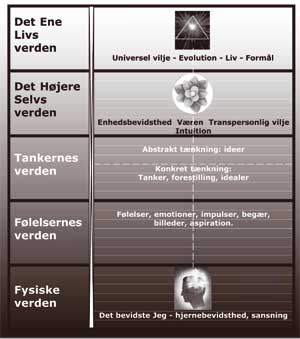 ”Der findes en række indre verdener med hver sine specielle egenskaber, og de består både af højere niveauer og af lavere niveauer. Den første er verdenen af lidenskab og følelser, hvor der er stor afstand og en markant forskel i niveau mellem blind lidenskab og de højere følelser. Så kommer verdenen for intelligens eller for sindet . Her findes også forskellige niveauer: Niveauet for det konkrete, analytiske sind, og niveauet for den højere filosofiske fornuft (nour). Endvidere er der verdenen for forestillingsevnen med et lavere og et højere område, verdenen for intuition , verdenen for vilje , og derefter de endnu højere og ubeskrivelige verdener, der kun kan omtales som “verdener af transcendens”.[14]
Denne beskrivelse af de indre verdener har jeg søgt illustreret i diagrammet til højre, hvor jeg kun har medtaget den fysiske verden og de fire ikke fysiske indre verdener, han oftest henviser til. Som det fremgår af planchen er det Højere Selv – dig og mig, et immaterielt (ikke-fysisk) væsen, der har projiceret en del af sin bevidsthed (emanation) ned i personlighedens verden. I forbindelse med denne nedstigning (involution) har vi tabt erindringen om vores åndelige ophav, men den kan vi generobre på tilbagevejen, der er en opstigning (evolution) op gennem niveauerne. Denne udvikling foregår ifølge Assagioli meget groft sagt gennem tre stadier:
1. Stadiet før den personlige psykosyntese . Selvet har endnu ikke skabt en selvbevidst og integreret personlighed.
2. Den personlige psykosyntese. Selvet har skabt en stærk selvbevidst og integreret personlighed, hvilket svarer til Maslows selvaktualiserede person.[15]
3. Den transpersonlige psykosyntese. Det personlige selv realiserer nu sin universelle bevidsthed, transcenderer egoet og forener sig med sin kilde: det Højere Selv. [16]
Assagioli beskriver hvorledes ovaldiagrammet ovenfor viser os følgende:
”1. Den tilsyneladende dualitet. Den åbenbare eksistens af to selv i os. Faktisk er det som om, der var to selv, da det personlige selv almindeligvis er uvidende om det andet og kan gå så langt som til at nægte eksistensen af det andet. Det andet, det sande Selv, findes latent og viser sig ikke direkte for vores bevidsthed.
2. Den virkelige enhed og Selvets enestående særpræg. Der findes i virkeligheden ikke to selv, to uafhængige og adskilte væsener. Selvet er ét, men manifesterer sig under forskellige former for bevidsthed og selvrealisation. Refleksionen (det personlige selv) fremtræder som noget selv-eksisterende, men har i virkeligheden ingen autonom virkelighed. Den er med andre ord ikke et nyt og anderledes lys, men en projektion af sit lysende ophav.”[17] Parentes i citatet er min tilføjelse.
Selvet er også vilje
En beskrivelse af Assagiolis selvbegreb ville være aldeles ufuldstændig uden at nævne viljen , lad mig derfor kort beskrive den anden side af selvets natur.
Selvet er mere end bevidsthedens kilde, den er også, som det er antydet ovenfor, et udtryk for vilje . Psykosyntesens betoning af viljen, som et helt centralt menneskeligt træk, eller mere præcist, som det et menneske i sin essens er, kendetegner et helt unikt træk ved psykosyntesen. I et interview med Sam Keen: Assagiolis gyldne middelvej beskriver Assagioli sit viljesbegreb:
”Jeg mener at viljen er den moderne psykologis Askepot. Den er blevet forvist til køkkenet. Den victorianske idé om at viljekraft kunne overvinde alle forhindringer, blev tilintetgjort af Freuds opdagelse af den ubevidste motivation. Men uheldigvis førte det til at den moderne psykologi fik et deterministisk syn på mennesket som et bundt stridende kræfter uden noget centrum. Det står i direkte modsætning til menneskets umiddelbare oplevelse af sig selv. På et eller andet tidspunkt, måske i en krise hvor der er fare på færde, sker der en opvågnen som fører til at individet opdager sin vilje. Denne åbenbaring af at selvet og viljen er tæt forbundne, kan ændre hele en persons oplevelse af sig selv og verden. Han opdager at han er et levende subjekt, en skuespiller, som er udstyret med evnen til at vælge, til at skabe relationer, og til at skabe ændringer i sin egen personlighed, i andre og i sine omstændigheder. Denne oplevelse fører til en følelse af helhed, sikkerhed og glæde. Da den moderne psykologi har negligeret viljens centrale position, benægter den at vi har en umiddelbar oplevelse af selvet. Når man bliver overbevist om at man har en vilje, opdager man den tætte forbindelse mellem viljen og selvet.” [18]
Ifølge Assagioli er det at ville, vælge, og være formålsrettet, bevidsthedstilstande der alle er udtryk for vilje. Disse tilstande er noget utroligt centralt ved det at være menneske og i den betydning er han enig med de eksistentialister, der betoner valget. Men hvor visse retninger inden for eksistentialismen betoner, at mennesket ikke er noget i sig selv, men udelukkende bliver til gennem sine valg – da betoner psykosyntesen, at vi er en essens – er et selv – som tilkendegiver og realiserer sin essentielle natur gennem vilje og valg.
Jeg vil senere beskrive hvorfor denne definition er afgørende vigtig, men inden da lad mig nu præsentere hans stjernediagram, hvor forholdet mellem selvet og de andre psykologiske funktioner er repræsenteret.
 Betoningen i dette diagram er at selvet har nogle psykologiske funktioner, men netop ikke er dem. Som det fremgår af diagrammet befinder selvet sig i midten som et udtryk for den indre selvbevidsthed, der oplever og iagttager livet gennem sine psykologiske erkendelsesredskaber. Vi er som mennesker uophørligt påvirket af kontinuerlige strømme af sansninger ude og indefra via de psykologiske funktioner, som påvirker vores selvbevidsthed. Disse indstrømninger af fx følelsesindtryk påvirker os behageligt eller ubehageligt og får os til at reagere mere eller mindre ubevidst.
Det mest almindelige er, at vi ofte må se til, at vi ikke er herre i vores eget hus (personligheden), men netop reagerer tvangsmæssigt på følelsesindtryk og begær. Situationen er klassisk og beskrevet af Paulus i Romerbrevet kap. 7: ”Viljen har jeg, men at udføre det gode kan jeg ikke. For det gode, som jeg vil, gør jeg ikke, men det onde, som jeg ikke vil, det gør jeg”.
Den situation kommer tydeligt til udtryk, når vi forsøger at ændre en rodfæstet vane og fx indleder en slankekur. Her må selvet med sin vilje ofte give op, men det er netop en klar indikation på, at det bevidste selv oplever sig selv som én ting, mens vanen, begæret efter mad ad libitum er noget andet, der på nuværende tidspunkt er os fremmed og uønsket. Begæret overmander os – det bevidste selv – uden at vi kan stille noget op.
Ud fra ovenstående kan vi fastslå, at selvom der ifølge psykosyntesen findes en central kerne af selvbevidsthed og vilje i mennesket, så er denne kerne ofte ikke i stand til at handle i overensstemmelse med sine bevidste ønsker og sin vilje.
Hvis det var muligt at styrke selvet og dermed viljen, så ville vi have en central kilde, der aktivt kunne tage del i at udvikle og forædle de psykologiske funktioner, således at vi ikke længere er slavebundet af vores vanemæssige reaktioner. Vi kunne bevidst søge at styrke vores intuition , kærlighed, kreativitet og intelligens. Det er netop den tanke der er hele Assagiolis pointe.
Viljen kan trænes så den i tiltagende grad virker som en konstruktiv kraft, der kan udnytte intuition, drifter, følelser, tanker og forestillinger til at opnå en fuldkommen selvrealisering.
Hvordan opleves selvet?
Indtil videre har jeg hovedsageligt beskrevet den teoretiske opfattelse af selvet og dets forhold til personlighedens øvrige indhold. Men skal teorien omsættes i en klinisk praksis, så må oplevelsen af såvel det Højere og personlige selv beskrives af kendere, der selv har foretaget den indre rejse. Assagioli hævder netop i ovenstående at hans beskrivelser tager udgangspunkt i hans egen levende praksis, lad mig derfor her og nu tage udgangspunkt i hans oplevelser.
I bogen Psykosyntese beskriver han i en øvelse hvad der bliver tilbage efter at man gennem selvidentifikationsteknikken har disidentificeret sig fra det fysiske, emotionelle og mentale indhold i personligheden:
”Tilbage bliver essensen af mig selv, kernen af mit selv – et center af ren selvbevidsthed og selvrealisation. Det er den permanente faktor i mit evigt skiftende personlige liv. Det er dette center, der giver mig følelsen af at være, af bestandighed og indre sikkerhed. Jeg erkender og bekræfter mig selv som et center af ren selvbevidsthed. Jeg erkender, at dette center ikke blot har en statisk selvbevidsthed, men også en dynamisk kraft. Det er i stand til at iagttage, kontrollere, styre og bruge alle de psykologiske processer og det fysiske legeme. Jeg er et center af bevidsthed og kraft.”[19]
Assagioli fastslår ved adskillige lejligheder at oplevelsen af det personlige selv er forbundet med ”en følelse af sikkerhed, indre vished, og bestandighed”, at ”det er en stille subtil ting” og ”ikke en højdepunktsoplevelse”[20] Det er altså ikke en forbigående ekstatisk tilstand vi søger, når det personlige selv skal findes, men derimod opdagelsen af iagttageren, der fra et stille og ubundet sted kan overskue bevidsthedens strøm og derfra handle viist på en måde der tilgodeser alle personlighedens behov i en given situation.
Eftersom det personlige selv blot er en refleksion af det Højere Selv, så bør det ikke overraske hvis der er ligheder i oplevelsen af såvel det Højere og personlige selv. I Psykosyntese beskriver han det selvrealiserede menneskes bevidsthedstilstand:
”Det er en bevidsthedstilstand karakteriseret ved glæde, klarhed, indre sikkerhed, en følelse af rolig kraft, klar forståelse og udstrømmende kærlighed. I sine højeste aspekter er det realisationen af en essentiel sameksistens, kommunikation og identifikation med det universelle liv.”[21]
Et andet sted skelner Assagioli mellem det Højere Selvs kerne og dets udstråling af kærlighed, visdom, oplysning etc. når Selvet udtrykker sig gennem det højere ubevidste . Men kernen i det Højere Selv er ”stabilt, fast og bestandigt, eller for at bruge et filosofisk ord ”ontologisk”. Det er Ren Væren.”[22] Det er en paradoksal og for intellektet uforståelig tanke at Selvet på den ene side er fuldkommen stille og på den anden side handler (transpersonlig vilje ), men det er således Assagioli beskriver det Højere Selv i artiklen Roberto Assagioli om Selvet.
Diskussion: Findes der et selv?
Det ligger uden for denne opgave at undersøge alle de forhold der kunne pege på eksistensen af den kerne i mennesket, som Assagioli m.fl. kalder for selvet . Det er et ældgammelt spørgsmål, som forskere i lang tid har søgt at besvare, men uden at nå til enighed. Det bestemmes formentlig helt af den synsvinkel man anlægger på virkeligheden. Er man materialist, det vil sige, at man udelukkende tager udgangspunkt i fysiske verificerbare undersøgelser, så har det ikke kunne lade sig gøre at bevise om selv-bevidstheden, dvs. selvet, udelukkende er et produkt af den fysiske hjerne eller ej. Eller om der overhovedet eksisterer et centralt organiserende selv, hvad mange sikkert vil bestride.
Tager vi udgangspunkt i Assagioli, så fastholder han i citatet ovenfor, at selvet er en ”indre virkelighed der empirisk kan verificeres og bevidst fremkaldes ved hjælp af de rette teknikker.”
Disse teknikker er introspektion og en fænomenologisk tilgang til spørgsmålet. Det uddyber han i nedenstående svar på et spørgsmål, om selvet kan bevises:
”Du spørger også, om det kan bevises videnskabeligt. Det afhænger helt af hvad du forstår som videnskab. Det kan ikke bevises ved hjælp af almindelig videnskab, fordi der ikke findes noget bevis på dette begrebsmæssige plan. Men hvis man antager den videnskabelige holdning og metode som jeg skitserer den, så ja. Det bevises gennem direkte oplevelse. Det er en af disse primære erfaringer som er beviser i sig selv. Ligesom med farve, en oplevelse af skønhed eller andet, der ikke behøver nogen forklaring. De er primære erfaringer og har derfor fuld videnskabelig værdi i en bredere betydning. …”[23]
Ken Wilber, der på mange måder har videreført og udvidet Assagiolis arbejde har også behandlet spørgsmålet indgående. Han tager udgangspunkt i virkelighedens indre eksistensplaner, som skitseret tidligere, og konkluderer på den baggrund, at der må anvendes forskellige videnskabelige metoder afhængig af hvilke fænomener man vil undersøge.
I hans bog Eye to Eye [24]gør han nøje rede for tre epistemologiske øjne, som han kalder for kødets, sindets og kontemplationens øje. Disse begreber dækker over bevidsthedens evne til at rette sig mod tre principielt forskellige ontologiske vidensområder: det fysiske plan, sindets plan og de transcendente planer. Vil man fx studere det Højere Selv, så må man ifølge Wilber tage de meditative teknikker i anvendelse som forskerne inden for visdomstraditionerne alle dage har anvendt og dermed kontemplationens øje.
Delkonklusion om selvbegrebet
På baggrund af ovenstående grove beskrivelse af Assagiolis selvbegreb kan vi konkludere:
- Selvet er et udtryk for den selvbevidste og viljesbetonede kerne i mennesket, der er uafhængig af de psykologiske funktioner.
- Selvet er udtryk for et spirituelt væsen, der i sin essens er ét med det Universelle Selv.
- Selvet opleves forskelligt på de 5 personlige og transpersonlige niveauer, men det er alligevel det samme selv.
- Selvet er ifølge Assagioli erfaret, oplevet og verificeret af såvel ham selv og andre gennem introspektive teknikker.
- Selvet opleves som en indre iagttager der er stille, stabil, fast, dynamisk og bestandig.
Jeg vil vil nu give en kort introduktion til hvorledes psykosyntesen anviser veje til at opleve selvet. Senere vil jeg give et klinisk eksempel på, hvorledes hans tanker om selvet kan omsættes i en psykosyntese terapi.
Vejen til centret og selvet
Selvopdagelsens kunst
At finde selvet eller ”sig selv” kunne med god ret kaldes for selvopdagelsens kunst. Der er nok en fælles årsag til at mange mennesker søger en dybere forståelse af hvem de er. Ifølge Assagioli er det på den ene side den udtalte forvirring og menneskelivets mange problemer og lidelser, der forårsager den intense interesse for selvudvikling. På den anden side er det Selvets indre intuitive stemme, der fremkalder en længsel og et behov for at lære sin sande natur at kende. Assagioli beskriver situationen således:
”I vort almindelige liv er vi begrænsede og bundne på tusinde måder – et bytte for illusioner og fantasier, slaver af uerkendte komplekser, kastet hid og did af ydre påvirkninger og blændet og hypnotiseret af bedrageriske fænomener. Det er intet under, at mennesket under
sådanne omstændigheder ofte er utilfreds, usikkert og oplever svingninger i humør, tanker og handlinger. Med en intuitiv følelse af at være ét, og alligevel opleve at være ”delt i sig selv” forvirres mennesket og fejler i forståelsen af sig selv eller andre. Det er ikke underligt, at så mange liv slår fejl eller bliver begrænset, når mennesket ikke forstår sig selv eller mangler selvkontrol.”[25]
Det er Assagiolis antagelse at denne selvopdagelse eller selvrealiseringsproces forløber gennem fire stadier:
1. Gennemgribende viden om sin egen personlighed
2. Kontrol af personlighedens forskellige elementer
3. Realisation af sit eget sande selv – opdagelsen eller dannelsen af et samlende center
4. Psykosyntese: Dannelse eller rekonstruktion af personligheden omkring dette nye center[26]
Der er ikke plads til i denne opgave at beskrive hele selvrealiseringsprocessen, derfor vil jeg hovedsageligt fokusere på det element, der har at gøre med udviklingen af ”centret af ren selvbevidsthed og vilje” eller det personlige selv . Dette center er særdeles vigtigt i ovenstående proces, da det er fra dette center vi kan harmonisere personligheden til en integreret helhed, hvorfra vi har adgang til alle vores ressourcer og potentialer. Ofte er vores situation at fx enkelte begær i perioder kaprer hele personligheden til stor skade for vores liv og andre essentielle behov. Det kan være overforbrug af stimulanser og fødevarer, som truer kroppens sundhed eller behov for seksuelle sidespring, der truer familiesituationen.
Et andet forhold er også, at vi ikke identificerer os med vores sande kerne, men med alle de kulturelle påvirkninger, og ”falske selvbilleder” som vi har internaliseret via barndommen og ungdommen. Vi identificerer os ligeledes med de forskellige bevidsthedstilstande som uophørligt skyller ind over os. Assagiolis pointe er:
”Hver gang vi ”identificerer” os med en svaghed, en skyld, en frygt eller enhver form for personlig emotion eller drift, begrænser og paralyserer vi vort eget selv.”[27]
Selvidentifikation og dis-identifikation
Vejen ud af denne situation, således at vi opnår kontrol over personlighedens forskellige elementer, sker gennem det Assagioli kalder selvidentifikation og dis-identifikation. Disse helt centrale teknikker har til hensigt at skabe det indre iagttagende center, hvoromkring vi kan integrere, samle og transformere personlighedens mangfoldige og ofte modstridende sider.
Et af Assagiolis helt centrale udsagn i den forbindelse er: ”Vi er domineret af alt hvad vores selv identificerer sig med. Vi kan dominere og beherske alt, som vi kan disidentificere os fra”.[28]
Herunder uddyber han selvidentifikation:
”Den bevidste og formålsrettede brug af selvidentifikation – eller dis-identifikation – er det grundlæggende inden for psykosyntesen. Den anvendes fra et dynamisk center, i hvilket hele processen med en syntetisering af de psykologiske mangfoldigheder til en organisk enhed er baseret. Den tilbyder et meget effektivt middel til at kunne kontrollere de forskellige elementer af personligheden. Den er baseret på et fundamentalt psykologisk princip, der blev omtalt i kapitel I. og som gentages her, på grund at dets store betydning: ”Vi domineres af alt, som vort selv identificerer sig med. Vi kan dominere og beherske alt, som vi kan disidentificere os fra” [29]
Der er ingen tvivl om at arbejdet med at disidentificere sig og finde sit indre center, står som noget helt centralt inden for psykosyntesen. Den praktiske metode til at foretage dette skridt sker især gennem Assagiolis dis-identifikationsøvelse.[30] Denne øvelse er på én og samme tid en selv-identifikation med det personlige selv og en dis-identifikation fra de falske selvbilleder mv.
I et interview med Beverly Besmer: Højdepsykologi – interview med Roberto Assagioli forklarer Assagioli, hvorledes det personlige selv verificeres gennem dis-identifikation:
”Lad os antage at der er et centrum i den menneskelige personlighed, en kerne, et bevidst selv, som ikke er hele personligheden, men kun et punkt af ren selvbevidsthed – en iagttager af al personlighedens indhold. Hvordan kan denne hypotese verificeres? Gennem en række eksperimentelle teknikker.
Den grundlæggende teknik er øvelsen i bevidsthedens dis-identifikation fra alle personlighedens forskellige indhold, med den efterfølgende afsløring eller afdækning af selvet – ren selv-bevidsthed/opmærksomhed. Det er grundigt beskrevet i Psykosyntese .
BB: Har det nogen forbindelse med meditation?
RA: For at styrke og gøre iagttagerens rene selvbevidsthed stabil, er det nødvendigt med perioder af indre stilhed, som bliver gradvis længere, for at skabe det der kaldes det tomme rum i bevidsthedsfeltet .
Så opdager man en anden vigtig funktion af selvet: det er ikke blot en iagttager, men kan også være aktivt og ændre personligheden. Det vil sige, at det kan styre og regulere psykens forskellige funktioner. Det kan være en der vil.”[31]
Arbejdet med dis-identifikation og dermed meditation er noget der i psykosyntesen allerede påbegyndes fra starten af den terapeutiske proces. Det fastslår han i Psykosyntese:
”I terapien bør teknikken i forbindelse med selvidentifikation benyttes så tidligt som muligt, da den letter og fremmer brugen af andre teknikker inden for psykosyntesen. Den bliver almindeligvis præsenteret på et ret tidligt tidspunkt.”[32]
For at understrege vigtigheden af kendskabet til dis-identifikation og det personlige selv, vil jeg afslutningsvis henlede opmærksomheden på nogle Retningslinier for psykosyntese træning som Assagioli har udsendt. Her nævner Assagioli syv punkter, som han kalder for essensen og det originale i psykosyntesen set i forhold til andre psykoterapier:
1. Dis-identifikation, 2. Det personlige selv, 3. Viljen; den gode, stærke og intelligente, 4. Ideal modellen, 5. Syntese (i dens forskellige aspekter), 6. Det overbevidste 7. Det transpersonlige Selv . [33]
Diskussion af vejen til centret
Der er ingen tvivl om, at Assagiolis radikale udsagn om at essensen i mennesket ikke er personlighedens tanker og følelser er vanskeligt at forholde sig til for mange. Der kan vel også ligge en reel fare i, at mennesker der træner sig i dis-identifikation bliver fremmedgjorte overfor deres følelser. Hvis vi ikke er vores følelser hvorfor så beskæftige sig med dem?
Der er efter min mening ingen tvivl om, at teknikken i ukyndige hænder kan fremme en tendens til fx fortrængning af følelseslivet, hvis den blev misbrugt. Sætningen i dis-identifikationsøvelsen[34] ”jeg er ikke mine følelser” kunne ubevidst fordrejes til: ”jeg har ingen følelser”. Men det er i så fald en anvendelse der går stik i mod formålet med teknikken, som netop har til hensigt at skabe en accepterende distance til følelseslivet, for netop at kunne iagttage og mærke følelserne klart, tydeligt og helt bevidst.
Assagioli var dog også klar over den fare som teknikken rummede. Han advarede mod at bruge den uden omhyggelig vejledning og tilpasning til den enkelte, især når det gjaldt klienter der var overdreven introverte eller havde tendens til dissociation eller havde psykotiske træk.
Der har især blandt fremtrædende psykosynteseterapeuter været en tendens til at omformulere dis-identifikationsøvelsen. Det er især sætningen: ”du er ikke” din krop, dine følelser, tanker, roller etc. de har ændret eller udeladt. Jeg har ikke kunne finde nogen direkte begrundelse derfor, men det fremgår indirekte at de lægger vægt på, at vi ikke er adskilte fra fx følelserne, men i stedet er noget andet, noget mere. Lad mig give et eksempel.
I Molly Young Browns gamle udgave af The Unfolding Self stod der: ”jeg er ikke kun kroppen” (I am not only the body). [35] I den nye udgave, der nu kaldes for: Unfolding Self[36] er hele dette aspekt af øvelsen taget ud, således at der ikke indgår et element, hvor man skal bekræfte hvad man ikke er. I stedet har hun valgt en udspørgende metode, hvor udøveren bedes reflektere over spørgsmålet: Hvem er du?
Hendes første modifikation: ”Jeg er ikke kun kroppen” er meget problematisk, fordi den indirekte siger at man delvist er kroppen. Dermed forlader hun en meget central pointe og indsigt i Assagiolis forståelse af selvet , hvor selvet er noget andet end kroppen, følelserne etc. I den anden modifikation går hun helt uden om problemstillingen og undlader dermed også aktivt at forlade Assagiolis definition, men hun bekræfter den heller ikke.
Assagioli kendte til modstanden mod ”Jeg er ikke” og forsvarede den ved flere lejligheder fordi ideen er central i psykosyntesen. Lad mig først med et eksempel vise hvorledes Assagioli forsvarer udsagnet:
”Vi identificerer os almindeligvis med vore tanker, men hvis vi analyserer dem og iagttager os selv, mens vi tænker, vil vi lægge mærke til, at intellektet fungerer som et redskab.
Vi kan betragte de logiske eller ulogiske forbindelser og opleve sindet arbejde ved at anskue det hele ovenfra. Det indikerer, at vi ikke er vore tanker. Tanker er ligeledes omskiftelige: Den ene dag mener vi ét, næste dag mener vi noget andet. Vi får tilstrækkeligt bevis på, at vi ikke er vore tanker, når vi prøver på at kontrollere og styre dem. Når vi ønsker at tænke på noget abstrakt eller kedeligt, nægter vort mentale instrument ofte at adlyde os. Alle elever, der har prøvet at lære noget, som er kedeligt, har gjort denne erfaring. Hvis sindet er opsætsigt og udisciplineret, betyder det, at ”Jeget” ikke er sindet. Disse ting giver os indikationer på, at legemet, følelserne og sindet er redskaber gennem hvilke, vi oplever, opfatter og handler – redskaber, der er foranderlige og ufuldkomne, men som kan være domineret, disciplineret og bevidst brugt af ”Jeget”, mens ”Jegets” beskaffenhed er noget helt andet. ”Jeget” er enkelt, uforanderligt, konstant og selv-bevidst. Oplevelsen af ”jeget” kan udtrykkes således: ”Jeg er mig – et center af ren bevidsthed .” [37]
Et andet sted siger han: ”… sindet har intet at gøre med Selvet … Selvet er i en helt anden dimension”[38] Her er det tydeligt, at han tænker de forskellige eksistensplaner ind i sit argument, da det Højere Selv befinder sig i en højere og mere transcendent verden end sindet.
I forhold til den modstand der rettes mod dis-identifikation, siger han i Psykosyntese:
”Hos visse patienter, især amerikanere, er der en del modstand mod tanken om dis-identifikation af sig selv i forhold til legeme, følelser og tanker samt en dyb frygt for at blive splittet i forskellige dele herved. Omvendt er der mange patienter, som synes godt om tanken om fuld oplevelse af et center i sig selv; et center, hvor de kan finde styrke og visdom til at stå imod presset fra det moderne liv.”[39]
På et spørgsmål der netop retter sig mod denne afvisning af dis-identifikation uddyber Assagioli i et andet interview sin holdning:
”SP: Nogle mennesker kan ikke lide at man siger ”jeg har et legeme, men jeg er ikke legemet” og så videre. De føler at det er en fornægtelse.
RA: Det er en af de mange misforståelser, som følger af den centrale misforståelse. Der er overhovedet ikke tale om fornægtelse, men om at tingene anbringes hvor de hører til. Vi har brug for legemer her, og vi bør tage os godt af dem og sætte pris på dem. Det er ikke kun mystikere og religiøse mennesker som ikke har den rette opfattelse, det er også intellektuelle, som fornægter deres legeme, ikke har nogen fornemmelse af deres legeme, ikke oplever det, end ikke er opmærksomme på det. Så vi må i allerhøjeste grad sætte pris på legemet uden fejlagtigt at sige, at jeg er det. Hvad er forskellen? Jeg kan sætte pris på et æble, men jeg er ikke æblet! Vi kan sætte pris på mange ting uden at være dem. Så vi kan også sætte pris på vores legeme, have god gavn af det og bede om tilgivelse for de synder vi begår mod det, uden at sige ”jeg er det”. Det er indlysende. Men der er en forklaring på den fejltagelse. I dag gælder det for mange mennesker, at det er legemet der har dem. De er slaver af deres legeme. Så til at begynde med er det, der psykologisk er brug for, et adskillende trin. Vi må for en stund gå i den anden grøft for at opnå det. Og det gælder alle slags besiddelser.” [40]
Hele spørgsmålet rejser naturligvis også et grundlæggende spørgsmål om hvorvidt bevidstheden eksisterer uden for legemet. Der er ingen tvivl om, at mange mystikere oplever det således. Ken Wilber, der selv har redegjort for sine transcendente oplevelser i sin bog, One Taste, er helt på linie med Assagioli. Han siger:
”Når du hviler i Vidnet og erkender at: Jeg er ikke objekter, Jeg er ikke følelser, Jeg er ikke tanker – da er alt hvad du vil bemærke en fornemmelse af frihed, befrielse og forløsning fra den forfærdelige begrænsning det er at være identificeret med de små begrænsende objekter. Den lille krop, det lille sind, det lille ego, der alle er objekter der kan iagttages og derfor ikke er den sande iagttager, det sande Selv, det rene Vidne, der er den du virkelig er.” [41]
Ken Wilber og Roberto Assagioli henter begge massiv inspiration i Østens visdomstraditioner, hvor der netop skelnes mellem Atman og Maya, det Højere Selv og den form som det opererer i. Jeg synes personligt at denne integrale holdning, dvs. evnen til at skabe en syntese ud af såvel Østens som Vestens indsigter er meget tiltalende og klog.
Der foreligger ligeledes på nuværende tidspunkt en omfattende forskning i nærdødsoplevelser, der tyder på at bevidstheden kan eksistere uafhængigt af kroppen. Det drejer sig om tilfælde, hvor klinisk døde patienter er blevet kaldt tilbage og har, kunne rapportere om hændelser der er sket mens de har været døde. Toneangivende forskere inden for dette felt er Dr. Raymond Moody, og Dr. Elisabeth Kübler-Ross.
Afslutningsvis vil jeg dog gerne understrege, at det ifølge mine egne erfaringer kan være en udmærket ide at undlade den benægtende del af dis-identifikationsøvelsen, hvis klienten har modstand mod det. Det gør jeg netop selv, hvad der også fremgår af øvelsen i bilag 1, som jeg ofte anvender i min kliniske praksis. Det er ikke meningen at klienterne skal tilpasses teknikkerne, men at man altid må tage udgangspunkt i klientens virkelighed.
Delkonklusion om vejen til centret
Ud fra ovenstående kan jeg konkludere, at teknikken med selvidentifikation og dis-identifikation er en vigtig og helt central teknik indenfor psykosyntesen; derfor tages teknikken i anvendelse tidligt i den terapeutiske fase. Meditation er en vigtig metode til at opnå den stabile identifikation med den indre iagttager.
I ovenstående afsnit har jeg ud fra primært Assagiolis egne kilder også bestræbt mig på at besvare følgende spørgsmål:
Hvorfor er opdagelsen af det personlige selv vigtig? Konklusionen er, at det især udvikler evnen til at iagttage bevidsthedsstrømmen fra et stabilt og permanent center. Derfra kan man med viljen påvirke, styrke og mestre personlighedens andre elementer.
Hvad er resultatet af det? Konklusionen er: Indre frihed og psykosyntese , dvs. en harmonisk og velintegreret personlighed som første skridt, der senere udvides til at omfatte en realisering af det Højere Selv.
Hvordan fremkalder man oplevelsen af selvet i en klinisk praksis? Konklusionen er, at det sker gennem især (men ikke kun) anvendelsen af meditation og dis-identifikationsøvelsen.
En terapeutisk Casestory
Introduktion til psykosyntese terapi
Jeg vil nu afslutningsvis eksemplificere hvorledes man kan arbejde med ovenstående ideer og metoder i en psykosyntese terapeutisk sammenhæng. Jeg vil alene fokusere på at beskrive de terapeutiske interventioner, som går på at fremkalde en dis-identifikation fra hæmmende og begrænsende personlighedsmønstre, samt hvorledes jeg arbejder på at styrke klientens iagttagerbevidsthed. Der er naturligvis ikke én metode som kan anvendes på alle, da enhver terapeutisk session har sit eget helt unikke forløb. Psykoterapeutisk arbejde må altid tilpasses til klientens virkelighed og behov.
Det terapeutiske rum som skabes af klientens og terapeutens fælles nærvær, udstråling og samarbejde er naturligvis det essentielle i terapien. Men der indgår også visse særlige træk som kendetegner en klinisk praksis med udgangspunkt i psykosyntese.
Meditation: Indledningsvis kan jeg fortælle, at der meget ofte indgår meditation i alle mine sessioner, hvis ikke den aktuelle situation taler i mod det. Meditationerne har især tre primære formål. 1. At styrke iagttager bevidstheden og dermed oplevelsen af selvet[42] 2. At kontakte og forankre transpersonlige energier til anvendelse i det terapeutiske arbejde. Det kan fx være accept, ærlighed, autenticitet , kærlighed, visdom etc. 3. At give indsigter og højere erkendelser.
Undervisning: Alle mine klienter får i løbet af sessionerne en præsentation af psykosyntesens grundelementer, så de kan forstå hvorledes jeg arbejder og hvorfor. Denne løbende undervisning sikrer at klienterne samarbejder kognitivt med det terapeutiske forløb og er enige i den målsætning jeg undervejs udvikler i samarbejde med klienten. Undervisningen suppleres med artikler og instruktioner som udleveres.
Teknikker: Jeg tager meget ofte specifikke teknikker i anvendelse, som styrker evnen til at dis-identificere sig fra falske selvbilleder mv. Det kan være stolearbejde (gestalt teknik) hvor klienten siddende på forskellige stole identificerer og dis-identificerer sig med forskellige sider af sig selv. Fri tegning, hvor klienten tegner/maler sine indre delpersonligheder og bevidsthedstilstande, bidrager til at tydeliggøre de indre aktører. Indre dialog med de forskellige indre tilstande er ligeledes en ofte benyttet metode. Spørgeskemaer, selvbiografi og dagbogsskrivning er også effektive værktøjer når klienten skal reflektere over vigtige sider af sig selv mellem sessionerne.
En terapeutisk case story
Birte var en enlig kvinde i slutningen af 50erne som i mange år havde arbejdet som sygeplejerske på en psykiatrisk afdeling. Hun opsøgte mig, fordi hun i en årrække havde lidt af lettere depressive tilstande og et lavt selvværd, som forhindrede hende i at føle glæde i livet. Et af de temaer, som vi arbejdede med i terapien var en stærk vrede og afmagtsfølelse over de arbejdsforhold, som hun oplevede på den psykiatriske afdeling. Da hun påbegyndte terapien, var hun plaget af en konstant dårlig samvittighed over ikke at kunne udføre sit arbejde ordentligt. Hun bebrejdede sig selv, at hun hver dag gik fra mennesker, som havde brug for hjælp, men ikke fik den. Behovene var langt større end hun kunne magte. Samtidig følte hun en overvældende vrede vendt mod kollegaerne, som hun følte ikke levede op til deres ansvar. De var efter hendes mening ”dovne, uansvarlige og ufølsomme” overfor de psykiatriske patienter.
Vreden tappede hende for en hel del energi samtidig med, at det gjorde hendes forhold til kollegaerne anstrengt, fordi hun havde vanskelig ved at holde sin vrede inde og ofte kom den ud som spydigheder og indirekte kritik. Hun havde allermest lyst til at stoppe arbejdet, men hun var samtidig bange for, at hun i sin forholdsvis høje alder ikke ville kunne få et nyt job der var bedre. Hendes liv som single og hendes alder betød, at hun følte sig magtesløs og som et offer for omstændighederne.
Det var min fortolkning, at hendes identifikation med offerrollen fastlåste hendes situation og betød at hendes handlemuligheder var særdeles begrænset. Offerrollen er en klassisk delpersonlighed , som altid fratager den person der er identificeret med den, sin kraft, vilje og frihed. At frigøre sig fra den er ofte et særdeles vanskeligt arbejde som kræver et længere forløb. Den terapeutiske intervention jeg besluttede mig for, var at styrke Birtes evne til at frigøre sig fra sin offerrolle, sin vrede og afmagtsfølelse, så den ikke styrede hende ind i depressive tilstande. Det valgte jeg at gøre ved at guide hende gennem tre faser, som jeg meget ofte ser udfoldet i den terapeutiske proces: accept, dis-identifikation og nyt positivt fokus.
Acceptfasen
Acceptfasen er en periode, hvor der fokuseres på at skabe et medmenneskeligt møde af varme, forståelse og tillid. At acceptere det der er ved at være bevidst og iagttagende, mens man oplever tilstande af vrede, afmagt og offerproblematikker. I denne fase arbejdede vi på at forstå og opleve hendes følelser og tanker uden at stille spørgsmålstegn ved dem. Vi arbejdede på at identificere de tilstande som overvældede hende på arbejdet og når hun gik der hjemme. Det gjorde vi gennem samtalen og ved at tegne/male/skrive tilstandene ud og ikke mindst gennem iagttagerøvelsen (bilag 1), som vi anvendte hver gang som indledning til sessionen [43]. Jeg opfordrede ligeledes Birte til i sin hverdag at iagttage sine reaktioner som en daglig vane.
Acceptfasen er også den udrensende fase, hvor hendes følelser fik lov at komme frit til udtryk. I meditationerne under sessionerne arbejdede vi i fællesskab på at skabe en så stærk stemning af accept som muligt ved at kontakte de højere bevidsthedslag og ved hjælp af forestillingsevnen sende accepten ud ”gennem hjertet”. I denne periode kom der utrolig megen smerte og sorg op som skulle accepteres og tillades at være der.
Dis-identifikationsfasen
På et tidspunkt begynder klienten at eje sine følelser, hvilket vil sige, at hun kan tillade dem at være der i en accepterende ånd. Da Birte nåede frem til denne fase i processen overgik vi glidende til dis-identifikationsfasen. I denne fase lægges vægten på at skabe en oplevelse af, at iagttageren og ofret er to forskellige ting. Vi arbejdede især med stole og indre dialog som teknikker til at indøve den oplevelse. Når hun sad i én stol var hun iagttageren, der kunne tale med de forskellige indre tilstande, som om der var flere indre personer tilstede. Når hun sad i en anden stol, spillede hun rollen som offer med alle de følelser det indebar. Her er et kort og nedskåret eksempel på, hvorledes en vigtig og afgørende samtale udspillede sig mens hun sad i ”offerstolen”:
Kenneth: Velkommen offer. Hvordan har du det i dag?
Birte: Jeg føler mig vred og frustreret.
Kenneth: Kan du beskrive din vrede lidt mere, hvor oplever du den i kroppen og hvordan sanser du den?
Birte. Jeg føler det som om der sidder en stor ildkugle nede i maven, som bare vil udspy sin ild uden hæmninger.
Kenneth: Hvad ønsker du?
Birte: Jeg ønsker at straffe de dovne og hamrende inkompetente kollegaer jeg har. De skulle simpelthen selv prøve at få den samme behandling, som de byder deres medmennesker på afdelingen. Jeg har lyst til at slå dem, så de kunne mærke noget af den samme smerte.
Kenneth: Hvad forhindrer dig i at gøre det?
Birte: Så mister jeg mit job.
Kenneth: Hvad har du dybest set behov for?
Birte: At se retfærdigheden ske fyldest. Jeg synes det er så uretfærdigt, at de slipper godt fra at behandle deres medmennesker på en sådan måde.
Kenneth: Kunne du have behov for at slå på madrassen mens du forestiller dig at du straffer en af dine kollegaer.
Birte: Ja, det vil jeg godt prøve. (Hun får en tennisketsjer i hånden og sidder på knæ foran madrassen. Efter 30 sekunders pause:) Jeg kan ikke. Jeg kan simpelthen ikke få mig selv til at gøre det. Så ville jeg blive som min mor. Jeg ville ikke være et hak bedre end de kollegaer som jeg skælder ud på. Jeg kan ikke.
Kenneth: Det er helt OK. Men hvad har du så behov for.
Birte: Jeg har behov for at slippe af med al den vrede. Den æder mig op indefra.
Kenneth: Godt, det kan jeg sagtens forstå. Vil du være venlig at sætte dig over i stolen, hvor du er iagttager.
Denne session blev et vendepunkt i forhold til det tema vi arbejdede med. Offerrollen mistede noget af sin magt i samme øjeblik Birte så den lignede sin mor og faktisk optrådte lige så uretfærdig som hendes kollegaer. I det øjeblik var Birte parat til at frigøre sig fra dens magt. Der var naturligvis langt flere aspekter inde i sagen som jeg ikke kan komme ind på her. Men hovedpointen er, at Birte først nu var parat til at give slip på offerrollen. Hun var parat til at identificere sig med noget andet fordi oplevelsen havde vagt hendes vilje til live.
Det er på dette stadie, at man med fordel kan introducere dis-identifikationsøvelsens ”Jeg spiller en offerrolle, men jeg er ikke denne rolle. Jeg er et center af ren selvbevidsthed og vilje”. Hun kunne nu begynde at se bag om offerrollen og iagttage de primære og sekundærgevinster der altid er forbundet med at identificere sig med en stærk delpersonlighed.
Dernæst flyttede vi det primære fokus hen på at styrke iagttageren og identificere det gode potentiale i offerrollen, som var hendes omsorg for patienterne og hendes retfærdighedssans etc.
Efterhånden som hun i sin hverdag oplevede, at hun kunne iagttage sine offerreaktioner, når kollegaerne fx efter hendes standard ikke levede op til deres ansvar, så lykkedes det også at dæmpe reaktionerne af især vrede. Hendes accepterende holdning tog toppen af reaktionerne. Således frigjort fra de stærkeste vredesfølelser og magtesløsheden, oplevede Birte at hun måske ikke kunne ændre forholdene på sin arbejdsplads, men hun kunne ændre den måde hun forholdt sig til arbejdspladsen på. Birtes evne til at være iagttager vækkede samtidig hendes vilje, dvs. hendes evne til at vælge perspektiv på sine oplevelser – et godt eksempel på hvorledes selvet og viljen er nært forbundet.
Vi arbejdede en hel del på at finde ud af, hvad der var hendes ansvar på jobbet og hvad der var sygehusledelsens. Det hjalp hende også til at frigøre sig fra en overvældende følelse af ansvar på jobbet, og til at tage større ansvar for sin egen helbredssituation.
Det hjalp ikke patienterne, at hun gik ned på en for stor arbejdsbyrde. Samtidig opdagede hun, at hun havde investeret en alt for stor identitet i sit arbejde som ”hjælper” på bekostning af sit øvrige liv. Dette er et klassisk eksempel på hvorledes en enkelt delpersonlighed kan erobre hele selvets opmærksomhed, således at alle de øvrige potentialer sygner hen i mørket.
Nyt positivt fokus
Arbejdet med viljen i en psykosyntese terapi er altid forbundet med at have et fokus, et formål man søger at realisere. I Birtes tilfælde var arbejdet med offerrollen med til at sætte fokus på hendes identitetsopfattelse og selvbillede. Terapien afslørede, at hun havde identificeret sig med den gode og opofrende hjælper, der solidariserede sig med patienterne. Da offerrollens tiltrækningskraft brød sammen satte det også spørgsmålstegn ved hele den måde hun levede og prioriterede sit liv på.
I terapien begyndte vi at arbejde med de store og eksistentielle spørgsmål: Hvad vil jeg med mit liv? Hvem er jeg? De spørgsmål vækkede en gammel længsel til live efter at beskæftige sig med kristendom og teologi. Hun opdagede en gammel kærlighed rettet mod at undervise og fortælle om evangeliernes historier og livskundskab, men hun havde aldrig fået gjort noget ved den. Hun besluttede (vilje) efter flere sessioner, hvor disse spørgsmål var i fokus, at tiden nu var inde til at gøre noget ved sin længsel.
Det terapeutiske arbejde gik nu over til primært at styrke hendes nye fokus, der udmøntede sig i nogle nye målsætninger om at studere på folkeuniversitetet, gå mere seriøst ind i et kristent menighedsarbejde og lave en langtidsplanlægning for hendes skribent og foredragsvirksomhed.
Det nye fokus begyndte at fyldte hendes liv med mening og betydning.
Under de løbende evalueringssamtaler trak vi hendes proces frem i lyset. Hun fortalte, at hun følte sig mere centreret, og efterhånden som hun blev bedre til at iagttage sine følelser og reaktionsmønstre, så styrede de hende ikke på samme måde som tidligere.
Hun havde også fået sit arbejde ned i ”øjenhøjde”, det fyldte ikke så meget og derfor kunne hun lettere acceptere de arbejdsbetingelser hun havde. Hun havde lettere ved at forstå kollegaernes begrænsede formåen, fordi hun havde set sine egne.
Men det vigtigste var, at hendes liv havde fået et nyt fokus fyldt med mening og betydning.
Konklusion om selvet
Jeg har også tidligere søgt at svare på tre vigtige spørgsmål:
Hvorfor er opdagelsen af det personlige selv vigtig? Konklusionen er, at det udvikler evnen til at iagttage bevidsthedsstrømmen fra et stabilt og permanent center.
Hvad er resultatet af det? Konklusionen er: Oplevelse af indre frihed, viljesstyrke og syntese , dvs. en harmonisk og velintegreret personlighed som første skridt, der senere udvides til at omfatte en realisering af det Højere Selv.
Hvordan fremkalder man oplevelsen af selvet i en klinisk praksis? Konklusionen er, at det især sker gennem (men ikke kun) anvendelsen af meditation og dis-identifikationsøvelsen.
Afslutningsvis har jeg søgt at efterprøve teorierne gennem en case story, hvor fokus har været at undersøge om klienten oplever ”et center af ren selvbevidsthed og vilje”.
Der er ingen tvivl om at Birte i løbet af træningen oplevede sig selv som iagttager i nogen udstrækning. Hun havde med sine egne ord, en større evne til at observere sine reaktionsmønstre i hverdagen, og til at dis-identificere sig fra offerrollen. Det gav større frihed og valgmuligheder (vilje ). Hun følte sig mere centreret og hendes liv har fået et nyt meningsfuldt fokus, hvilket er en af de parametre Assagioli netop tillægger opdagelsen af viljen .
Derfor vil jeg tillade mig at konkludere, at der ud fra denne case og mine øvrige erfaringer er meget der tyder på, at Assagiolis selvbegreb, kan verificeres i det kliniske arbejde. Birte nåede ikke frem til at opleve sig som en harmonisk og helstøbt personlighed. Hun fik heller ingen oplevelser af universel bevidsthed . Men hun fik fat i sin iagttagerbevidsthed og vilje. Herfra kan hun selv arbejde videre på at verificere om Assagiolis større perspektiver også er virkelige.
Litteraturliste
- Abrahamowitz, Finn, (1999), Psykologi Leksikon, Høst & Søn
- Assagioli , Roberto, (1967), Jung og Psykosyntese , Psychosynthesis Research Foundation. No. 19. Findes I en dansk oversættelse af Kirsten Hansen: http://www.psykosyntese.dk/a-100/
- Assagioli, Roberto , (1973), Sjælens genfødsel i moderne psykologi, et interview af Stuart Miller, bragt i Intellectual Digest, August, 1973. I dansk oversættelse af Kenneth Sørensen: http://www.psykosyntese.dk/a-98/
- Assagioli, Roberto, (1973b), Højdepsykologi, et interview af Beverly Besmer, bragt i Interpersonal Development, 4, 1973-4, pp. 215-225. I dansk oversættelse af Ella Ostermann: http://www.psykosyntese.dk/a-101/
- Assagioli, Roberto, (1974), Roberto Assagiolis Gyldne Middelvej, interview af Sam Keen bragt første gang i Psychology Today. Dansk oversættelse af Ella Ostermann http://www.psykosyntese.dk/a-103/
- Assagioli, Roberto, (1993), Transpersonal Development, Thorsons.
- Assagioli, Roberto, (2005), Viljens Psykologi, Kentaur Forlag
- Assagioli, Roberto, (2005a), Psykosyntese, Kentaur Forlag.
- Assagioli, Roberto, (ukendt), Roberto Assagioli om Selvet , Samtalen mellem Assagioli og en gruppe studerende er en udskrift der er stillet til rådighed af Will Parfitt, som har fået den udleveret på The Psychosynthesis and Education Trust i London. Oversat til dansk af Ella Ostermann: http://www.psykosyntese.dk/a-98/
- Assagioli, Roberto, (ukendt), Retningslinier for psykosyntese træning. Disse retningslinier er stillet til rådighed af Will Parfitt, som har fået den udleveret på The Psychosynthesis and Education Trust i London. Oversat til dansk af Kenneth Sørensen: http://www.psykosyntese.dk/a-93/
- Brown, Molly Young (2000), The Unfolding Self, Psychosynthesis Press
- Brown, Molly Young (2004), Unfolding Self, Helios Press
- Wilber, Ken (2000), Integral Psychology, Shamballa
- Wilber, Ken (2000b), The Collected Works, vol. 8. One Taste, Shamballa
- Wilber, Ken (2000c), The Collected Works, vol. 3. A sociable God – Eye to Eye, Shamballa
Selvidentifikationsøvelse
Bilag 1.
Fysisk afspænding
Indtag en behagelig fysisk position, hvor du kan give helt slip på kroppen. Etabler dig selv som en indre iagttager, der nu iagttager kroppens forskellige sansninger. Følesansninger: kroppens kontakt med tøjet, stolen, luften … Høresansninger, duft og smag. Iagttag nu dit åndedræt uden at ændre det, blot iagttag det uden at gribe ind i det – (30 sek.).
Bemærk at selve det, at du kan iagttage din krops sansninger er det bedste vidnesbyrd på, at du ikke er din krop, men den indre bevidsthed der anvender kroppen som et redskab til oplevelse og handling.
Flyt nu din iagttagelse ind i følelsernes verden.
Følelsesmæssig afspænding
Iagttag helt neutralt din følelsesmæssige tilstand her og nu. Undlad helt bevidst at vurdere om følelsestilstanden er god eller dårlig, blot iagttag den som en midlertidig sansning, der er foranderlig. Er du opstemt, nedtrykt, neutral eller noget helt fjerde? (30 sek.)
Forestil dig nu, at du sidder ved bredden af en blikstille skovsø, en lun sommernat hvor alt ånder fred og ro. Lad dette billedes stilhed og ro påvirke din følelsestilstand fuldt ud. (forestil det i 30 sek.)
Bemærk at selve det, at du kan iagttage dit følelseslivs sansninger er det bedste vidnesbyrd på, at du ikke er dine følelser, men den indre bevidsthed der anvender følelserne som et redskab til oplevelse og handling.
Flyt nu din iagttagelse ind i tankens verden
Mental afspænding
Iagttag helt neutralt din mentale tilstand – de tanker, forestillinger og billeder som opholder sig i dit bevidsthedsfelt lige nu. Hvis du tænker at der ikke er nogle tanker, så vid at det også er en tanke. (30 sek.)
Tankerne kommer og går ofte helt spontant som følge af ude- og indefrakommende påvirkninger. Ofte er det tankerne der tænker i os, selvom det burde være os der tænkte tankerne. Derfor, iagttag dine tanker og oplev at de falder til ro …
Det, at du kan iagttage dine tanker er det bedste vidnesbyrd på, at du ikke er dine tanker, men den der kan lære at tænke. Du er tænkeren – ikke tankerne.
Selvidentifikation
Hvem er det der har iagttaget kroppen, følelserne og tankerne? Det er iagttageren – dig som bevidsthed. Hvem er det der har foretaget denne indre handling? Det er dig som vilje . Du er med andre ord et center af ren bevidsthed og vilje. Bekræft denne holdning ved at sige (gerne højt):
Jeg er et center af ren selvbevidsthed og vilje
Meditation på iagttageren
Saml nu dit sind om meditationens formål: at skabe kontakt til dit selv gennem meditation på iagttageren.
Vælg dit meditationstema: (Hvem er iagttageren)
Mediter i ca. 5-10 minutter og fasthold en åben og vågen opmærksomhed på dit spørgsmål. Søg at trænge ind i stilheden og undersøg den der iagttager.
Noter til artiklen
[1] 2005, s. 178[2] Roberto Assagioli om Selvet
[3] 1973
[4] Ibid.
[5] 1967
[6] Ibid.
[7] 2005a, s. 17
[8] 1967
[9] 2005, s.111
[10] 1973b
[11] 2005a, s. 31
[12] Assagioli om Selvet
[13] 2000, s. 5.
[14] 1993, s. 92
[15] 2005, s. 108
[16] 2005, s. 106-108
[17] 2005a, s. 33.
[18] 1974
[19] 2005a, s. 134.
[20] Assagioli om Selvet
[21] 2005a, s. 69.
[22] Assagioli om Selvet
[23] Ibid.
[24] 2000c.
[25] 2005a, s. 34
[26] 2005a, s. 34
[27] 2005a, s. 36
[28] 2000, s. 19
[29] 2005a, s. 125
[30] 2005a, s. 131. Der findes en forkortet og oversat udgave på denne webside.
[31] 1973b
[32] 2005a, s. 134
[33] Retningslinier for psykosyntese træning, af Roberto Assagioli
[34] Dis-identifikationsøvelsen kan hentes på denne side.
[35] 2000, s. 12
[36] 2004, s. 15
[37] 2005a, s. 131-32
[38] Assagioli om Selvet
[39] 2005a, s. 137
[40] Assagioli om Selvet
[41] 2000b, s. 466
[42] Se bilag 1. Her har jeg vedlagt et meditationsomrids som jeg ofte anvender og udleverer til klienten.
[43] Se note 40.
Sådan kan du komme videre
Her kan du modtage syv gratis meditationer, hvor du udvikler forskellige sider af dig selv
Læs også artiklen Psykosyntese en integral psykologi og biografien om Roberto Assagioli
Læs introartiklen om integral meditation
