

Why Assagioli put the star at the top of his egg diagram: the Higher Self remains on its own level, and the “I” is its reflection
Compiled by Kenneth Sørensen, MA, with help from Claude AI.
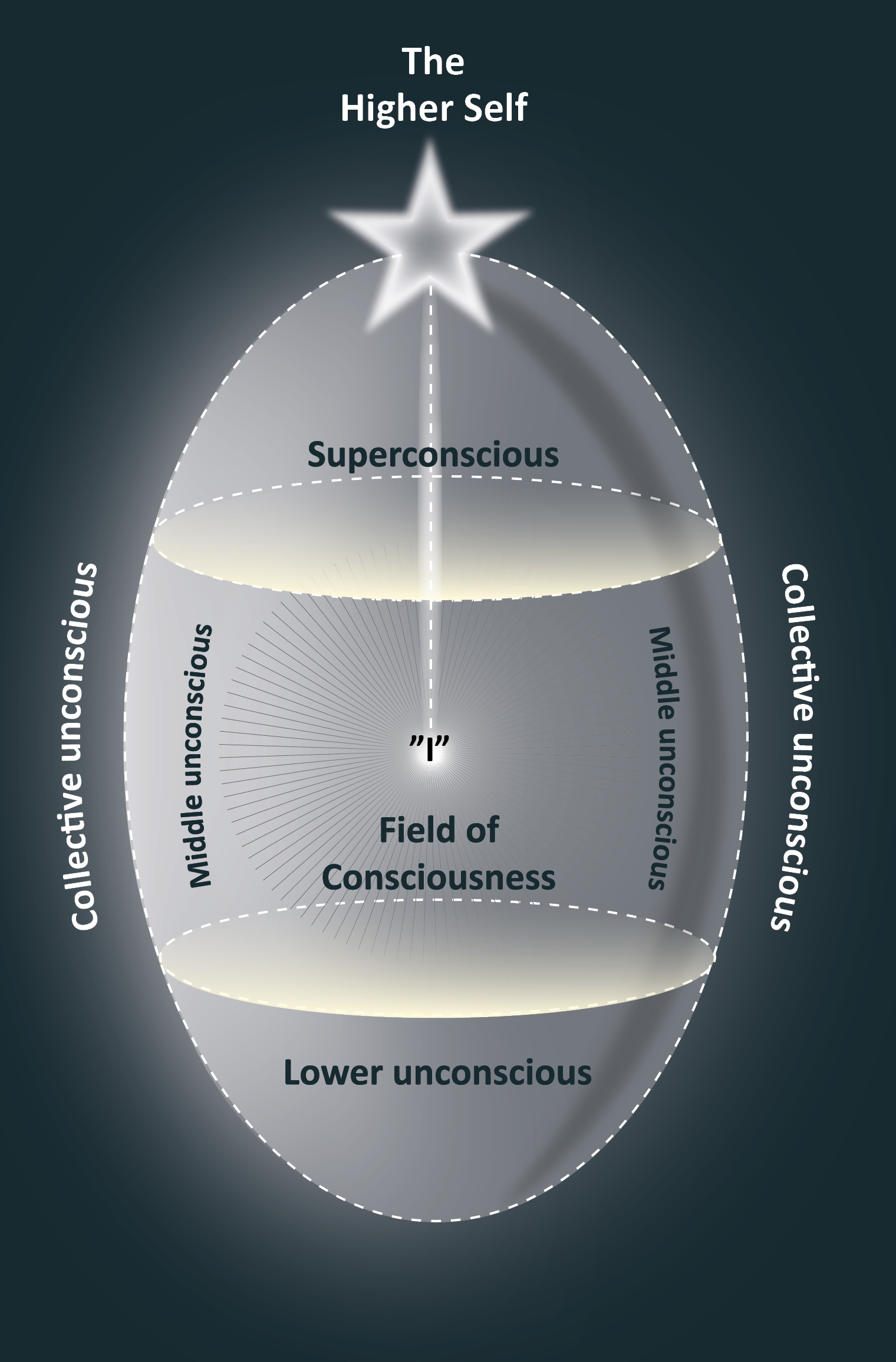
Roberto Assagioli’s Egg-diagram
In Roberto Assagioli’s egg diagram, the Higher Self, or Transpersonal Self, is drawn as a star at the top of the egg, partly inside it and partly outside. The conscious “I” sits at the centre of the field of consciousness, joined to the star by a dotted line. The placement is deliberate. For Assagioli, the Self is transcendent to the personality:
- It does not descend into the body, feelings and mind.
- It remains on its own level, “above” the flow of psychological life.
- From there it projects a small part of itself, the “I”, into the personality as its reflection.
The Self acts on the personality by radiation. The “I” can climb back toward it and, at moments, become one with it. What the Self does not do is become immanent. It is like the sun; it resides in the “heaven” but pervades the solar system with its radiations.
This is not a late or marginal idea. He lived it in his diaries in the 1920s and 1930s, wrote it in his books, noted it on working cards for his last book, Height Psychology and the Self, and repeated it in recorded conversations until 1973. He framed it in Indian philosophy: the Atman of the Upanishads, the “I remain” of the Bhagavad Gita, the Purusha of Samkhya, and Sri Aurobindo’s reading of the Gita.
It is also the point on which later Psychosynthesis has departed from him. John Firman and Ann Gila removed the star from the top of the egg and treated the Self as equally present at every level of the psyche. This entry gathers Assagioli’s own words, published and unpublished, so that his position can be read as he stated it.
1. The star at the top of the egg
In Psychosynthesis (1965) he describes the sixth element of the diagram:
“This Self is above, and unaffected by, the flow of the mind-stream or by bodily conditions; and the personal conscious self should be considered merely as its reflection, its ‘projection’ in the field of the personality.” — Psychosynthesis, p. 19
The star is drawn “partly within the periphery of the personality, and partly above. This indicates that the Self, while it is the most real and essential element of the human being, is also part of a transcendent, supra-individual, universal [Reality]” (Exercise of Disidentification and Self-Identification). In The Act of Will, he drew three versions of the egg, each with the Self as a star at its apex and its radiation directed differently: downward to the personality, evenly up and down, or upward towards transcendent Reality.
The working papers for Height Psychology and the Self show the same picture in his own hand. On a card for James Vargiu, who was preparing the drawings, he wrote: “Jim — In the triple diagram: make the rays from the Self longer”, and sketched the egg with the Self at its top, its rays fanning down into it (Archivio Assagioli, ID Doc. 13338). Among his notes on the “Symbols of the Higher Self”, the first group is “Angel — Lotus — Sphere of fire — Star — Sun” (ID Doc. 11857, provisional translation from the Italian; “Sun” is in English on the card).
A year before his death, he used the star as shorthand for the Self itself. Writing to Fred Rosenzveig about speaking “in the name” of the Higher Self, he warned that the “as if” qualification “can help to avoid the illusion of having really reached the top, the ‘star’” (letter of 23 August 1973).
2. The Self is above the personality
His working definition of the Self, typed on a card for his book, reads:
“SELF / Static aspect: Transcendent / Point / Immutable / Immovable / That who ‘remains’ / Being / Sat / Center / ‘Sun’ / Self-sustained / Self-contained” — Archivio Assagioli, ID Doc. 12852
“That who ‘remains’” is Krishna’s “I remain” from the Gita, turned into a quality of the Self. Sat is the Vedanta word for pure Being. A companion card adds that the Self has “Static and Dynamic aspects — both essential” (ID Doc. 13333). The transcendent Self is not a passive abstraction.
On the meaning of “transcendental” he noted:
“A plane or sphere of reality which is beyond and above the usual, conscious personality, but which is not ‘abstract’: it is alive and dynamic and has vital relationships.” — Archivio Assagioli, ID Doc. 10376
And on the “transcendent I”:
“The ‘transcendent’ I. Show clearly that it is a real, living, active I, not an ‘abstraction’, a concept, a detached and inactive principle.” — Archivio Assagioli, ID Doc. 13204 (provisional translation from the Italian)
The Self is also above time. “The transpersonal Self is ‘outside’ time and above it. It exists and lives in the dimension of the Eternal” (The Conflict Between Generations and the Psychosynthesis of the Ages). It is an “immobile point of awareness, which is fixed, immutable, in a certain sense transcendent, although emanating powerful energies, which can be compared to the radiations of a star or the sun” (Psychosynthesis – Its Essential Components).
3. The Self does not become immanent
The clearest statement is in a conversation with Jim and Susan Vargiu, recorded in August 1972 for Height Psychology and the Self. The typescript survives in the Archivio Assagioli. Asked how to help people with the difficulty of a Self seen as “wholly other”, he first distinguishes absolute from relative transcendence, and then says:
“Now applying that to the Self. The Self, in a sense, is the highest level of transcendence which we may reach. The difference is this: the Self doesn’t become immanent in itself. The Self radiates in the superconscious and … but it remains at its own level. The Self doesn’t become immanent in the sense I’ve said. We might eventually reach an awareness of the Self, but that’s another thing. Then it is the personal self or ego which mounts along, as a spider on a thread, and identifies with the Self. But it is not the Self [that] becomes immanent. That’s the difference. But the Self is not ‘other’; it is there all the time, and the personal self is a direct reflection of it, and in [a very] feeble way reflects its nature.” — Conversation with James and Susan Vargiu, August 1972, original English typescript, Archivio Assagioli, Florence (orange box “Psicosintesi, Transpersonale, Sé Anima” (Psychosynthesis, Transpersonal, Self, Soul)); published as Transcendence of the Self
The movement is one way. The Self radiates downward, and the “I” climbs upward “as a spider on a thread”. Self-realization is the ascent of the “I”, not the descent of the Self.
On 8 August 1972 Susan Vargiu asked him what he meant by calling the Self transcendent and the superconscious immanent. He answered:
“We’ll go back to the fundamental duality of the unmanifest and the manifest. Transcendent means non-manifested in time and space. So it’s consistent, immutable, eternal. All the rest is immanent. This is very clear. And in more easy terms, having pervaded, I remain. I am pervaded, immanent, but I remain, that is, he is not identified with His creation. I think that there is something good too, in Aurobindo about that.” — Second interview with the Vargius, concerning the Higher Self, 8 August 1972, typescript, Archivio Assagioli
When she concluded, “we say quite clearly that the Self is above time and space”, he answered: “Oh, certainly! We must leave it there. Definitely. Perhaps it is better to say ‘beyond’.”
The same doctrine appears in his conversations with the psychiatrist Bruno Caldironi (1967–1971), in the language of the soul:
“…it is the soul that projects a new personality… the soul does not incarnate as a soul, it always remains at its own level, but it creates a temporary personality that lives an earthly life that then dissolves.”
“The Self, as a soul, is eternal. At the beginning of each incarnation it projects its own ray, its own reflection, around which it forms a human personality… But the center of consciousness is a direct reflection of the spiritual self: at the death of the physical body this center — personal self, ego or personal Self — withdraws back and reabsorbs into the Self.” — Bruno Caldironi, L’uomo a tre dimensioni: Colloqui con Roberto Assagioli (1967–1971) [English translation provisional]
A handwritten plan for the book on the Self says it in six words: “It remains on its own (higher mental) plane and does its ‘business’ there!” (ID Doc. 10342). In 1968 he gave the Psychosynthesis Research Foundation a definition that begins the same way: “The Self is an ontological Reality, a Being, and is on Its own level a stable Center of Life, from which It radiates energies.”
4. The “I” is the reflection, projection and emanation of the Self
If the Self remains above, it is present in us through the “I”. Assagioli uses five closely related images throughout his life.
A sunbeam into a lake. In an early Italian essay:
“That is, our ordinary self would be the reflection and a projection of the higher and eternal Self residing in the highest levels of Spirit. The ray of the divine spark, in descending from level to level, through denser and denser layers, undergoes various attenuations, refractions and colorings, in the same way as a sunbeam descending to the bottom of a lake…” — The Interplay of Psychic Forces (Le forze psichiche e il loro gioco), translated by Jan Kuniholm
The lamp and the screen. “The Spiritual Self corresponds to the source of the light, the lamp, which projects the white light upon the screen… the point representing our normal self… is connected by a dotted line (representing the descending ray or thread) with the star indicating our Spiritual Self” (Psychoanalysis and Psychosynthesis).
The sun and the planet. “The relationship between the spiritual or transpersonal Self and the personal self, or ‘I’, can be compared to that between the Sun and a planet… In the same way the Self projects a small portion, a spark, a tiny center of self-consciousness” (Psychosynthesis Research Foundation, Newsletter 34, October 1968).
Emanation. “The Ego, or conscious ‘I’, is an emanation from or projection of the Self” (C. G. Jung and Psychosynthesis).
Outpost. “The ‘I’ is a projection or reflection of the Self, an outpost of the Self in the world of the personality” (The Superconscious and the Self).
The reflection is real but derivative. In Psychosynthesis he writes: “The reflection appears to be self-existent but has, in reality, no autonomous substantiality. It is, in other words, not a new and different light but a projection of its luminous source” (p. 20).
5. How the Self acts while remaining above
Remaining on its level does not make the Self idle. In the plan for Height Psychology and the Self he speaks of “a direct line between the spiritual Self, the Soul, and the spark of personal Self”. In the Vargiu conversations, he explained that the same energy reaches the “I” by two routes:
“It is the same energy which permeates through the superconscious and arrives to the [I] in a direct line. It is a question of way and points of arrival… Perhaps you might say that the energy that goes from the self to the I has a quality of self-awareness.” — Conversation with the Vargius, August 1972
“The superconscious is radiated, irradiated by the light of the self. But there is another sun.” A typed card states the key difference between Self and “I”: “The relationship between the Self and the Superconscious is analogous to the existing between the I (or ego?) and the contents of … consciousness. It is analogous but not identical. Differences: The I identifies itself with the contents; the Self does not” (ID Doc. 10534). And in The Superconscious and the Self: “At the same time the Self, by means of the Transpersonal Will, attracts and reabsorbs the personal ‘I’ which it emanated.”
6. Lived before it was taught: his own experience
Assagioli insisted that the Self “is an experience, not a conception”. His diaries show the transcendent Self first as a discipline of daily life.
At the Franciscan Hermitage in October 1931 he wrote:
“During and after meditation, I felt strongly that I must above all strive to maintain alignment, continuous inner contact, during all activities and experiences — not identify with the personality… Stay up; ‘do not all descend’ — maintain the consciousness of the Spectator; always feel and reaffirm that I am a Soul, a centre of spiritual consciousness. Maintain a double consciousness continuously: be simultaneously the actor and the Spectator.”
On 22 December 1931 in Rome, after reading Śaṅkara’s Vivekachudamani:
“I had a realization of the Reality of the Supreme, of Brahman and of His infinite Glories — Sense of identification with ‘I am That’ — From this sense of freedom, of detachment — I felt disidentified, freed from things, events, people, activities, from my own body… I felt how one can act while remaining ‘free,’ superior.”
At Arezzo on 2 October 1933:
“Remaining in the consciousness of the Self, disidentified, uninvolved… registering them, allowing the bodies to act accordingly, but remaining above, detached, a Spectator. Fix your attention, interest, and consciousness on the Self…”
Six days later, again after the Vivekachudamani: “awareness of the Spectator, of the Sannyasin — sense of the Real”. A card in his own hand puts the practice in three lines: “Be above my activity. Act from above, uninvolved. Remain always ‘serenely Lord’” (ID Doc. 9460).
“Do not all descend” is the transcendent Self as a rule of life. Some part of us remains above, as Spectator, while the personality acts. Forty years later he taught the same in meditation: raise the centre of consciousness towards the Higher Self, deliberately “not into” it, and wait for “the downflow of energy from above”. When a colleague objected that the Self is only a subjective claim, he answered: “the one who affirms an experience is right insofar as he has had an experience… the agnostic position is justified, but not the negative position.” A card for the book makes the same point: “Transcendent Reality … unattainable by thinking … but it is not [a] question of faith but of transpersonal experience (illumination)” (ID Doc. 13417).
7. The Indian frame: Atman, Jiva, Purusha and Aurobindo
Assagioli named the Self in Indian terms himself. “The ancient sages of India, who knew this spiritual Self well, called it Atman” (The Self – Enlargement and Elevation of Consciousness). In 1972 he gave the observing “I” its oldest name:
“Almost always start from the enjoyer, the willer, the knower, the observer… So in psychosynthesis, we stick to that, and we express it in modern terms. It is the old… Atman, the Self, the knower, the observer. Really it’s very clear… And that’s also quoting the Gita as endorsement.” — Conversation with the Vargius, August 1972
The Gita. His favourite formula for transcendence is Krishna’s “Having pervaded this whole universe with a fragment of Myself, I remain” (Gita 10.42). “What ‘remains’,” he explained, “is the Self on its own level. Yet while it remains there, it can pervade and is pervading the whole universe of the personality, and this it does through the superconscious” (The Superconscious and the Self). He called the verse “a fantastic formula for co-existence, for union and communion of Immanence and Transcendence” (A Brief Address on the Self). On a card headed “Transcendance” (in French, “Transcendence”) he set it beside Aristotle’s unmoved mover and Teilhard’s Omega Point (ID Doc. 13272). Among the book notes there is a card bearing only “I remain” (ID Doc. 10191).
Purusha. In The Study of Self (1922) he framed disidentification in the terms of Samkhya philosophy, as the discrimination between “the ‘eternal observer’ and the field of manifestation”: the Purusha and Prakriti of that school. A card under “Self” reads: “Purusha and Jivatma: Aurobindo, The Synthesis of Yoga, Chapt. The Supreme Will, p. 205” (ID Doc. 11336).
Jiva. Another card reads simply: “Jiva — wanderer and conqueror” (ID Doc. 13263). Assagioli knew the Vedantic distinction between the Jivatman, the individual soul that wanders through births and conquers its way back, and the Atman that remains. His own structure follows it closely:
- The Self remains on its level.
- Its reflection, the “I”, lives in the personality, and its “ray” forms a new personality in each life, to be “reabsorbed into the Self”.
His own word for that relation is “reflection”. It is also the classical Vedantic image of the individual self as the reflection of the one Self, like the sun reflected in water.
The Vivekachudamani. Besides the diary entries, his cards cite Śaṅkara’s text directly: “Being — The basic distinction (viveka) is that between Being and becoming (Vivekachudamani)” (ID Doc. 13314). Another note copies “The majesty of the ocean of Supreme Brahman…”, Vivekachudamani, v. 482 (ID Doc. 13286).
Aurobindo. For his last book he planned to draw on Sri Aurobindo extensively. A typed card for Height Psychology reads, in his own English, “Quote extensively Aurobindo” (ID Doc. 11485). Others record these points:
- “Transcendence and Immanence. Their synthesis is the supreme secret taught in the Bh[agavad] Gita. See Aurobindo, Essays on the Gita, 496” (ID Doc. 10569).
- “Aurobindo’s ‘Supermind’ = superconsciousness” (ID Doc. 11536, provisional translation from the Italian).
- The superconscious “as intermediary between the mind and the Absolute”, with a reference to The Life Divine (ID Doc. 11697).
- Aurobindo’s terminology of the planes above the mind: “Supramental – Supermind; Surmental – Overmind; Mental intuitif; Mental illuminé; Mental humain” (ID Doc. 10421).
He also connected Aurobindo with the great paradox of the Self, its being both individual and universal: “Aurobindo speaks of it and Radhakrishnan in his comment on the Gita speaks of it” (interview with Stuart Miller, 23 January 1973).
Not strict non-dualism. Assagioli accepted the Vedanta identity of Atman and Brahman at the level of essence but would not collapse the individual into it:
“Relationship between the Spiritual Self and the Universal Self (Atman — Brahman)… Identity of nature, of substance, but not ‘confusion’ nor annihilation. Rational ‘paradox’ but experienced reality: Simultaneous consciousness of individuality and universality… Is it absolute identity or ‘images’, ‘likeness’? Let the question open.” — Archivio Assagioli, ID Doc. 11315
From Radhakrishnan’s Gita he noted: “‘Equivalence with God (sadharmya) and not identity (sayujya) is emphasized’” (ID Doc. 13318). When Susan Vargiu proposed mapping Brahman onto the “jewel” and Atman onto the superconscious, he answered: “Well, that’s dangerous too. I would leave it.” His structure is Vedantic: a transcendent Self, with the “I” as its reflection. His final position stands nearer to the traditions that hold identity and difference together, such as Aurobindo’s, than to a strict Advaita.
8. One Self, not two
Transcendence does not mean two beings:
“There are not really two selves, two independent and separate entities. The Self is one; it manifests in different degrees of awareness and self-realization.” — Psychosynthesis, p. 20
“What we call the ‘ordinary self’ is as much, or as little, of the ‘higher Self’ as the waking consciousness can take in, assimilate and implement at any given moment… It is a reflection; but one that can become more and more vivid and luminous and may one day come to unite with its Source.” — The Mystery of the “I”
“The Self is not ‘other’; it is there all the time.” The difference between “I” and Self is one of level and degree of awareness, not of being.
9. Qualifications
The star is partly inside. The Self sits “at the highest point on the periphery of the personality, partly inside it — as it is in a continuous relationship with the superconscious — and partly outside” (Transpersonal Development, p. 26). It is transcendent to the personality, not absent from the human being.
Transcendence is relative and graded. A handwritten note sets out the levels:
“Synthesis of immanence and transcendence. It happens at various levels. For the personality the transcendent is the Soul. For the Soul it is the Monad. Realize it in the ‘intermediate Centre’. In every case: Immanence (periphery, activity, evolution, Shakti); Synthesis (Ray); Transcendence (Centre, Immobility, Shiva).” — Archivio Assagioli, ID Doc. 5129 (provisional translation from the Italian)
The superconscious too “is transcendent to the personality. But it is a relative transcendence. It is not transcendent to the Self” (8 August 1972). Absolute transcendence, the unmanifest, “can only be mentioned as an overall background”.
Not supernatural. “The idea that there is a supernatural realm, as religion says, is not true. It is all natural, only different levels of natural reality” (Vargiu / RA-Self, 17 August 1972; ID Doc. 10523). The Self is a higher level of one reality, not an intervention from another world.
Pervading is not descending. The Self pervades the whole personality, but it does so “while it remains there… through the superconscious”, by radiation and through its reflection, the “I”.
Embodiment is expression. Psychosynthesis aims to embody the Self in daily life. “We have to live at both levels. Complete immanence at all levels and transcendence and the complete synthesis” (ID Doc. 10525). Embodiment means the personality becoming the Self’s channel, not the Self taking the personality’s place.
Neutral about God, not about the Self. In public, Psychosynthesis did not pronounce on the relation between the spiritual I and God:
“The spiritual I and God: we do not pronounce on this.” — Archivio Assagioli, ID Doc. 13289 (provisional translation from the Italian)
It “leads to the door, but stops here” (Psychosynthesis, pp. 6–7). But the Self’s transcendence of the personality he treated as a fact of experience, not a belief.
Mystery. He also warned against fixing the Self in concepts:
“Always reaffirm its transcendent, mysterious aspect, ungraspable by the concrete mind.” — Archivio Assagioli, ID Doc. 11403 (provisional translation from the Italian)
Why the transcendent Self matters in Psychosynthesis
The star at the top of the egg carries the method:
- Disidentification leads somewhere. Because the “I” is the reflection of a Self that remains above, the “I” discovers itself as pure self-awareness and can then rise along the thread towards its source.
- Self-realization is an ascent. Because the Self does not descend, Self-realization is a gradual ascent and fusion, described in stages.
- The ascent is a return. Because “I” and Self are one in essence, the ascent is a return to one’s own origin, not a journey towards something foreign.
Remove the transcendent Self, as Firman and Gila did, and the shape changes. The Self is then everywhere and nowhere in particular; the “I” relates to it but never unites with it; and the stages of ascent disappear. Assagioli had criticised a structurally similar omission in his own time. He noted that a religious view which places only “the personality and God”, with no Higher Self between them, “ignores the Higher Self” (ID Doc. 11561). Whatever one thinks of the later revision, it is not his view. His view, stated from the diaries of 1931 to the conversations of 1973, is that the Higher Self “remains at its own levels” and that the “I” is “a direct reflection of it”.
Related entries
Sources
Books
- Assagioli, Roberto. Psychosynthesis: A Manual of Principles and Techniques. New York: Hobbs, Dorman & Company, 1965.
- Assagioli, Roberto. The Act of Will. New York: Viking Press, 1973.
- Assagioli, Roberto. Transpersonal Development: The Dimension Beyond Psychosynthesis. London: Crucible, 1991.
- Caldironi, Bruno. L’uomo a tre dimensioni: Colloqui con Roberto Assagioli (1967–1971). Edited by Laura Oretti.
- Meditation Group for the New Age, course sets written by Roberto Assagioli with Michal Eastcott and Nancy Magor. Meditation Mount reprints, Ojai, California.
Articles, talks and interviews on kennethsorensen.dk
- A Brief Address on the Self
- C. G. Jung and Psychosynthesis
- The Conflict Between Generations & Psychosynthesis
- Exercise of Disidentification and Self-Identification
- The Interplay of Psychic Forces
- The Mystery of the “I”
- Psychology and Religion (Psychoanalysis and Psychosynthesis)
- Psychosynthesis – Its Essential Components
- The Self – Enlargement and Elevation of Consciousness
- The self and Self (incl. the 1968 PRF definition)
- The Study of Self
- The Superconscious and the Self
- Transcendence of the Self
Unpublished sources, Archivio Assagioli, Florence
- Conversations with Jim and Susan Vargiu for Height Psychology and the Self, August 1972 (including 8 and 17 August), typescripts. Orange box “Psicosintesi, Transpersonale, Sé Anima” (Psychosynthesis, Transpersonal, Self, Soul), and AAP-PRF Archive. Transcribed by Kenneth Sørensen, September 2026.
- Interview with Stuart Miller, 23 January 1973, typescript.
- Letter to Fred Rosenzveig, Villa Ilario, 23 August 1973.
- Working cards and notes, Archivio Assagioli online (ID Doc.):
- 5129, 9460, 10191, 10342, 10376, 10421, 10523, 10525, 10534, 10569;
- 11315, 11336, 11403, 11485, 11536, 11561, 11697, 11857;
- 12852, 13204, 13263, 13272, 13286, 13289, 13314, 13318, 13333, 13338, 13417.
- Spiritual diaries, 1931–1933, translated by Jan Kuniholm.
Commentary
- Sørensen, Kenneth. “Why Assagioli Put a Star in the Sky.”
- Sørensen, Kenneth. “What Is Self-Realization? Firman vs Assagioli.”
- Sørensen, Kenneth. “The Transcendence of the Transpersonal Self.”
